

J-PARC Project Newsletter No.104, October dispatch
★☆-------------------------------------------------------------------------------------------------
J-PARC Project Newsletter
No.104, October 2026
Japan Proton Accelerator Research Complex under joint operation by the
High Energy Accelerator Research Organization (KEK) and the Japan Atomic
Energy Agency (JAEA)
http://j-parc.jp/index-e.html
-------------------------------------------------------------------------------------------------☆★
HEADLINES AND CONTENTS
1. [Overview]
- RECOVERY FROM THE APRIL 7 FIRE INCIDENT AND PREPARATIONS FOR RESUMING OPERATIONS
- J-PARC USERS COUNCIL MEETING
- JOINT OPEN HOUSE OF J-PARC AND JAEA NSRI
2. [Accelerator Division]
- STATUS OF THE ACCELERATORS
- PASJ AWARDS FOR J-PARC ACCELERATOR DIVISION MEMBERS
3. [Particle and Nuclear Physics Division]
- PROGRAM ADVISORY COMMITTEE MEETING
- NEUTRINO EXPERIMENTAL FACILITY UPGRADE PROGRESSES TOWARD 1.3 MW OPERATION
- STATUS OF THE JSNS2 / JSNS2-II (SEARCH FOR STERILE NEUTRINOS AT J-PARC MLF, E56 / E82)
- SEARCHES FOR HIDDEN PARTICLES IN KAON DECAYS
- EXPLORING NEW FRONTIERS IN HADRON PHYSICS AT J-PARC
- STATUS OF THE COMET EXPERIMENT
- STATUS OF THE MUON g-2/ELECTRIC DIPOLE MOMENT (EDM) (E34)
4. [Materials and Life Science Division]
- NEUTRON SOURCE; ONGOING MAINTENANCE WORKS DURING THE LONG SUMMER SHUTDOWN
- NEUTRON INSTRUMENT AND SCIENCE; USER PROGRAM REVIEW, EDUCATIONAL ACTIVITIES, AND RESEARCH HIGHLIGHTS
- MUON SCIENCE FACILITY (MUSE); ICE MYSTERY, GOLDEN SHACHIHOKO, AND ACCELERATED MUONS: A SUMMER OF BREAKTHROUGHS AT J-PARC MUSE
5. [Quantum Beam Technology Division]
- WORKSHOP ON J-PARC PROTON BEAM IRRADIATION FACILITY
6. [Outreach Activities]
7. [Editorial Note]
PAST ISSUES ARE AVAILABLE FROM THE LINK BELOW.
http://j-parc.jp/c/en/topics/project-newsletter/index.html
☆-------------------------------------------------------------------------------------------------…
1. [Overview] by KOBAYASHI Takashi
…-------------------------------------------------------------------------------------------------★
-------------------------------------------------------------------------------------------------
RECOVERY FROM THE APRIL 7 FIRE INCIDENT AND PREPARATIONS FOR RESUMING OPERATIONS
-------------------------------------------------------------------------------------------------
First of all, I would like to express, once again, my sincere apologies to all J-PARC users and collaborators for the prolonged suspension of beam operations following the fire at the MR substation on April 7. The incident has significantly affected our scientific programs, and we deeply regret the inconvenience caused to our user community.
On July 24, the final report on the fire incident, including the investigation results and measures to prevent recurrence, was formally accepted by the relevant local authorities. This marked an important milestone in our recovery efforts. Since then, we have continued implementing preventive measures and preparing for the safe resumption of operations, with safety remaining our highest priority. We are working toward the resumption of beam delivery to the MLF on October 21 and user operations at the MR on November 27.
-------------------------------------------------------------------------------------------------
J-PARC USERS COUNCIL MEETING
-------------------------------------------------------------------------------------------------
The J-PARC Users Council meeting was held on September 4. The Council meets twice a year, bringing together representatives of the various domestic user communities. It provides an important forum for sharing information on J-PARC's operational status and future plans, as well as for discussing requests and proposals from users.
The September meeting focused on requests from the user communities, including issues related to J-PARC operations. We greatly appreciate the continued support and constructive feedback from our users, particularly during this challenging period.
-------------------------------------------------------------------------------------------------
JOINT OPEN HOUSE OF J-PARC AND JAEA NSRI
-------------------------------------------------------------------------------------------------
On September 13, J-PARC and the JAEA Nuclear Science Research Institute jointly held their annual Open House, welcoming 2,006 visitors, an increase from 1,646 last year.
Visitors enjoyed tours of accelerator and experimental facilities, exhibitions, hands-on activities, and five outreach lectures.
It was a wonderful opportunity to share the excitement of science with the public and strengthen our ties with the local community. We hope that the event helped visitors gain a better understanding of our research activities and the role of J-PARC in advancing science and technology.
☆-------------------------------------------------------------------------------------------------…
2. [Accelerator Division] by YAMAMOTO Kazami
…-------------------------------------------------------------------------------------------------★
-------------------------------------------------------------------------------------------------
STATUS OF THE ACCELERATORS
-------------------------------------------------------------------------------------------------
Beam delivery to MLF users ended on the morning of June 23. Following this, beam commissioning of the LINAC and RCS was conducted until the morning of June 29, after which maintenance activities commenced for both accelerators.
The MR did not resume operation following the fire incident on April 7. Due to a failure of the high-voltage disconnecting switch, the main dipole magnets could not be energized, and the machine remained under maintenance throughout that period.
Maintenance work on the accelerators is scheduled to continue until early October. Beam commissioning of the LINAC is scheduled to restart on October 10.
-------------------------------------------------------------------------------------------------
PASJ AWARDS FOR J-PARC ACCELERATOR DIVISION MEMBERS
-------------------------------------------------------------------------------------------------
We are pleased to announce that three members of the J-PARC Accelerator Division received awards at the 23rd Annual Meeting of the Particle Accelerator Society of Japan, held in Sendai from August 26 to 28.
Specifically, TAKAYANAGI Tomohiro (Accelerator Section 2) received the 22nd PASJ Award for Technological Contribution for his work on "Development of an Accelerator Kicker Power Supply Using SiC MOSFETs and the LTD Method." MATSUMOTO Hiroshi (Accelerator Section 5) was honored with the Award for Distinguished Services for his "Long-Term Contributions to Accelerator Technology, Particularly the Development of High-Power RF Technology and Human Resource Development." Finally, SATO Atsushi (Accelerator Section 3) received the Annual Meeting Poster Award for "Construction of a Long-Distance Stable Laser Transport Line for Laser Charge-Exchange Experiments at J-PARC."
https://www.j-parc.jp/c/en/topics/2026/09/16001906.html
https://www.j-parc.jp/c/en/topics/2026/09/15001905.html
☆-------------------------------------------------------------------------------------------------…
3. [Particle and Nuclear Physics Division]
…-------------------------------------------------------------------------------------------------★
-------------------------------------------------------------------------------------------------
PROGRAM ADVISORY COMMITTEE MEETING (by NAKADAIRA Takeshi)
-------------------------------------------------------------------------------------------------
The 42nd Program Advisory Committee (PAC) meeting was held at the J-PARC research building on July 8 - 10. The status of the experiments was reported, and prospects for the program from the autumn onwards were discussed. The discussion focused mainly on the allocation of the experimental program going forward, considering the suspension of beam operation from April to June. Taking into account the schedules for the upgrade work at the neutrino experimental facility and the reconfiguration of the experimental area at the hadron experimental facility, a plan was presented for the latter half of this fiscal year, with hadron experiments scheduled for November-December and neutrino experiments from February onward.
https://kds.kek.jp/event/60321/
The PAC report will be available through the following web page.
http://j-parc.jp/researcher/Hadron/en/PAC_for_NuclPart_e.html
The next PAC meeting will be held in January 2027.
-------------------------------------------------------------------------------------------------
NEUTRINO EXPERIMENTAL FACILITY UPGRADE PROGRESSES TOWARD 1.3 MW OPERATION (by ISHIDA Taku)
-------------------------------------------------------------------------------------------------
A major upgrade of the J-PARC Neutrino Experimental Facility has been progressing rapidly this summer toward 1.3 MW beam operation for the upcoming Hyper-Kamiokande experiment.
At the Target Station, a new target designed for 1.3 MW operation has been installed into the newly fabricated Horn 1. The target consists of an approximately 90-cm-long isotropic graphite core cooled by helium gas. When the beam power is increased from 750 kW to 1.3 MW, the heat deposited in the target increases from approximately 24 kW to 41 kW. To remove this increased heat load, the helium flow rate needs to be almost doubled. A number of improvements have therefore been introduced to increase the pressure capability of the target and its helium cooling system.
In mid-September, two engineers from the Rutherford Appleton Laboratory (RAL) in the United Kingdom, which has been collaborating on the target development, visited J-PARC to assemble and test the new target together with the J-PARC facility team. A new helium piping system incorporating balancing bellows was installed to compensate for the thrust force generated by the higher helium pressure. The target was then precisely positioned inside Horn 1. The cooling system was pressurized to 5 atm, and it was confirmed that the resulting target displacement remained within the small range expected from the design.
Prior to this work, in the last week of August, a new Optical Transition Radiation (OTR) beam profile monitor developed in Canada was installed on Horn 1. The new Horn 1, equipped with both the 1.3 MW target and the new OTR monitor, is scheduled to be installed in the helium vessel of the Target Station in late November.
Meanwhile, a new target helium cooling system designed for the higher flow rate and pressure has been assembled in the newly constructed Research and Development Building at J-PARC, where high-pressure commissioning tests have recently begun. The system is scheduled to be installed in the B2 machine room of the Target Station toward the end of this year.
In parallel, robotics for remote maintenance are being developed in the Research and Development Building. These systems will enable highly activated components, including beam monitors and gate valves located at the downstream end of the primary beamline, to be maintained remotely. Development includes robotic systems capable of remotely attaching and removing large vacuum clamps, an important technology for future high-power operation.
Major upgrades of the cooling-water systems are also underway at the Target Station and the downstream utility building (NU3), including replacement of heat exchangers and circulation pumps to increase their capacity from 750 kW to 1.3 MW operation. At NU3, the building housing the Data Acquisition (DAQ) system for the muon monitor is also being replaced by a new building with approximately twice the floor space of the existing one.
These upgrades toward 1.3 MW operation are thus progressing steadily throughout the Neutrino Experimental Facility. The series of upgrade works is scheduled to be completed around February next year, marking another major step toward high-power neutrino beam operation in the Hyper-Kamiokande era.
-------------------------------------------------------------------------------------------------
STATUS OF THE JSNS2 / JSNS2-II (SEARCH FOR STERILE NEUTRINOS AT J-PARC MLF, E56 / E82) (by MARUYAMA Takasumi)
-------------------------------------------------------------------------------------------------
The JSNS2 (E56) / JSNS2-II (E82) collaboration investigates the anomaly reported by the LSND experiment, namely the observed excess of electron antineutrinos, through a direct measurement at the J-PARC Materials and Life Science Experimental Facility (MLF).
Preparation for the next physics run, including data taking with both the near detector, which will be installed on the third floor of the MLF, and the far detector, located outside the MLF building, is currently underway.
In parallel with these preparation efforts, we have analyzed the data collected in 2022 and 2024. The results were presented at the Neutrino 2026 conference in June 2026 and at the 42nd J-PARC PAC meeting in July 2026.
The new far detector is currently in the commissioning phase. Effective passive shielding against neutron backgrounds is required and has been investigated through various measurements. Based on these studies, additional countermeasures have been implemented and will be tested in the next physics run.
-------------------------------------------------------------------------------------------------
SEARCHES FOR HIDDEN PARTICLES IN KAON DECAYS (by NOMURA Tadashi)
-------------------------------------------------------------------------------------------------
Dark matter accounts for most of the matter in the universe, yet its true nature remains unknown. There is strong theoretical motivation for dark matter particles with masses below 1 GeV that couple weakly to ordinary matter. The KOTO experiment at the Hadron Experimental Facility of J-PARC, designed to study the rare CP-violating decay of neutral kaons, has recently carried out two searches for such hidden particles.
The first search targeted the kaon decay into a photon and an invisible particle, which can be interpreted as a dark photon. An analysis of dedicated data collected in 2020 revealed no excess over the expected background. Consequently, upper limits on the branching fraction of the decay were established, ranging from O(10-7) to O(10-3) depending on the assumed mass.
The second search focused on the kaon decay into two neutral pions and an axion-like particle that subsequently decays into two photons. Constrained kinematic fits were employed to suppress the dominant background from the kaon decay into three neutral pions. An analysis of data collected in 2021 revealed no evidence for an axion-like particle for masses above the neutral-pion mass, and KOTO set upper limits of O(10-7) at the 95% confidence level.
These results narrow the possible properties of hidden particles. Further details can be found in the articles published in Physical Review Letters in May and July 2026, respectively.
https://doi.org/10.1103/zyx1-y1bj
https://doi.org/10.1103/pt2h-99by
-------------------------------------------------------------------------------------------------
EXPLORING NEW FRONTIERS IN HADRON PHYSICS AT J-PARC (by TAKAHASHI Hitoshi)
-------------------------------------------------------------------------------------------------
The Workshop on New Frontiers in Hadron Physics at J-PARC pi20 and K10 took place from August 5 to 6 at the Research Center for Nuclear Physics, Osaka University. The pi20 and K10 are both high-momentum charged secondary beamlines planned in the J-PARC Hadron Experimental Facility. The pi20 beamline delivers unseparated secondary particles (mostly pions) with a momentum of up to 20 GeV/c, while the K10 provides a well-separated beam of up to 10 GeV/c. A total of 68 people (including 26 international attendees) participated in the workshop in person or remotely. The physics opportunities and experimental equipment at these beamlines were actively discussed. Additionally, the organizational structure of the K10 collaboration was discussed with the aim of realizing the K10.
-------------------------------------------------------------------------------------------------
STATUS OF THE COMET EXPERIMENT (by MIHARA Satoshi)
-------------------------------------------------------------------------------------------------
The COMET experiment aims to search for the lepton-flavor-violating muon reaction, mu-e conversion, with a sensitivity better than 10-14 in Phase I.
Preparations for the COMET experiment are steadily advancing toward the 2028 beam start. Collaborative activity between Osaka University and the COMET Magnet Group is actively driving the magnetic field measurements for the Detector Solenoid (DS). In parallel, detector preparation is in full swing: the final assembly design for the central detector (CyDet) is nearing completion, and assembly preparations for the Cosmic-Ray Veto (CRV)--essential for suppressing background events--are well underway.
Furthermore, results from the 2023 muon beam run were recently presented at a summer conference, with a paper scheduled for submission shortly.
-------------------------------------------------------------------------------------------------
STATUS OF THE MUON g-2/ELECTRIC DIPOLE MOMENT (EDM) (E34) (by MIBE Tsutomu)
-------------------------------------------------------------------------------------------------
The E34 collaboration aims to measure the muon anomalous magnetic moment (g-2) and electric dipole moment (EDM) with high precision, using a low-emittance muon beam produced by cooling and reacceleration.
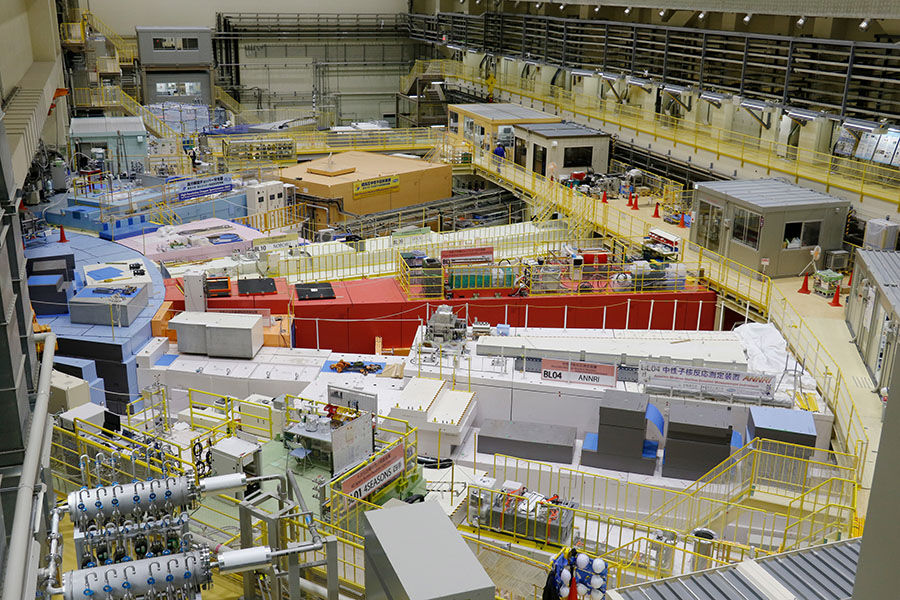
On August 31, the research group jointly announced a new milestone in muon acceleration. In the H2 area, recently commissioned at the Materials and Life Science Experimental Facility (MLF), positive muons were cooled and then accelerated to 0.3 MeV, about 8% of the speed of light, with a Radio Frequency Quadrupole (RFQ) linear accelerator (https://j-parc.jp/c/en/press-release/2026/08/31001875.html). The muons were cooled by ionizing muonium with a Lyman-alpha laser. Compared with the previous result, this result demonstrated acceleration with three times the energy and about 200 times the intensity. It was also achieved in the experimental area H-line, where the g-2/EDM measurement itself will take place. Muon acceleration is therefore moving from the demonstration stage to the implementation stage. The next milestone is acceleration to 4 MeV with an Interdigital H-mode Drift Tube Linac (IH-DTL), targeted for around 2027.
Studies on the IH-DTL, three-dimensional spiral injection, and the silicon strip positron detector were published in Physical Review Accelerators and Beams, Physical Review Letters, and Journal of Instrumentation, respectively. Recent results were presented in a plenary talk at the International Conference on High Energy Physics (ICHEP 2026) in Natal, Brazil, on August 6.
☆-------------------------------------------------------------------------------------------------…
4. [Materials and Life Science Division]
…-------------------------------------------------------------------------------------------------★
-------------------------------------------------------------------------------------------------
NEUTRON SOURCE; ONGOING MAINTENANCE WORKS DURING THE LONG SUMMER SHUTDOWN (by HARADA Masahide)
-------------------------------------------------------------------------------------------------
The beam operation of MLF ended as scheduled on June 23, and so the annual long summer shutdown for maintenance work began. On July 7, the used mercury target vessel was transported from MLF to the storage building (the so-called RAM building), where a total of 10 used target vessels are now stored. Test pieces were cut from the used proton beam window (#4) to investigate erosion and radiation damage. Since no significant erosion or damage was observed in the test pieces, and it was determined that the proton beam window (#5), currently in operation, can remain in service until next year, its replacement was postponed until next fiscal year. The air filters in the hot cell and the radioactive devices storage room were replaced for the first time since MLF began operation in 2008.
Replacement of the motor and power cable of the mercury pump and mercury target trolley has been completed. In addition, the annual inspection of the cryogenic circulation system is underway, and mechanical maintenance of the power manipulator is scheduled for October. The maintenance work during the long shutdown is proceeding as scheduled.
After all the maintenance work has been completed, the beam operation is scheduled to resume around October 21.
-------------------------------------------------------------------------------------------------
NEUTRON INSTRUMENT AND SCIENCE; USER PROGRAM REVIEW, EDUCATIONAL ACTIVITIES, AND RESEARCH HIGHLIGHTS (by SANO Asami)
-------------------------------------------------------------------------------------------------
The review process for the 2026B user program was completed following the review committee meeting on August 31. Of the 326 proposals submitted, 176 were approved, giving an acceptance rate of 54.9%.
On August 24, the J-PARC Center, National Institute of Technology (KOSEN), Ibaraki College, and CROSS jointly held the inaugural "Science and Technology Symposium: Charting the Future Together with J-PARC and the National Institute of Technology, Ibaraki College". About 120 participants attended the event, which included oral and poster presentations by students and MLF researchers as well as a tour of MLF. The event, born from a vision to connect J-PARC's research community with future scientists and engineers, is expected to be the first of many, paving the way for deeper collaboration ahead.
https://j-parc.jp/c/en/topics/2026/10/30001916.html
MLF also continued discussions on future upgrades, including the proposed Second Target Station (TS2). The third workshop on the future of MLF was held on September 18 to discuss its future direction with the user community. The discussions will contribute to refining MLF's future through continued collaboration between the facility and its user community. In parallel, several research achievements were highlighted through press releases, including discoveries related to topological magnetic materials, antithrombotic polymers, ultrafast proton conduction, and novel electronic states.
Scientific Achievements (Press Release):
BL18 on Jul. 2 "A Dirac-like ferrimagnet Ce3Au4Ge2Bi4 as a member of a homologous series of square-net topological materials"
https://doi.org/10.1021/jacs.6c03149
BL02 on Jul. 21 "Dynamics of Intermediate Water in Biocompatible Poly (2-methoxyethyl acrylate) Revealed by Quasi-Elastic Neutron Scattering"
https://doi.org/10.1021/acs.jpcb.6c02094
BL20 on Aug. 24 "Competing Electron-Deficient σ-Bond Configurations across Successive Structural Transitions in Li0.5VS2"
https://doi.org/10.1021/acs.chemmater.6c01358
BL02 on Aug. 18 "Extreme Activation of Surface Proton Hopping Conduction Mechanism via Self-Assembly of Liquid-Crystalline Discotic Molecules"
https://doi.org/10.1021/jacs.5c22190
-------------------------------------------------------------------------------------------------
MUON SCIENCE FACILITY (MUSE); ICE MYSTERY, GOLDEN SHACHIHOKO, AND ACCELERATED MUONS: A SUMMER OF BREAKTHROUGHS AT J-PARC MUSE (by STRASSER Patrick)
-------------------------------------------------------------------------------------------------
The Muon Science Proposal Review Committee (MSPRC) reviewed proposals for the next beam cycle, 2026B. Of 46 general-use proposals, 27 were approved, 17 were reserved, and 2 were not approved. Additionally, the project-use for nondestructive elemental analysis of historical and cultural heritage adopted 3 of 5 proposals. No new S1- or S2-type proposals were submitted in this cycle. The accepted proposals will be assigned to the beam cycle beginning in November 2026. The 2026A general-use proposals, canceled in April and May 2026 due to a fire at a high-voltage switchboard in the J-PARC 50 GeV substation, will also be rescheduled for the 2026B cycle starting this autumn.
This summer, J-PARC issued three press releases about experiments conducted at MUSE.
• The mystery of muon behavior in ice was solved, with quantum effects revealing the key to a more than 50-year-old enigma (https://j-parc.jp/c/en/press-release/2026/07/10001844.html).
• Using negative muon non-destructive analysis, researchers uncovered the mystery of Nagoya Castle's golden shachihoko, confirming that the scales' surface has the highest gold concentration (https://j-parc.jp/c/press-release/2026/08/24001869.html in Japanese).
• Muon Acceleration: From Demonstration to Implementation. Cooled muons were successfully accelerated to 0.3 MeV in the new dedicated experimental area, marking an important milestone toward operating the world's only muon accelerator (https://j-parc.jp/c/en/press-release/2026/08/31001875.html).
☆-------------------------------------------------------------------------------------------------…
5. [Quantum Beam Technology Division] by MAEKAWA Fujio
…-------------------------------------------------------------------------------------------------★
-------------------------------------------------------------------------------------------------
WORKSHOP ON J-PARC PROTON BEAM IRRADIATION FACILITY
-------------------------------------------------------------------------------------------------
On September 10, a workshop on "J-PARC Proton Beam Irradiation Facility" was held as an in-person and online hybrid mode. There were 108 participants, with 57 in-person and 51 online, including many participants, 35 individuals, from the industry. After briefly reviewing progress on the facility planning over the past year, researchers from three fields, namely the evaluation of space radiation resistance in electronic components, the production of medical radioisotopes, and radiation-resistant lubricants, expressed their expectations regarding the facility. Next, J-PARC staff presented an overview of the development of a proton irradiation field for spacecraft utilizing the existing LINAC tunnel, Linac Space Irradiation Facility (LSIF). A poster session was held for the first time at this workshop. Featuring a total of 14 presentations, the session was well-received, offering an opportunity for open discussion on research achievements across various fields. Finally, a general discussion took place, during which a specific point was raised regarding the LSIF such as the need for careful attention to the transport of large volumes of equipment that users would be bringing in and out. This workshop reaffirmed the high expectations held by various industrial sectors regarding J-PARC's proton beam.
Workshop home page : (https://kds.kek.jp/event/57214/ in Japanese)
☆-------------------------------------------------------------------------------------------------…
6. [Outreach Activities]
…-------------------------------------------------------------------------------------------------★
★ Muographic Investigation of Ancient Burial Mounds in Tokai: "Mock Excavation" Experience (June 28)
https://www.j-parc.jp/c/en/topics/2026/09/16001883.html
★ Outreach Lecture at KIPP Nakameguro - Children's Program at Nakameguro Elementary School (July 4)
https://www.j-parc.jp/c/en/topics/2026/09/16001883.html
★ Outreach Lecture at Yunago Elementary School, Hitachi City (July 7)
https://www.j-parc.jp/c/en/topics/2026/09/16001883.html
★ Outreach Lecture at National Institute of Technology, Kagawa College, Takamatsu Campus (July 8)
https://www.j-parc.jp/c/en/topics/2026/09/16001883.html
★ Tokai Village Enjoy Summer School 2026 (July 24 and 30, August 5 and 20)
https://www.j-parc.jp/c/en/topics/2026/10/06001896.html#BNo3
★ Muographic Investigation of Ancient Burial Mounds in Tokai (July 26)
https://www.j-parc.jp/c/en/topics/2026/10/06001896.html
★ Hands-on Workshop Held at Children's Kasumigaseki Tour Day (July 29-30)
https://www.j-parc.jp/c/en/topics/2026/10/06001896.html
★ Outreach Lecture at Higashiyamato Mirai Base, Higashiyamato City (August 29)
https://j-parc.jp/c/en/topics/2026/10/30001916.html
★ J-PARC and Nuclear Science Research Institute Open House 2026 (September 13)
https://j-parc.jp/c/en/topics/2026/10/30001916.html
☆-------------------------------------------------------------------------------------------------…
7. [Editorial Note]
…-------------------------------------------------------------------------------------------------★
Past issues are available from the link below.
http://j-parc.jp/c/en/topics/project-newsletter/index.html
┏----…----…----…----…----…----…----…----…----…----…----…----…☆
┃ Editorial Board:
┃ OGURI Hidetomo (Chair) : oguri.hidetomo[at]jaea.go.jp
┃ SHOBUDA Yoshihiro: yoshihiro.shobuda[at]j-parc.jp
┃ OZAWA Kyoichiro: ozawa[at]post.kek.jp
┃ MARUSAWA Machiko: machiko[at]post.kek.jp
┃ Bruce YEE-RENDON: byee[at]post.j-parc.jp
┃ OGAWA China (Secretary) : ogawa.china[at]jaea.go.jp
┃ * Please replace "(at)" with "@" when you enter an email address.
★----…----…----…----…End of Letter…----…----…----…----…----