


J-PARC News August 2026 (Issue#256)
■Press Release
(1) Unusual Muon Behavior in Ice Revealed - Quantum Behavior Holds the Key to a 50-Year-Old Mystery - (July 10)
It has been known for about 50 years, since the beginning of muon research, that the spin state of muons differs between water and ice. However, the mechanism behind this change has remained unknown.
The research group precisely measured changes over time in the spin of implanted positive muons in a magnetic field of 20 gauss, using the ARTEMIS spectrometer in the S1 area of the Muon Facility at the Materials and Life Science Experimental Facility (MLF) of J-PARC.
The results showed that in liquid water, a regular waveform-like signal, similar to the wobbling motion of the muon spin, continued for a long time. In ice, however, the signal weakened quickly, and the period of the wave shifted slightly.
To explain this phenomenon, the research group developed a model in which the muon spin in a MuOH molecule interacts quantum mechanically with surrounding water molecules.
(Mu is a bound state of a positive muon and an electron and corresponds to a hydrogen atom.) The model was confirmed to reproduce the experimental data, revealing that quantum effects appear in muons in ice.
For more details (in Japanese only), please visit the J-PARC website.
https://j-parc.jp/c/press-release/2026/07/10001847.html
(2) Elucidating the Origin of Barrier Function in Antithrombogenic Polymers - Analysis of Intermediate Water Motions Using Neutron Scattering - (July 21)
Treatment using extracorporeal membrane oxygenation (ECMO) has become an indispensable medical technology for sustaining the lives of patients not only with coronavirus infection but also with severe respiratory diseases. The surface of the artificial circuit through which blood flows is coated with a polymer material designed to resist blood clot formation; however, since long-term use remains challenging, there is a demand for the development of new materials with superior antithrombogenic properties. Previous research suggested that a specially structured form of water (intermediate water), formed through interaction with the polymer, acts as a barrier layer that suppresses thrombus formation.
However, the mechanism by which this barrier layer forms had not been elucidated.
The research group conducted neutron scattering experiments using the dynamics analyzer BL02, DNA at J-PARC MLF, investigating the motional states of antithrombogenic polymers and the water adsorbed on their surfaces in order to clarify the mechanism underlying their antithrombogenic properties. As a result, the group demonstrated for the first time that intermediate water exists on the polymer surface, with its motion 10 to 100 times slower than that of bulk water. This achievement is expected to serve as a guideline for designing new materials that can more effectively control intermediate water, thereby supporting the development of next-generation medical devices that combine both safety and performance.
For more details (in Japanese only), please visit the J-PARC website.
https://j-parc.jp/c/press-release/2026/07/21001850.html
■J-PARC Hello Science "Intermediate Water Cherenkov Detector - A Neutrino Detector That Floats and Moves Up and Down Like a Ship" (July 31)
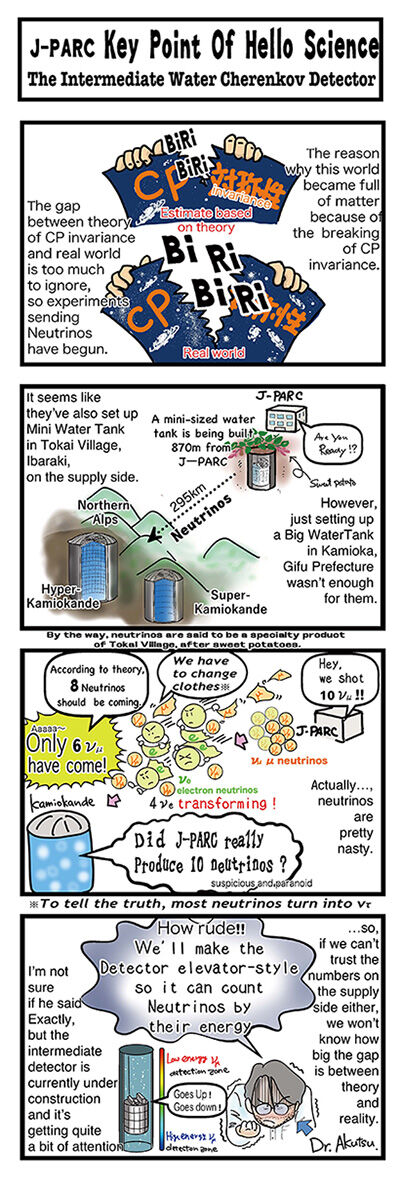
Dr. AKUTSU Ryosuke of the Particle and Nuclear Physics Division introduced the current status of the construction of the "Intermediate Water Cherenkov Detector," a neutrino experimental facility being built as part of the Hyper-Kamiokande project.
The Hyper-Kamiokande project aims to begin operation in FY2028. It will observe neutrino oscillations with greater precision and seek a definitive test of CP violation. The Intermediate Water Cherenkov Detector, which is currently under construction, is an important part of the project. It will be installed about 1 km from the neutrino production target at J-PARC. The detector will float in a water-filled shaft and move up and down as the water level changes. By changing the position of the detector, neutrinos can be observed under different energy conditions before oscillation. This will allow accurate measurement of neutrino interaction events that will be detected as signals at Hyper-Kamiokande.
Participants asked many questions about collaboration with research projects overseas. A member of the Intermediate Water Cherenkov Detector construction team also shared their hope of "building a more precise experimental facility while understanding the research being conducted."
 |
■Tokai Village Enjoy Summer School 2026 (July 24 and 30, August 5 and 20, Tokai Village Museum)
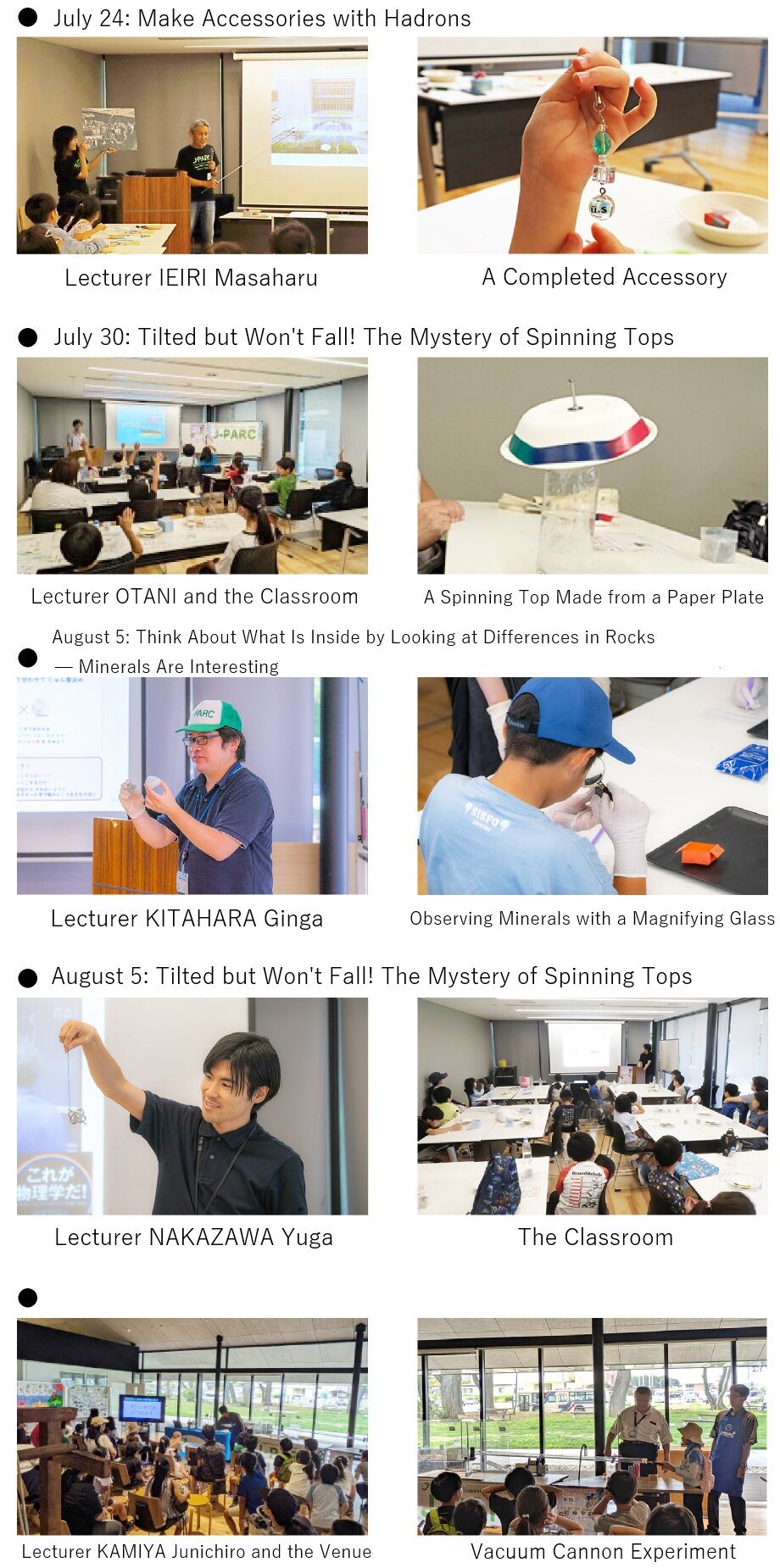
With the cooperation of local communities, organizations, and businesses in Tokai Village, the "Tokai Village Enjoy Summer School," a hands-on event for elementary school students, was held.
J-PARC held four science experiment workshops as part of "J-PARC Hello Science: Summer Vacation Science Experiment Classes." The classes included "Make Accessories with Hadrons," "Tilted but Won't Fall! The Mystery of Spinning Tops," "Think About What Is Inside by Looking at Differences in Rocks - Minerals Are Interesting," and "What Are Air and a Vacuum?"
Many of the children who participated said in the questionnaire that they had fun. This experience is expected to inspire the children to make new discoveries and learn more about science.
 |
■Hands-on Workshop Held at Children's Kasumigaseki Tour Day (July 29-30, Ministry of Education, Culture, Sports, Science and Technology)
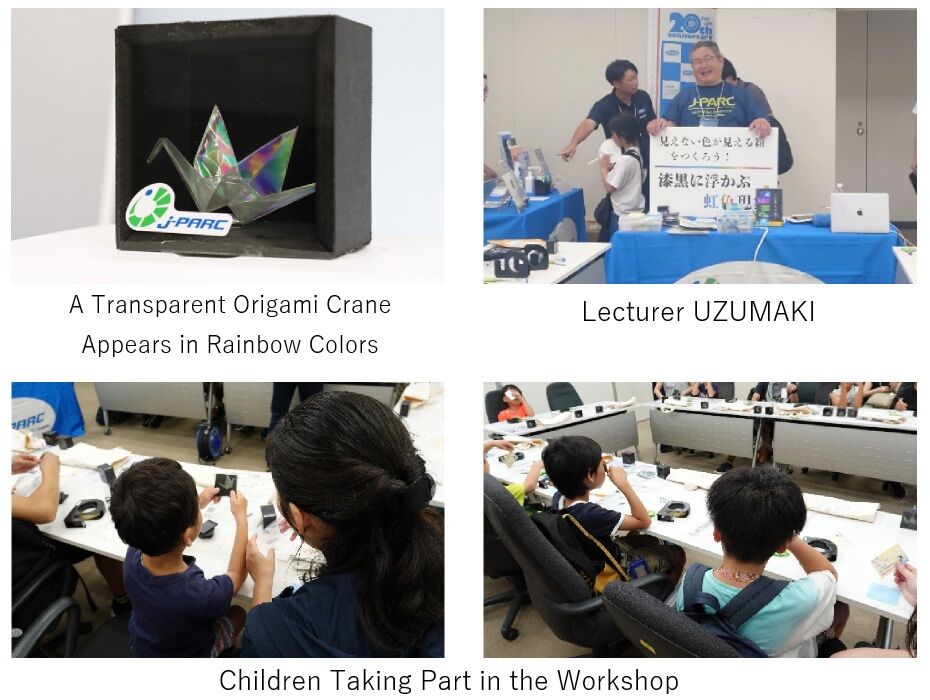
Children's Kasumigaseki Tour Day was held during the summer vacation, with the Ministry of Education, Culture, Sports, Science and Technology and other government ministries and agencies working together to offer various activities and exhibitions. At the JAEA booth, children took part in a hands-on workshop with the theme "Let's Make a Box That Makes Invisible Colors Visible! A Rainbow of Colors Floating in Pitch-Black Darkness."
First, the children made a cube-shaped box by putting together four black craft boards and covering the front and back with polarizing filters. They then placed a transparent origami crane inside the box. When they looked inside, an origami crane in rainbow colors appeared to float in the pitch-black darkness.
The children turned the box around and tilted their heads, gazing at the faintly colored crane with curiosity.
 |
■Muographic Investigation of Ancient Burial Mounds in Tokai (July 26, Tokai Village Museum)
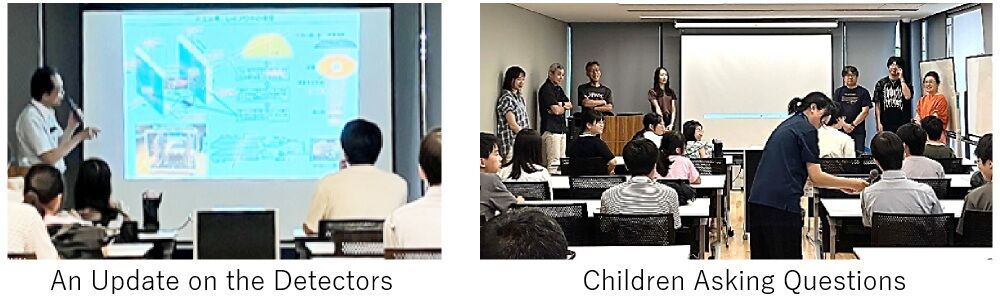
The third activity of FY2026 was held. In the first part, Dr. FUJII gave an update on the two detectors. After reviewing the previously reported observation results from "Detector for History and Future No. 1," he explained the status of "Detector for History and Future No. 2," which was newly installed last November. Although the detector experienced flooding caused by a typhoon in June and problems due to high temperatures in July, the necessary measures have already been taken, and smooth observations are expected.
In the second part, seven scientists participating in the project gave short talks on the theme, "What were they like as children, and how did they become scientists?" After listening to the talks, the children asked questions of their own, including, "What should I do if I study physics at university?" and "Why are there so few female scientists?" A girl sitting in the front row asked the latter question. A female scientist who participated in the event answered that although there are still fewer female scientists, their number has increased compared with the past, and there is no difference between women and men when it comes to study.
The children listened with curiosity as the scientists shared stories about their childhoods and their journeys to becoming scientists. They seemed to relate the scientists' experiences to their own lives.
 |
■J-PARC Sanpo-michi 73: - The MR Above and Below Ground After Nearly 20 Years -
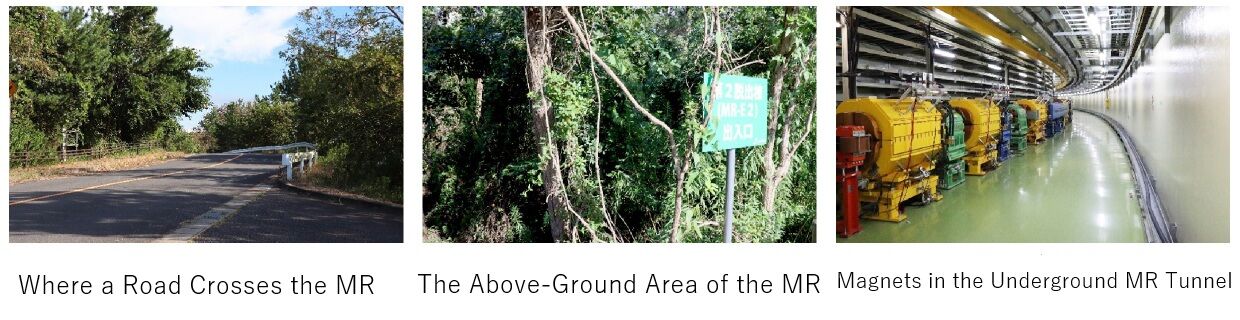
At J-PARC, the paths taken by protons in all three accelerators are located more than ten meters underground. Above the tunnel of the largest accelerator, the MR, soil was piled up to form a 1.6-km-long ridge around the accelerator ring. However, trees have grown thickly in the area, making it difficult to see the entire ridge from above ground.
During the construction of the MR, the ground was first dug up to build the tunnel. After construction was completed, the soil was put back, and trees were planted except in areas with buildings, such as the handling building, power supply building, and machinery building. This was done to restore the greenery around the facility. The MR facility was completed in January 2007, so nearly 20 years have now passed since its completion.
Inside the 1.6-km-long tunnel, the curved sections are lit by evenly spaced lights. The reflections of the lights create gentle arcs on the walls and floor. Various magnets that guide the proton beam are neatly arranged inside the tunnel. At first glance, the scene may look the same as it did before. However, equipment has been replaced and improved over the years, and the power of the proton beam has increased greatly since the facility was first completed. Like the area above ground, the accelerator underground has continued to change and improve over the years.
 |