


J-PARC Project Newsletter No.101, January dispatch
★☆-------------------------------------------------------------------------------------------------
J-PARC Project Newsletter
No.101, January 2026
Japan Proton Accelerator Research Complex under joint operation by the
High Energy Accelerator Research Organization (KEK) and the Japan Atomic
Energy Agency (JAEA)
http://j-parc.jp/index-e.html
-------------------------------------------------------------------------------------------------☆★
HEADLINES AND CONTENTS
1. [Overview]
- J-PARC RESTARTS FULL USER OPERATIONS WITH STABLE BEAM DELIVERY
- USERS' COUNCIL MEETING, COMMUNITY REQUESTS PRESENTED
- GROUNDBREAKING OF IWCD FOR HYPER-KAMIOKANDE PROJECT HELD
2. [Accelerator Division]
- ACCELERATOR OPERATIONS STATUS
- WORKSHOP REPORT
3. [Particle and Nuclear Physics Division]
- RESUMPTION OF HIGH-INTENSITY BEAM OPERATION AT THE NEUTRINO EXPERIMENTAL FACILITY AND START OF CONSTRUCTION OF THE HYPER-KAMIOKANDE INTERMEDIATE DETECTOR
- STATUS OF THE JSNS2 / JSNS2-II (SEARCH FOR STERILE NEUTRINOS AT J-PARC MLF, E56 / E82)
- SUCCESSFUL COMPLETION OF THE SECOND HALF OF 2025 OPERATION FOR THE HADRON EXPERIMENTAL FACILITY
- STATUS OF THE COMET EXPERIMENT
4. [Materials and Life Science Division]
- NEUTRON SOURCE; COMPLETION OF MAINTENANCE WORK OF THE NEUTRON SOURCE AND BEAM OPERATION RESUMPTION AS SCHEDULED
- SINQ-MLF WORKSHOP ADVANCES NEUTRON INSTRUMENTATION AND FACILITY DEVELOPMENT
- MUON SCIENCE FACILITY (MUSE); BEAM OPERATION RESUMED
5. [Nuclear Transmutation Division]
- WORKSHOP ON J-PARC PROTON BEAM IRRADIATION FACILITY
6. [Safety Division]
- FISCAL 2025 J-PARC SAFETY AUDIT
- AN EMERGENCY DRILL AT MLF
7. [Outreach Activities]
8. [Editorial Note]
PAST ISSUES ARE AVAILABLE FROM THE LINK BELOW.
http://j-parc.jp/c/en/topics/project-newsletter/index.html
☆-------------------------------------------------------------------------------------------------…
1. [Overview] by KOBAYASHI Takashi
…-------------------------------------------------------------------------------------------------★
-------------------------------------------------------------------------------------------------
J-PARC RESTARTS FULL USER OPERATIONS WITH STABLE BEAM DELIVERY
-------------------------------------------------------------------------------------------------
This autumn marked a steady resumption of user operations across J-PARC following the summer maintenance period. We successfully established stable, continuous beam delivery for all experimental facilities. MLF operations resumed at 710 kW equivalent per pulse to secure the two-year mercury target lifetime, the Hadron Experimental Facility achieved 80 kW stable operation, and the Neutrino Experimental Facility successfully resumed stable operation at around 750 kW for T2K after the target failure in March 2025.
-------------------------------------------------------------------------------------------------
USERS' COUNCIL MEETING, COMMUNITY REQUESTS PRESENTED
-------------------------------------------------------------------------------------------------
The Users' Council meeting serving as an important forum for community engagement was held on September 25. Following the J-PARC status report delivered by the Center, we received presentations outlining requests and expectations from the particle physics, nuclear physics, muon, neutron, and industrial application communities. We agreed that the Users' Council will consolidate these inputs into a formal proposal document and submit it to J-PARC for continued improvement of accelerator availability, beamline environment, and user support frameworks.
-------------------------------------------------------------------------------------------------
GROUNDBREAKING OF IWCD FOR HYPER-KAMIOKANDE PROJECT HELD
-------------------------------------------------------------------------------------------------
On November 4, the groundbreaking ceremony for the Intermediate Water Cherenkov Detector (IWCD) facility for the Hyper-Kamiokande project was held at the construction site in Tokai Village. The ceremony was honored by distinguished guests who have long supported J-PARC and the IWCD project. We welcomed the Mayor of Tokai Village, community representatives from the region, the contracted design company, and the contracted construction company. We expressed our deep appreciation for their continued support as we move toward the IWCD first physics observations planned for FY2028.
☆-------------------------------------------------------------------------------------------------…
2. [Accelerator Division] by YAMAMOTO Kazami
…-------------------------------------------------------------------------------------------------★
-------------------------------------------------------------------------------------------------
ACCELERATOR OPERATIONS STATUS
-------------------------------------------------------------------------------------------------
Following the summer shutdown, maintenance work was carried out on all the accelerators. The linac was tuned on October 17, followed by the 3 GeV Rapid Cycling Synchrotron (RCS) on October 23. User operation of the Materials and Life Science Experimental Facility (MLF) began on October 30. As the current MLF target will remain in use for the next two years, operations are being conducted at a beam power equivalent to approximately 800 kW per pulse in order to maximize the target's lifespan.
Beam tuning and user operation also commenced at the Main Ring Synchrotron (MR) and the Hadron Experimental Facility (HD) on November 5, with the HD operating at a maximum beam power of 88 kW.
Shortly after operations began, the MR experienced a main magnet power supply failure and the RCS encountered a vacuum pump issue. Both incidents required approximately one and a half days to resolve, but have since been fixed.
-------------------------------------------------------------------------------------------------
WORKSHOP REPORT
-------------------------------------------------------------------------------------------------
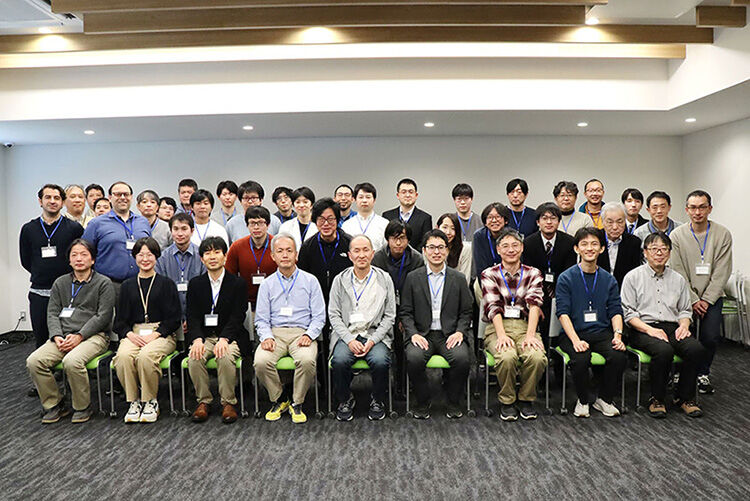
The fourth Machine Learning Workshop on Accelerator and Beam Physics took place on December 8-9 at the Tokai Mirai Base in a hybrid format. A total of 103 people registered to attend, with around half of them attending in person. The workshop provided an overview of recent progress in applying machine learning to accelerator operation, tuning, and beam diagnostics. It also served as a platform for lively discussions on the latest initiatives at various facilities and future work within the accelerator and beam physics community.
☆-------------------------------------------------------------------------------------------------…
3. [Particle and Nuclear Physics Division]
…-------------------------------------------------------------------------------------------------★
-------------------------------------------------------------------------------------------------
RESUMPTION OF HIGH-INTENSITY BEAM OPERATION AT THE NEUTRINO EXPERIMENTAL FACILITY AND START OF CONSTRUCTION OF THE HYPER-KAMIOKANDE INTERMEDIATE DETECTOR (by ISHIDA Taku)
-------------------------------------------------------------------------------------------------
At the Neutrino Experimental Facility, remote repair work on a target piping issue that occurred in March was successfully completed. Following this, commissioning of the Main Ring and the neutrino beamline was carried out starting on November 28, and continuous beam operation for the T2K experiment was resumed in the evening of November 29.
The beam power at the restart was 700 kW, and it was subsequently increased to 750 kW on December 15. In addition, the facility successfully completed its periodic radiation safety inspection on December 17. While continuing further tuning toward stable operation at higher beam intensities, the facility plans to maintain high-intensity beam operation for the T2K experiment through June 2026, following a temporary shutdown during the year-end and New Year holidays.
Meanwhile, on November 4, a groundbreaking ceremony was held in Tokai Village, Ibaraki Prefecture, for the Intermediate Detector facility, one of the key components of the international Hyper-Kamiokande project.
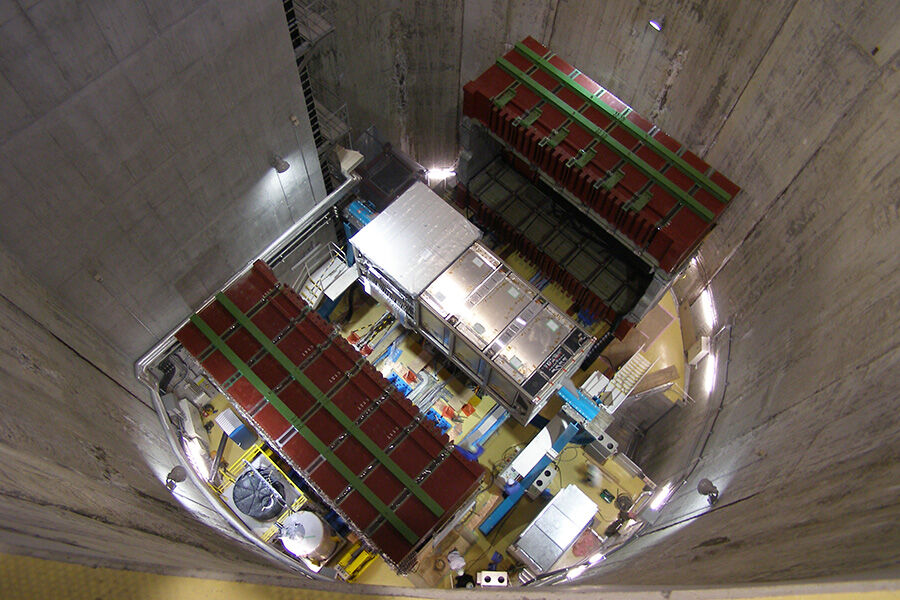
The Intermediate Water Cherenkov Detector (IWCD) will observe neutrinos produced at J-PARC neutrino beamline at a location approximately 1 km from the neutrino production target. In parallel with upgrades to the Main Ring accelerator and the neutrino beamline, J-PARC has been preparing for the construction of this intermediate detector. The start of physics observations is planned for fiscal year 2028.
https://www.kek.jp/en/topics/202511111200iwcd
-------------------------------------------------------------------------------------------------
STATUS OF THE JSNS2 / JSNS2-II (SEARCH FOR STERILE NEUTRINOS AT J-PARC MLF, E56 / E82) (by MARUYAMA Takasumi)
-------------------------------------------------------------------------------------------------
The JSNS2 (E56) / JSNS2-II (E82) collaboration investigates the anomaly reported by the LSND experiment, namely the observed excess of electron antineutrinos, through a direct measurement at the J-PARC Materials and Life Science Experimental Facility (MLF).
Data taking with both the near detector, located on the third floor of the MLF, and the far detector, installed outside the MLF building, began in November 2025.
In parallel, we have finalized the first results of our studies based on data collected in 2022.
These results are scheduled to be published and presented in January 2026. The new far detector is currently in the commissioning phase. Analysis of the beam commissioning data indicates that the rate of beam-induced neutrons is higher than expected.
-------------------------------------------------------------------------------------------------
SUCCESSFUL COMPLETION OF THE SECOND HALF OF 2025 OPERATION FOR THE HADRON EXPERIMENTAL FACILITY (by TAKAHASHI Hitoshi, OZAWA Kyoichiro, TAKAHASHI Toshiyuki, NOMURA Tadashi)
-------------------------------------------------------------------------------------------------
The beam time after the summer maintenance period was conducted in November. Beam commissioning in the MR began on November 5, and user operation commenced on November 10. The beam time concluded on the morning of November 26. In this beam operation, multiple experiments conducted important data-taking and commissioning activities, as summarized below.
The J-PARC E16 experiment aims to measure mass spectra of vector mesons in nuclei to study the partial restoration of chiral symmetry of QCD in a finite density matter. The E16 experiment took pilot data in the last year to evaluate the detector performance. After the discussion at the last PAC meeting, the experiment started the data acquisition for physics data in November. The experiment recorded over 400 terabytes of data and will continue the data-taking in the next beam time.
A new experiment, E72, was conducted at K1.8BR beamline to establish a narrow Lambda resonance with spin 3/2 and determine its parity. In the E72, K$^-$ + p -> Lambda + eta reaction at p(K)=735 MeV/c and nearby is measured using a liquid hydrogen target and a large-acceptance Hyperon Spectrometer which comprises a time projection chamber (TPC) and the surrounding scintillator hodoscope inside a superconducting Helmholtz magnet. From the angular distribution and polarization of a Lambda, the spin and parity of a parent Lambda resonance would be obtained.
At K1.8 beamline, commissioning of hyper-nuclear gamma-ray spectroscopy (E63) using beam and scattered particle spectrometers and a Germanium detector array, Hyperball, was carried out. In the E63, energy difference between 1+ and 0+ states of Hydrogen-4-Lambda hyper-nucleus is precisely measured and compared with that of Helium-4-Lambda, 1406 keV in order to study charge symmetry breaking in Lambda-Nucleon interaction. The 1+ state of Hydrogen-4-Lambda will be produced as a fragment via the K$^-$ + Lithium-6 -> pi- + (Lithium-6-Lambda*) reaction. By the present commissioning run, both spectrometers and Hyperball have become ready to conduct physics runs in the next SX beam operation.
Moreover, the KOTO experiment, which searches for rare kaon decays, continued to accumulate data at the KL beam line.
-------------------------------------------------------------------------------------------------
STATUS OF THE COMET EXPERIMENT (by MIHARA Satoshi)
-------------------------------------------------------------------------------------------------
The COMET experiment aims to search for the lepton-flavor-violating muon reaction, mu-e conversion, with a sensitivity better than 10-14 in Phase I.
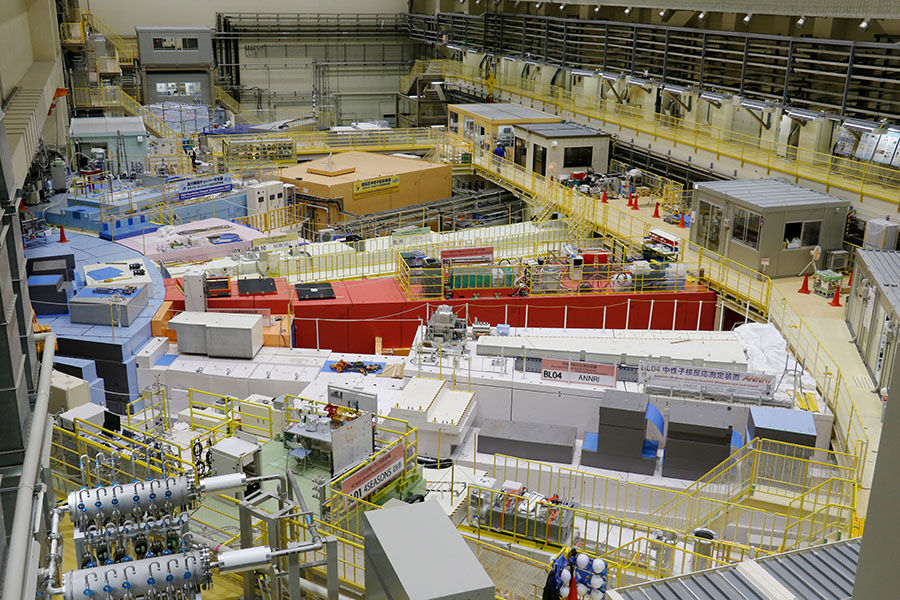
The COMET Group, with significant cooperation from the Cryogenic Section, has completed the installation of the bridge solenoid (BS)-which connects the detector solenoid magnet (DS) to the transport solenoid magnet (TS) for muon transport-in the experiment area. Following installation, the magnets were also connected to each other. Moving forward, we plan to conduct excitation tests of these magnets and perform magnetic field measurements.
Construction of detectors for physics and beam measurements is also progressing smoothly. At the newly constructed R&D building, collaborators from Japan and abroad are gathering to fabricate and adjust the detectors. Preparations for assembling the individual detectors and installing them inside the DS are also proceeding steadily.
In November, a collaboration meeting was held at IHEP in China. Discussions focused on important issues for the experiment start-up, such as detector commissioning and run planning.
☆-------------------------------------------------------------------------------------------------…
4. [Materials and Life Science Division]
…-------------------------------------------------------------------------------------------------★
-------------------------------------------------------------------------------------------------
NEUTRON SOURCE; COMPLETION OF MAINTENANCE WORK OF THE NEUTRON SOURCE AND BEAM OPERATION RESUMPTION AS SCHEDULED (by HARADA Masahide)
-------------------------------------------------------------------------------------------------
The maintenance work was successfully performed during the outage of the MLF facility. In September, the used proton beam window mounted on the shielding plug was replaced with a new one, as preparation for the replacement of the proton beam window and shielding plug assembly next summer. Then, the power supply cables for the mercury pump were replaced with the temporary cables in order to recover their insulation resistance. In parallel, in the cryogenic circulation system, the activated charcoal was replaced with a new one and periodic voluntary inspections were conducted in accordance with the High Pressure Gas Safety Law.
No major problems were confirmed in this system. In October, hardware-related maintenance was performed on the power manipulator. And meters and valves at the off-gas process system were replaced with new ones. With these tasks completed, the maintenance works in the neutron source were successfully completed. The user program resumed on November 30 on schedule. The target diagnostic system indicated that pressure waves in the new mercury target vessel were reduced effectively by the bubble injection. However, in order to ensure the planned two-year operation of the mercury target vessel, the average beam power was reduced to approximately 720 kW.
Finally, on October 23 and 24, a mini workshop on neutron sources with Swiss Spallation Neutron Source (SINQ) group of PSI (Paul Scherrer Institute) was held. Progress of international collaboration for neutron source developments is expected.
-------------------------------------------------------------------------------------------------
SINQ-MLF WORKSHOP ADVANCES NEUTRON INSTRUMENTATION AND FACILITY DEVELOPMENT (by NAKAMURA Mitsutaka)
-------------------------------------------------------------------------------------------------
The General User Proposal call for the 2026A cycle (short-term and one-year proposals) closed on November 7 and was reopened to both domestic and international applicants. A total of 277 neutron proposals were received, including 152 from abroad.
All proposals are currently under review, and final decisions will be made by the MLF Advisory Board on March 10.
The workshop "Advancing Neutron Facilities Together: Instrumentation, Source Operation, and International Collaboration between SINQ and MLF" was held on October 23 (https://conference-indico.kek.jp/event/351/). Experts from SINQ and J-PARC MLF discussed neutron instrumentation, source operation, and future facility development. A tour of MLF and focused discussions with the Neutron Source, Sample Environment, and Neutron Optics groups further strengthened collaboration, enhancing mutual understanding and fostering new connections to support ongoing cooperation.
From November 17 to 21, the 14th AONSA Neutron School and 9th Neutron and Muon School hosted 38 graduate students and early-career researchers from Japan and abroad. The program offered lectures and hands-on training, with sessions at J-PARC MLF and JRR-3 providing direct experience at world-class facilities. (Program details: https://conference-indico.kek.jp/event/322/)
Recent press release from Neutron Science at MLF:
BL15 and BL18 (October 23): "A metallic p-wave magnet with commensurate spin helix"
https://doi.org/10.1038/s41586-025-09633-4
BL16 (October 6): "Supramolecular Interface Engineering via Interdiffusion for Reusable and Dismantlable Polymer Adhesion"
https://doi.org/10.1002/adma.202507939
-------------------------------------------------------------------------------------------------
MUON SCIENCE FACILITY (MUSE); BEAM OPERATION RESUMED (by KAWAMURA Naritoshi)
-------------------------------------------------------------------------------------------------
Beam operation resumed on October 30 after an annual long maintenance shutdown. The malfunctioning target rotation introduction system was replaced as a preventive maintenance measure. All high-voltage modules for the S-line kicker power supply have been replaced with SiC-based units, replacing the frequently failing Si-based units. Preparations for the commissioning run of the muon accelerator in the H2 area on the H-line are nearly completed.
Repairs to the malfunctioning refrigerator for the D-line solenoid magnets have been completed, and it is now operating without issues. All instruments have been restarted without problems.
The 10th symposium on "Integration of arts and sciences" was held at the National Museum of Nature and Science, Tokyo, on October 10-11, gathering more than 250 attendees, including online participants. At the public lecture, three speakers provided accessible explanations for the public on non-destructive studies on cultural properties, introduced cultural property research at the Cyprus Research Institute, and discussed "ukiyo-e" production techniques.
The J-PARC workshop on "Bridging Research Innovations in Diverse muon and neutron science by GEneral collaboration between Japan and Switzerland (BRIDGE2025)" was held on October 20-22 at the University of Tokyo (https://conference-indico.kek.jp/event/321/).
This workshop aims to promote academic exchange on experimental techniques in muon and neutron science and related areas between Japan and Switzerland. 60 participants, primarily researchers and engineers from J-PARC and PSI, gathered in lively discussions. On the second day of the meeting, a tour of J-PARC was also conducted. On the final day, future collaboration plans were reaffirmed, and the meeting concluded.
☆-------------------------------------------------------------------------------------------------…
5. [Nuclear Transmutation Division] by MEIGO Shin-ichiro
…-------------------------------------------------------------------------------------------------★
-------------------------------------------------------------------------------------------------
WORKSHOP ON J-PARC PROTON BEAM IRRADIATION FACILITY
-------------------------------------------------------------------------------------------------
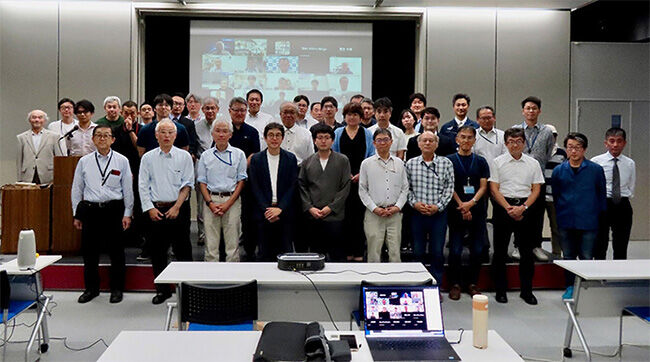
On October 2, a workshop on "J-PARC Proton Beam Irradiation Facility" was held as an in-person and online hybrid mode. There were 101 participants, with 50 in-person and 51 online, including a large number of participants, 30 individuals, from the industry. After reviewing progress on the facility planning over the past year and the irradiation fields currently available at J-PARC, the facility's expectations and needs were explained for four potential research areas: material irradiation damage, semiconductor soft-error testing, radioisotopes (RIs) production for medical applications, and proton-beam applications. Additionally, recent progress on the RI production plan for molybdenum-99 (99Mo) for medical applications, and on the plan to develop a proton irradiation field in the existing LINAC tunnel with external funding from the Space Strategy Fund organized by the Japan Aerospace Exploration Agency (JAXA), were discussed. Throughout the discussion, it was demonstrated that there is a very high demand for proton and neutron beams at the proton beam irradiation facility, given the current shortage of irradiation facilities domestically and internationally. Furthermore, it was noted that improving access to the irradiation fields is essential for efficient experiments and that human resource development is crucial to advancing each research area to maturity.
☆-------------------------------------------------------------------------------------------------…
6. [Safety Division] by BESSHO Kotaro, KASUGAI Yoshimi
…-------------------------------------------------------------------------------------------------★
-------------------------------------------------------------------------------------------------
FISCAL 2025 J-PARC SAFETY AUDIT
-------------------------------------------------------------------------------------------------
Two auditors conducted the fiscal 2025 J-PARC safety audit.
At the preliminary briefing on September 29, the following points were explained: 1) The recent status of J-PARC, including accidents and issues, and 2) safety management initiatives and follow-up on issues raised in the previous year's audit.
A site inspection of the LINAC and MLF facilities, as well as interviews with leaders, were carried out on October 2. The focus of this year's inspection was to provide a comprehensive overview of the current situation at the workplaces. The auditors provided valuable recommendations. (1) Even for minor incidents, it is imperative to confirm whether they had the potential to escalate into serious accidents, and to implement countermeasures that reflect this potential. (2) When updating or modifying equipment installed during the initial construction phase, it is recommended that procedures be reviewed as new work and that risk assessments are re-conducted. All workers must thoroughly understand the fundamental meaning of safety measures. Past failures and innovations should be documented to facilitate knowledge transfer to future generations.
-------------------------------------------------------------------------------------------------
AN EMERGENCY DRILL AT MLF
-------------------------------------------------------------------------------------------------
An emergency drill was conducted at MLF on October 7. During the drill, a fire broke out in an experimental cabin in the First Experimental Hall of MLF and the staff performed initial firefighting procedures. Assuming that irradiated samples on the desk were dropped onto the floor during firefighting, scattering and causing radioactive contamination, decontamination of the affected area was carried out. Based on the lessons learned from the drill, various improvements will be implemented to enhance the emergency response.
☆-------------------------------------------------------------------------------------------------…
7. [Outreach Activities]
…-------------------------------------------------------------------------------------------------★
★ Muographic Investigation of Ancient Burial Mounds in Tokai: Installation Site for "Detector for History and Future No. 2" Decided (September 21, Funatsuka No. 2 Burial Mound, Tokai Village)
https://www.j-parc.jp/c/en/topics/2025/10/31001670.html
★ Outreach Lecture at Sannomaru Elementary School, Mito City (September 30)
https://www.j-parc.jp/c/en/topics/2025/09/30001654.html
★ Outreach Lecture at the National Institute of Technology, Sendai College (October 10)
https://www.j-parc.jp/c/en/topics/2025/10/31001653.html
★ Outreach Lecture at Kujigawa San-iku Elementary School (October 14)
https://www.j-parc.jp/c/en/topics/2025/10/31001653.html
★ Outreach Lecture at Ibaraki High School and Junior High School (November 15)
https://www.j-parc.jp/c/en/topics/2025/11/26001652.html
★ Outreach Lecture at the National Institute of Technology, Kagawa College, Takamatsu Campus (November 17)
https://www.j-parc.jp/c/en/topics/2025/11/26001652.html
★ Muographic Investigation of Ancient Burial Mounds in Tokai: Installation of "Detector for History and Future No. 2" (November 16, Funatsuka No. 2 Burial Mound, Tokai Village)
https://www.j-parc.jp/c/en/topics/2025/09/25001617.html
★ J-PARC Lecture 2025: "Think it's Difficult? Let's Explain the Expanding World of Elementary Particles and Atomic Nuclei at J-PARC in an Easy-to-Understand Way" (November 29, Tokai Village Industrial and Information Plaza, iVil).
https://www.j-parc.jp/symposium/lecture2025e/
★ Outreach Lecture at Muramatsu Elementary School, Tokai Village (December 2)
https://www.j-parc.jp/c/en/topics/2025/12/09001674.html
★ Outreach Lecture at Nakamura Elementary School, Tokai Village (December 16)
https://www.j-parc.jp/c/en/topics/2025/12/09001674.html
★ Outreach Lecture at the National Institute of Technology, Kagawa College, Takuma Campus (December 18)
https://www.j-parc.jp/c/en/topics/2025/12/09001674.html
☆-------------------------------------------------------------------------------------------------…
8. [Editorial Note]
…-------------------------------------------------------------------------------------------------★
Past issues are available from the link below.
http://j-parc.jp/c/en/topics/project-newsletter/index.html
┏----…----…----…----…----…----…----…----…----…----…----…----…☆
┃ Editorial Board:
┃ OGURI Hidetomo (Chair) : oguri.hidetomo[at]jaea.go.jp
┃ SHOBUDA Yoshihiro: yoshihiro.shobuda[at]j-parc.jp
┃ OZAWA Kyoichiro: ozawa[at]post.kek.jp
┃ MARUSAWA Machiko: machiko[at]post.kek.jp
┃ Bruce YEE-RENDON: byee[at]post.j-parc.jp
┃ OGAWA China (Secretary) : ogawa.china[at]jaea.go.jp
┃ * Please replace "(at)" with "@" when you enter an email address.
★----…----…----…----…End of Letter…----…----…----…----…----