

J-PARC News April 2026 (Issue#252)
■Fire from a High-voltage Switchboard inside the J-PARC 50 GeV Substation
At approximately 7:00 a.m. on Tuesday April 7, a fire broke out from a high-voltage switchyard inside the J-PARC 50 GeV Substation. The fire was extinguished by the public fire department at around 7:47 a.m. There were no injuries or impact on the surrounding environment. The cause of this fire is currently under investigation.
We sincerely apologize for the inconvenience and trouble this incident may cause. We will make every effort to prevent a recurrence.
Takashi Kobayashi, Director of the J-PARC Center
For more information, please visit the J-PARC website.
https://j-parc.jp/c/en/information/2026/04/07001779.html
■Construction Site Tour of the Hyper-Kamiokande Intermediate Water Cherenkov Detector (IWCD) (April 2)
KEK held a press tour of the construction site for the Intermediate Water Cherenkov Detector (IWCD), a neutrino detector newly developed for experiments related to the Hyper-Kamiokande project.
For more details (in Japanese only), please visit the J-PARC website.
https://www.kek.jp/ja/topics/202604221400
■Award
Beam Physics Young Presentation Award 2025
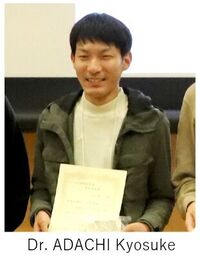
Dr. ADACHI Kyosuke, a postdoctoral researcher of Accelerator Section II, received the Young Presentation Award 2025 at the 2025 Beam Physics Workshop and Young Researchers' Meeting for his presentation entitled "Optimization study of bunch lengthening with second harmonic RF voltage in J-PARC RCS." This award is presented to outstanding young researchers and students in the field of beam physics in order to encourage their research activities and support their independence and development as researchers and professionals.
Dr. ADACHI investigated a method for flattening the beam bunch shape by applying a radio-frequency voltage with twice the fundamental frequency during the final stage of acceleration in the accelerator. This approach successfully reduced beam loss and is expected to contribute significantly to realizing even higher-intensity beams at J-PARC.
 |
■Press Release
(1) Corrosion-Resistant Structural Material with Self-Healing Ability in Flowing Lead-Bismuth Eutectic - A Step toward Realizing Accelerator-Driven Systems that Convert Nuclear Waste into Energy - (March 3)
Toward the realization of carbon neutrality by 2050, Accelerator-Driven Systems (ADS), which can provide zero-carbon electricity while effectively using high-level radioactive waste as an energy source, are attracting attention. However, ADS uses liquid lead-bismuth eutectic (LBE) as both a target material and a coolant, and LBE is corrosive to structural materials. Therefore, improving the reliability of structural materials under high-temperature and high-flow conditions is important for the practical use of ADS.
In this study, in collaboration with Institute of Science Tokyo, corrosion tests of FeCrAl alloy, one of the candidate structural materials for ADS, were carried out using the large non-isothermal high-temperature liquid metal flow loop "OLLOCHI" installed at JAEA.
The corrosion tests were conducted in flowing LBE for up to 4000 hours. As a result, it was confirmed that a multilayer oxide film formed on the surface of the FeCrAl alloy effectively suppressed corrosion during a 2000-hour test in flowing LBE at 723 K (450℃).
Furthermore, the study found that this multilayer oxide film has a self-healing function.
Even when part of the film was artificially damaged, it was spontaneously re-formed after an additional 2000-hour immersion in flowing LBE.
These results are expected to greatly improve the reliability of structural materials for the practical use of ADS, which aims to reduce the volume and toxicity of radioactive waste while supplying zero-carbon electricity at the same time. In the future, long-term functional evaluation tests considering the structure and function of in-reactor equipment will be conducted to establish material design guidelines and reliability-based lifetime prediction models under actual operating conditions.
For more details (in Japanese only), please visit the J-PARC website.
https://j-parc.jp/c/press-release/2026/03/03001762.html
(2) Balancing Both Coercivity and Magnetization - Toward Next-Generation Energy-Efficient Magnetic Memory with up to Tenfold Higher Coercivity - (March 18)
As power consumption continues to increase, next-generation magnetic memory with low standby power consumption is attracting attention. However, there has long been a trade-off relationship between coercivity, which is related to information stability, and magnetization, which is related to signal strength.
This study introduced a "nano-gradient design," in which the concentration of additive materials is continuously changed on the nanometer scale along the thickness direction of the film. As a result, the coercivity was improved by up to about ten times while maintaining high magnetization at room temperature. To clarify the mechanism of this performance enhancement, complementary analyses combining polarized neutron reflectometry using SHARAKU at the Materials and Life Science Experimental Facility (MLF) of J-PARC and synchrotron radiation analysis at NanoTerasu in Miyagi Prefecture were carried out.
This study demonstrates that properties previously considered difficult to achieve simultaneously can be improved together by utilizing magnetization enhancement inside the material. Such material design is expected to contribute to the development of next-generation magnetic memory with nearly zero standby power consumption and ultra-high-performance magnetic sensors.
For more details (in Japanese only), please visit the J-PARC website.
https://j-parc.jp/c/press-release/2026/03/18001766.html
(3) Successful Observation of Φ Mesons at J-PARC - A New Measurement Approaching the Origin of Mass in Matter - (March 23)
All matter is made of elementary particles called quarks. However, even if we add up the masses of all the quarks in our body, they cannot account for the total mass of the human body. This is because most of the mass of matter is thought to originate not from the particles themselves, but from the strong interaction between them. Theories concerning the "origin of mass" predict that the mass of the Φ meson, which consists of a quark and an antiquark, changes in high-density environments such as inside atomic nuclei. To study this effect, it is necessary to measure the decay of the Φ meson into an electron-positron pair, because the electron and positron can carry information out of the nucleus. However, this decay is very rare, occurring only once in several thousand events, which makes the measurement extremely challenging.
In this study, the research group directed one of the world's highest-intensity proton beams onto carbon and copper targets and precisely measured the emitted electron-positron pairs using the E16 spectrometer at the J-PARC Hadron Experimental Facility. As a result, the group succeeded for the first time in reconstructing Φ mesons using electron-positron pairs in the 30 GeV incident-energy region. Furthermore, the production yield of Φ mesons was found to be nearly proportional to the nuclear mass number. This result indicates that the mesons are not strongly absorbed inside nuclei.
This method enables information to pass through the "walls" of the nucleus and be carried outside. The establishment of this method is expected to contribute to future studies on the origin of mass.
For more details (in Japanese only), please visit the J-PARC website.
https://j-parc.jp/c/press-release/2026/03/23001769.html
■J-PARC Hello Science
Handling Technologies for Lead-Bismuth Eutectic toward the Realization of Accelerator-Driven Systems (March 19)
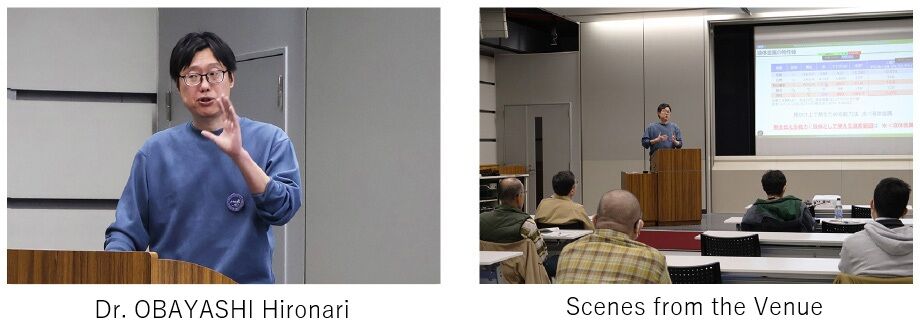
Dr. OBAYASHI Hironari of the Transmutation Division* introduced handling technologies for lead-bismuth eutectic (LBE), which is indispensable for the Accelerator-Driven System (ADS).
Spent nuclear fuel from nuclear power plants contains long-lived radionuclides that continue to emit radiation over long periods of time. ADS has attracted attention as a technology capable of converting these radionuclides into more stable and shorter-lived ones. In ADS, LBE plays an important role both as a coolant for removing generated heat and as a target material for producing neutrons. On the other hand, LBE presents several technical challenges because it easily corrodes metals, has strong surface tension, and exhibits flow characteristics different from those of ordinary liquids such as water.
At J-PARC, research toward the realization of ADS is being conducted while improving the understanding of the properties of LBE and addressing these technical challenges.
Participants asked many questions regarding LBE flow measurement technologies, corrosion control techniques, and areas in which Japanese technologies are superior compared with those overseas, reflecting the high level of interest in this field.
*Currently the Quantum Beam Technology Division.
 |
■The 15th Science Koshien National Tournament (March 20-23, Tsukuba International Congress Center and Tsukuba Capio)
The "Science Koshien" National Tournament, a nationwide science competition for high school students, where science-loving students from across Japan gather to compete and showcase their talents, was held at the Tsukuba International Congress Center and Tsukuba Capio. Approximately 400 high school students participated in the event.
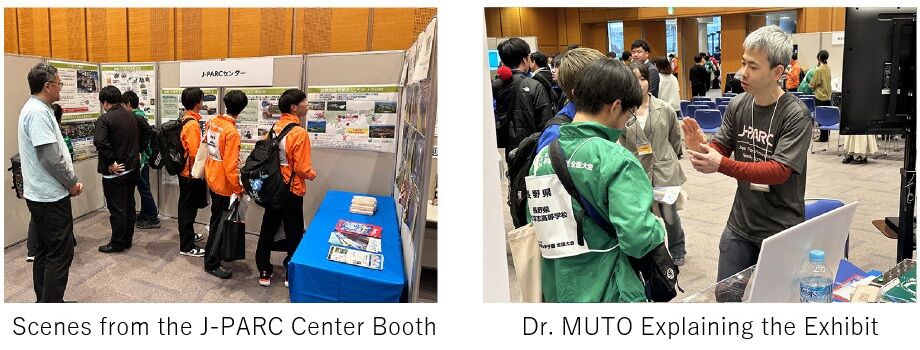
With the aim of allowing students to enjoy and engage with science and technology in Ibaraki Prefecture, the Ibaraki Prefectural Government invited organizations to set up exhibition booths. On the afternoon of March 22, the third day of the competition, a total of 17 organizations, including the J-PARC Center, took part in the exhibition.
At the J-PARC Center booth, Dr. MUTO Ryotaro and Dr. CHIMURA Motoki presented exhibits, including a model of the accelerator, and provided explanations. High school students who visited the booth listened with great interest.
 |
■J-PARC Sanpo-michi 69: - The Meaning of 36.4 Degrees -
36.4 degrees--what does this number bring to mind? For many people, it may be the average human body temperature.
The J-PARC neutrino experimental facility is located at latitude 36.4° north and longitude 140.6° east. Meanwhile, both the Super-Kamiokande detector and the newly constructed Hyper-Kamiokande detector are located at latitude 36.4° north and longitude 137.3° east. Although located about 295 kilometers apart, both detectors share the same latitude.
Neutrinos produced at J-PARC travel almost directly westward toward the enormous water tanks in Kamioka.
The line of latitude at 36.4° north crosses a remarkable range of landscapes across Japan. It stretches from the alluvial plains of Ibaraki Prefecture, passes through the Fossa Magna that divides the Japanese archipelago, and reaches the Hida region of Gifu Prefecture, home to some of Japan's oldest rocks. Along this line are diverse geographical features, including the Tone River, which has the largest drainage basin in Japan, the Shinano River, the country's longest river, Mount Asama, one of Japan's most active volcanoes, and the Hida Mountains, among the steepest mountain ranges in the country. As a result, the climate also changes dramatically along the same latitude--from the intensely hot northern Kanto Plain to the snow-covered Northern Alps and the heavy snowfall regions of Hida.
A new facility, the Intermediate Water Cherenkov Detector (IWCD), has now joined this unique 36.4° north latitude line. Located about one kilometer from J-PARC, IWCD is designed to precisely measure the properties of neutrinos immediately after they are produced. These measurements will improve the accuracy of neutrino oscillation observations at Hyper-Kamiokande.
Neutrinos are extremely small particles that rarely interact with matter. Yet humanity, with an average body temperature of around 36.4 degrees, is trying to understand the origins of the universe by studying the behavior of these mysterious particles. Research toward that goal is now accelerating.
 |