


J-PARC News December 2025 (Issue#248)
■J-PARC Lecture 2025: "Think it's difficult? Let's explain the expanding world of elementary particles and atomic nuclei at J-PARC in an easy-to-understand way" (November 29)
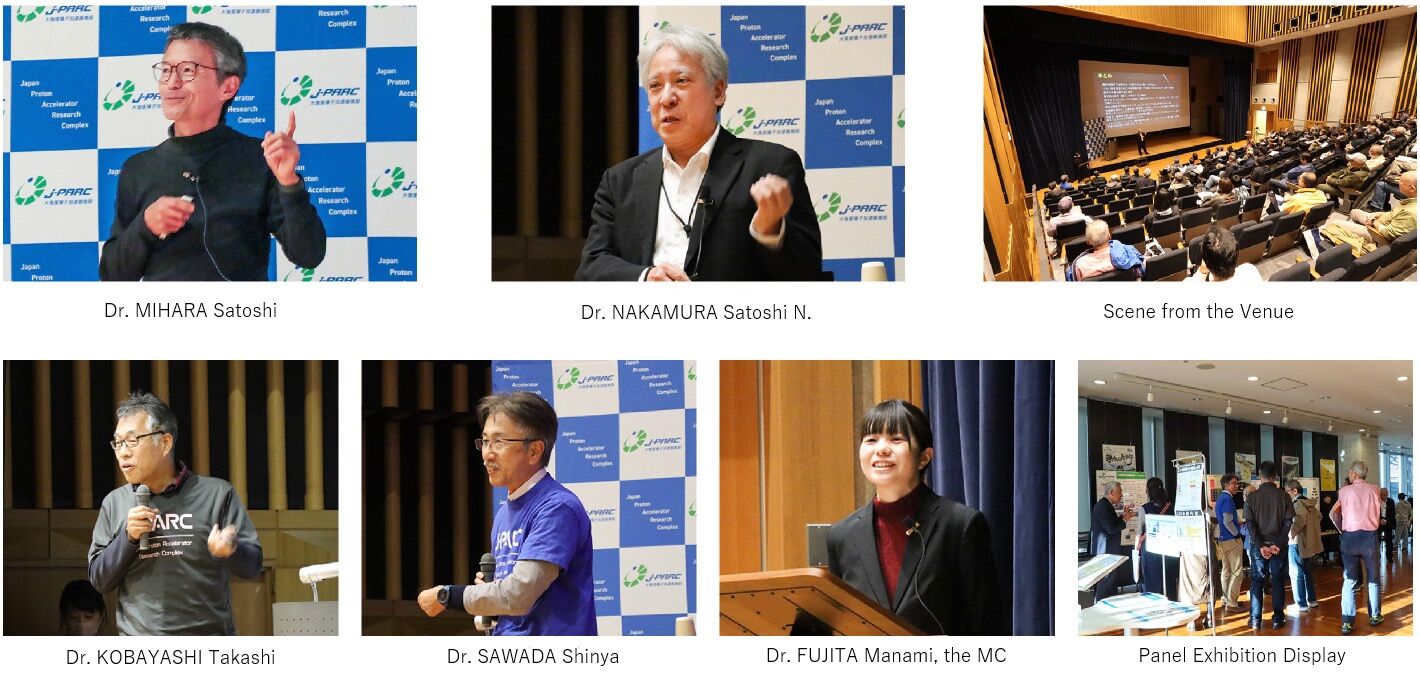
J-PARC holds this annual lecture to provide local residents and many others with a better understanding of its research activities. This year, it was held together with the 100th session of J-PARC Hello Science, the monthly outreach program that explores one theme in depth. A total of 102 participants attended the event at the Tokai Village Industrial and Information Plaza (iVil).
After opening remarks by Dr. KOBAYASHI Takashi, Director of the J-PARC Center, and Mr. YAMADA Osamu, Mayor of Tokai Village, Dr. MIHARA Satoshi of the Hadron Section delivered a talk titled "The Shadow Protagonist: Muon Reveals the Map of Elementary Particles." In his talk, he traced the history of muon research, from their discovery to the gradual understanding of their properties.
The second lecture was given by Dr. NAKAMURA Satoshi N., Professor in the Department of Physics and Director of the Quark Nuclear Science Institute at the Graduate School of Science, the University of Tokyo. His talk, "Exploring the Extremes of Matter with Quantum Beams from Hypernuclei to Neutron Stars," began with the story of alchemy, then moved on to the structure of nuclei, nucleons, and the quarks within them-especially strange quarks.
He highlighted recent advances in hypernuclear physics and concluded by outlining future research possibilities enabled by the planned extension of the hadron experimental facility.
Each lecture was followed by many questions from the audience. In the lobby, panel displays showing the overall layout of J-PARC and details of the Hadron Experimental Facility encouraged further discussion during breaks and before and after the sessions.
A full recording of the event is available on the J-PARC YouTube channel (Japanese only).
https://www.youtube.com/watch?v=9u4IK6Hacv0
 |
■Award
(1) 20th Young Scientist Award (2026), Physical Society of Japan and the 32nd Nuclear Physics Colloquium Young Researcher Prize
① 20th Young Scientist Award (2026), Physical Society of Japan - Particle Experiment Division
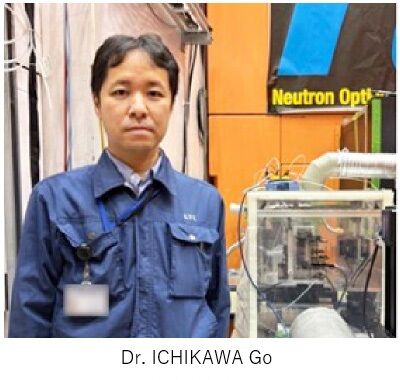
Dr. ICHIKAWA Go of the Neutron Science Section has successfully measured a neutron whispering gallery state using the neutron beam of the Neutron Optics and Fundamental Physics Beamline (BL05/NOP) at the J PARC Materials and Life Science Experimental Facility (MLF). This is the first time in the world that such a measurement has been achieved with pulsed neutrons.
When a neutron beam travels along a concave mirror, a near surface quantum state appears due to the centrifugal force. This is known as a whispering gallery state. When the equivalence between gravity and acceleration is applied, this quantum state can be treated as an analogy to a quantum state bound by gravity, allowing researchers to explore quantum behavior under a "virtual" gravitational field. The observed results matched theoretical calculations very well, and the experiment confirmed-at a precision of 2%-that quantum mechanics holds even under conditions equivalent to seven million times Earth's gravity.
With mirrors of even higher precision, it may become possible not only to further test quantum mechanics but also to search for hypothetical interactions between neutrons and the mirror surface.
The originality of this research and its significance as an important step toward fundamental experiments were highly evaluated, leading to Dr. ICHIKAWA receiving the award.
 |
②20th Young Scientist Award (2026), Physical Society of Japan - Experimental Nuclear Physics Division and the 32nd Nuclear Physics Colloquium Young Researcher Prize
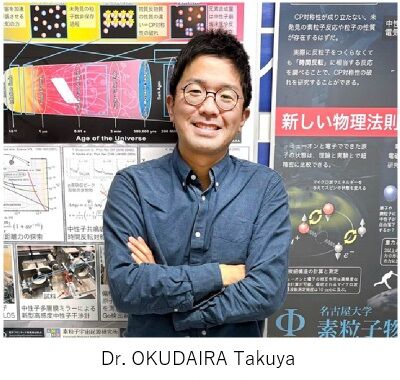
Dr. OKUDAIRA Takuya, Assistant Professor at the Graduate School of Science, Nagoya University, and Visiting Researcher in the Technology Development Section of the J-PARC Center, has received the award. This award also serves as the 32nd Young Researcher Prize of the Nuclear Physics Forum.
Dr. OKUDAIRA, together with Dr. OKU Takayuki and colleagues at the J-PARC Center, developed a 3He spin filter, achieving world leading performance. By installing this device on a J-PARC neutron beamline, he conducted research on the enhancement effect of time reversal symmetry violation in neutron resonance reactions of nuclei. These results were made possible by using J-PARC's high intensity polarized neutron beams and represent achievements unique to J-PARC.
This study demonstrated that, in neutron resonance reactions of nuclei, time reversal symmetry violation-believed to exist in nucleon-nucleon interactions-can appear with an effect up to one million times larger than in elementary processes. This is an important result in the search for physics beyond the Standard Model. In addition to the excellence of the research, Dr. OKUDAIRA's strong future potential was highly recognized.
Further contributions to the development of the Physical Society of Japan and the field of nuclear physics are expected in the future.
 |
(2) 2025 Ibaraki Prefecture High-Pressure Gas Safety Award
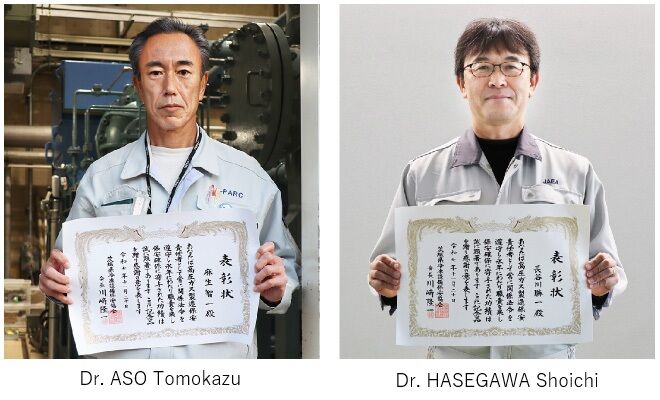
Dr. ASO Tomokazu and Dr. HASEGAWA Shoichi of the Neutron Source Section, who operate and manage the moderator cooling system for the neutron source at the MLF, received the President's Award from the Ibaraki Prefecture Refrigeration Equipment Safety Association as Excellent Refrigeration Safety Supervisors.
Dr. ASO serves as a Refrigeration Safety Supervisor, and Dr. HASEGAWA serves as an Assistant Refrigeration Safety Supervisor. They were recognized for their outstanding contributions as High-Pressure Gas Safety Supervisors, consistently complying with relevant regulations and fulfilling their responsibilities over many years to ensure safe and reliable operations.
 |
■Press Release
Development of a Distorted Triangular-Lattice Antiferromagnet Allowing Diverse Elemental Substitutions - Exploring the Mystery of One-Dimensional Magnetism Using a "Mixed-Anion Compound" - (November 27)
Research on quantum spin liquid states, which are considered unusual magnetic states, has been gaining more attention in recent years. Until now, most studies have focused on two-dimensional triangular-lattice antiferromagnets, where spins sit on the corners of equilateral triangles, or on one-dimensional antiferromagnets, where spins line up along a chain. The isosceles triangular antiferromagnet found in this study connects these two models, making it possible to examine in detail how the ground state changes-or does not change-when moving from one limit to the other.
In this work, seven new compounds were synthesized based on the non magnetic mineral pinacolite (Pb3WO5Cl2), where tungsten (W) was replaced by the magnetic element rhenium (Re). In addition, calcium (Ca), strontium (Sr), and barium (Ba) were substituted at the lead (Pb) sites, and bromine (Br) was substituted at the chlorine (Cl) sites. All seven compounds showed one dimensional magnetic interaction behavior at low temperatures.
Neutron inelastic scattering experiments using the cold neutron disk chopper spectrometer AMATERAS at the J PARC MLF, together with muon spin rotation measurements using Muon D1, confirmed that dynamic spin fluctuations remain even at extremely low temperatures without any magnetic phase transition. These results suggest magnetic excitations consistent with a Tomonaga-Luttinger liquid, where electrons move collectively like waves in a one dimensional system.
These findings indicate that quantum spin liquid states may be controlled through chemical substitution and are expected to contribute to further progress in studying Tomonaga-Luttinger liquid behavior on anisotropic triangular lattices.
For more details (Japanese only), please visit the J-PARC website.
https://j-parc.jp/c/press-release/2025/11/27001651.html
J-PARC Outreach Lecture
Muramatsu Elementary School, Tokai Village (December 2)
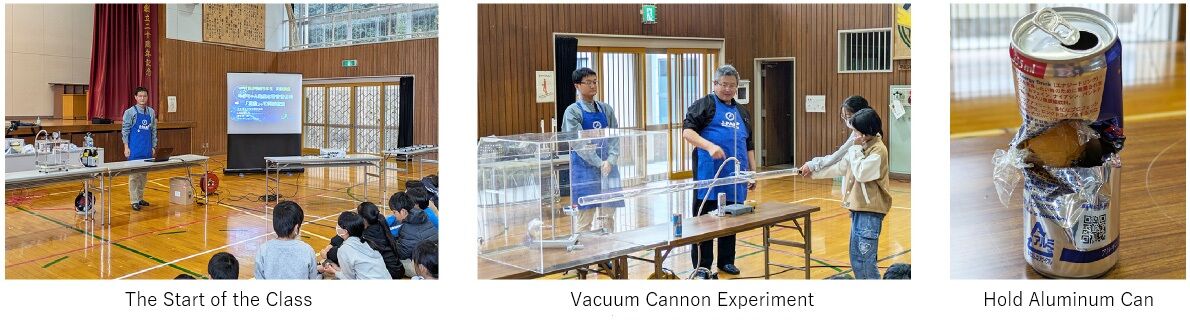
Dr. KAMIYA Junichiro from the Accelerator Division and Mr. YASU Toshiyuki from the Tokai Village Board of Education delivered a science class titled "What Is a Vacuum?" for 5th grade students.
The class began with experiments that helped students understand invisible air, such as floating a ping-pong ball above the nozzle of a hair dryer. They then carried out experiments to observe what happens to balloons, hot water, carbonated water, and marshmallows when they are in vacuum. The instructors also guided the lesson by asking questions such as "Why does a loud burglar alarm become silent when there is no air?"
At the end of the lesson, the students counted down as a ping-pong ball was launched into an aluminum can using a vacuum cannon.
The instructors also explained that at J-PARC, maintaining a vacuum is extremely important because air molecules can interfere with the proton beam and reduce its intensity.
 |
■Muographic Investigation of Ancient Burial Mounds in Tokai: Talks on Muon Imaging of Pyramids and Ancient Burial Mounds (November 30, Tokai Village Museum)
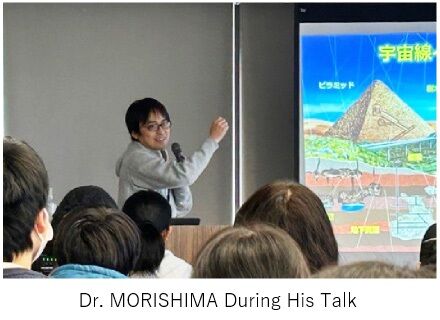
A total of 32 people - both children and parents - participated in the final session of the year. For this session, Dr. MORISHIMA Kunihiro, Associate Professor of Nagoya University, gave the lecture. He achieved major results in the international ScanPyramids project, conducted in collaboration with KEK researchers and other partners.
Dr. MORISHIMA and his research team at Nagoya University used cosmic-ray muons to visualize the interior of the Great Pyramid of Khufu, discovering a previously unknown large void without causing any damage to the structure. In his talk, he explained how nuclear emulsion plates, which detect muons, were installed inside the pyramid, how the recorded data are analyzed, and how muon imaging technology can be applied to various fields.
Following his talk, Mr. KUZUBA Masaya, a graduate student at Ibaraki University, introduced the results of their muon-based measurements of the Funatsuka No. 2 Burial Mound and outlined future plans for the project.
To conclude the session, participants gathered around a pot of Yamagata-style and Miyagi-style imoni stew prepared by the staff, enjoying warm food and conversation with one another.
 |
■J-PARC Sanpo-michi 65 : Winter Sunlight and Russian Olive
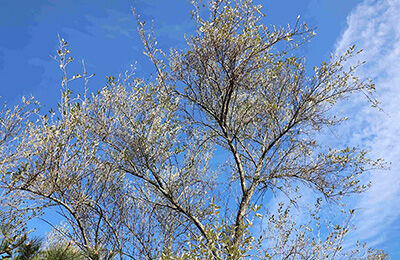
As Christmas approaches, Russian olive trees become more noticeable. While evergreen trees such as Kuromatsu (Japanese black pine), Tabunoki (Machilus thunbergii), and Sudajii (Japanese evergreen beech) stay covered with deep green leaves even in winter-almost as if they are trying to photosynthesize as much as possible-the Russian olive looks very different. In winter, it has only a small number of long, pale-green leaves, making its thin branches stand out clearly.
Russian olives are semi-deciduous, meaning they may lose their leaves depending on the surrounding conditions. The Russian olives on the J-PARC site have already dropped some of their leaves, and the remaining ones reflect sunlight strongly. The backs of the leaves are almost white, so when the winter sun shines from a low angle, the trees seem to shimmer with a silver glow. Because the branches are thin and light, even a small breeze makes the tree sway, and the reflected light flickers like soft Christmas decorations.
Despite their delicate appearance, Russian olives are surprisingly hardy. They tolerate heat, cold, and dry environments, grow well in well-drained soil, and resist pests. Although they may look fragile, they are actually strong and adaptable, and their presence on the J-PARC grounds appears to be gradually increasing.
 |