

"J-PARC Outreach Lecture" held in January 2025
◆◇◆ Takamatsu Campus, National Institute of Technology, Kagawa College (Monday, January 6, 2025) ◆◇◆
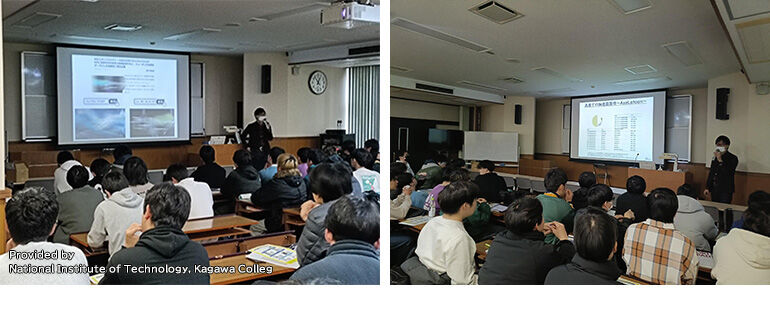
At Takamatsu Campus in National Institute of Technology, Kagawa College (hereinafter referred to as the College), Dr. OTANI Masashi of the Accelerator Division gave a lecture titled "The Mechanism of Accelerators that Reveal the Microscopic World: Muon Acceleration Technology that Reveals Everything from Elementary Particle Phenomena to Giant Structures" to about 100 fourth-year students.
In his lecture, he first explained the principles of accelerators and then introduced examples of accelerator applications, including medical applications. Next, he discussed elementary particle muons, which are used to discover the secret rooms of ancient pyramids and to see through inside volcanoes, and explained the latest technological developments and research being carried out using the large quantities of artificially produced muons at J-PARC. At the beginning of the lecture, he also introduced the songs "Atokata" and "Motto Hayaku" by the creative label Academimic, which aims to fuse the research that he supervises with pop culture.
At the end of the lecture, he also touched on the efforts being made at the College to build accelerators, and explained how the expertise and skills learned at the College contribute to the development of useful devices for society, including accelerators, based on his own experience as a graduate of National Institute of Technology. In the post-lecture questionnaire, comments such as "I wanted to hear more about the relationship between space and accelerators" were received, and it was clear that the audience was interested in the content of research using accelerators.
 |
◆◇◆ Tanaka Elementary School, Namekawa-City, Toyama (Wednesday, January 22, 2025) ◆◇◆
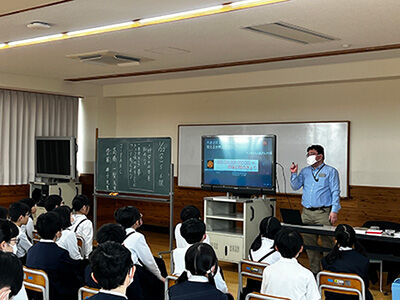
Mr. TAKAHASHI Kazutoshi, Radiation Control Section, gave a lecture on the theme of "Small Secrets of Big Universe" to about 40 children in the fourth grade.
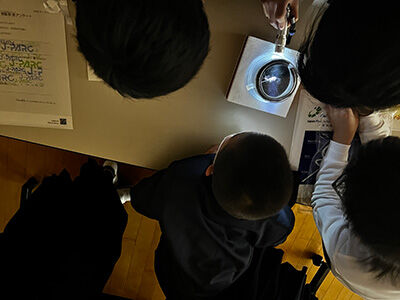
He gave a lecture about accelerators that aim for the edge of the small world. The children tried making a cloud chamber, a device that makes invisible radiation visible, and experienced the world of subatomic particles, the universe's little secrets.
 |
 |
◆◇◆ Ichige Elementary School, Hitachinaka City (Monday, January 27, 2025) ◆◇◆
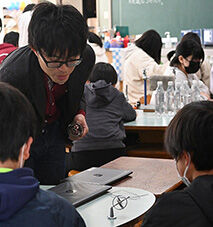
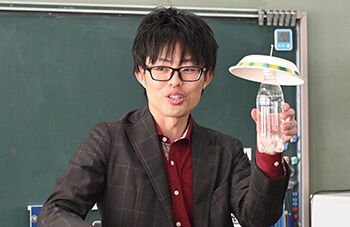
Dr. OTANI Masashi of the Accelerator Section Ⅶ was the lecturer on the topic "How to make a strange top that leans but doesn't fall over?" to about 80 children from two 6th grade classes at Ichige Elementary School.
Dr. OTANI explained elementary particle research at J-PARC using gyroscopes and self-assembled spinning tops. A top that continues to spin while tilted, and the axis of the top rotates with the top itself. This movement, known as precession, changes the direction of rotation of the axis when the center of gravity of the top is changed. Through the observation of the top, we hope that the students have been able to sense the existence of subatomic particles.
 |
 |
◆◇◆ National Institute of Technology, Nagano College (Friday, January 31, 2025) ◆◇◆
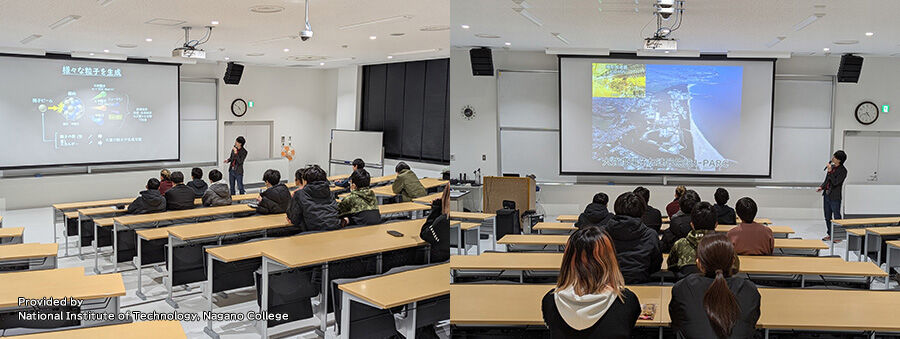
Dr. OTANI Masashi from the Accelerator Division gave a lecture titled "How an accelerator works to reveal the microscopic world - muon acceleration technology for probing particle phenomena to giant structures-" to about 20 students from grades 1 to 5.
The lecture began with an explanation of the principles of accelerators and followed by examples of their use, such as in medical applications. Next, the lecture covered elementary particles called muons, which have been used to discover hidden chambers in ancient pyramids and to image the interior of volcanoes. He then introduced research utilizing artificially produced high-intensity muons at J-PARC, as well as the latest technological developments and research advancements in this field.
 |