Applied research with proton beams

Moving to the next step by evolving the Transmutation Experimental Facility

The proton beam at J-PARC is primarily used for academic research in particle and nuclear physics, materials and life science, and so on. In terms of application, it can also contribute to aeras directly benefit our lives, such as the development of nuclear energy, pharmaceuticals, space technology, and semiconductors.
Based on the design of the "Transmutation Experiment Facility" that we have been developing, we are designing a new "Proton Beam Irradiation Facility" that will apply the proton beam to a variety of aeras.

Fig20260420_00

Overview of the Proton Beam Irradiation Facility

1. Nuclear Energy (Material Irradiation)

In accelerator facilities such as Accelerator-Driven nuclear transmutation Systems (ADS) and J-PARC, when protons and neutrons hit structural materials, material strength is reduced by radiation damage. Changes in material strength through proton and neutron irradiation can be evaluated in this facility, contributing to the stable operation of these nuclear-related facilities.
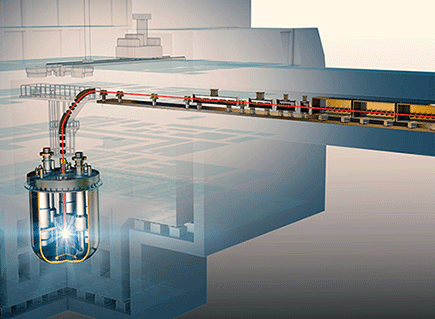
ADS_435s 

Accelerator-driven nuclear transmutation system (ADS)

Fig20260420_02m

An example of detoxification of radioactive materials through nuclear transmutation

2. Pharmaceuticals

Based on the Atomic Energy Commission's action plan, the Japan Atomic Energy Agency (JAEA) is working towards the production of medical radioactive isotopes (99Mo, 225Ac) at JAEA’s research reactors. Since J-PARC can also produce the same radioactive isotopes, collaboration with the research reactors will enable the establishment of a stable pharmaceutical supply system throughout the year. 

Fig1_e

Schematic diagram of medical radioisotope production using a proton beam

3. Semiconductors

Neutrons from space can cause malfunctions in semiconductor devices. Semiconductor devices will be irradiated with neutrons similar to cosmic rays to investigate the frequency of failures. These results will contribute to the development of semiconductors with higher neutron resistance.

Fig20260420_04

4. Space technology

In outer space, galactic cosmic rays and protons from solar flares can cause failures in semiconductor equipment onboard spacecraft. Semiconductor devices will be irradiated with protons to investigate the frequency of failures and gaining insights into developing semiconductor devices with high cosmic ray resistance, for contributing to space development.