<?xml version="1.0" encoding="UTF-8"?>
<feed xmlns="http://www.w3.org/2005/Atom">
    <title>Topics</title>
<link rel="alternate" type="text/html" href="index.html" />
    <link rel="self" type="application/atom+xml" href="atom.xml" />
    <id>tag:j-parc.jp,2019-02-26:/c/en/topics/8</id>
    <updated>2026-04-28T00:42:27Z</updated>
    

<entry>
    <title> J-PARC Project Newsletter No.102, April dispatch</title>
    <link rel="alternate" type="text/html" href="2026/04/27001797.html" />
    <id>tag:cms01.j-parc.jp,2026:/c/en/topics//8.1797</id>

    <published>2026-04-27T06:54:48Z</published>
    <updated>2026-04-28T00:42:27Z</updated>

    <summary>★☆--------------------------------------...</summary>
    <author>J-PARC</author>
    
        <category term="J-PARC Project Newsletter" />
    
    
    <content type="html" xml:lang="ja" xml:base="http://cms01.j-parc.jp/c/en/topics/">
        <![CDATA[<p>★☆<strong>-------------------------------------------------------------------------------------------------</strong></p>
<p><span>&nbsp;&nbsp;&nbsp;&nbsp; J-PARC Project Newsletter</span></p>
<p><span>&nbsp;&nbsp;&nbsp;&nbsp;&nbsp;&nbsp;&nbsp;&nbsp;&nbsp;&nbsp;&nbsp;&nbsp;&nbsp;&nbsp;&nbsp;&nbsp; &nbsp;&nbsp;&nbsp;&nbsp;&nbsp;&nbsp;&nbsp;&nbsp;&nbsp;&nbsp;&nbsp;&nbsp;&nbsp;&nbsp; No.102, April 2026</span>
<br /> Japan Proton Accelerator Research Complex under joint operation by the 
<br /> High Energy Accelerator Research Organization (KEK) and the Japan Atomic 
<br /> Energy Agency (JAEA) 
<br /> <a href="http://j-parc.jp/index-e.html" style="text-decoration: none;"><span color="blue" style="color: blue;">http://j-parc.jp/index-e.html</span></a>
<br /> <strong>-------------------------------------------------------------------------------------------------</strong>☆★</p>
<p>HEADLINES AND CONTENTS</p>
<p>1. [Overview] 
<br /> - STABLE OPERATION FROM LAST OCTOBER TO MARCH 
<br /> - MR SUCCEEDED IN A 1 MW DEMONSTRATION OF FAST EXTRACTION FOR NEUTRINO BEAM, A BIG MILESTONE TOWARD HYPER-KAMIOKANDE EXPERIMENT 
<br /> - TWO PROJECTS FROM J-PARC APPROVED UNDER THE SPACE STRATEGY FUND 
<br /> - INTERNATIONAL ADVISORY COMMITTEE WAS HELD 
<br /> &#10059; J-PARC has suspended operations since April 7 due to a fire that occurred at the 50 GeV substation. Further details will be provided in the next issue. </p>

<p>2. [Accelerator Division] 
<br /> - OPERATION STATUS OF THE ACCELERATORS 
<br /> - ACCELERATOR TECHNICAL ADVISORY COMMITTEE (A-TAC) MEETING WAS HELD 
<br /> - THE RCS BEAM COMMISSIONING GROUP, REPRESENTED BY DR. PRANAB KUMAR SAHA, HAS WON THE SUWA PRIZE </p>

<p>3. [Particle and Nuclear Physics Division] 
<br /> - PROGRAM ADVISORY COMMITTEE MEETING 
<br /> - ACHIEVEMENT OF STABLE 900 kW HIGH-POWER OPERATION AT THE NEUTRINO EXPERIMENTAL FACILITY AND THE INTERNATIONAL ADVISORY COMMITTEE MEETING TOWARD THE HYPER-KAMIOKANDE PROJECT  
<br /> - STATUS OF THE JSNS2 / JSNS2-II (SEARCH FOR STERILE NEUTRINOS AT J-PARC MLF, E56 / E82) 
<br /> - MAJOR HONORS FOR KEK/J-PARC RESEARCH: SUWA PRIZE FOR TWO PIONEER LEADERS OF RARE K DECAY EXPERIMENTS AND AWARD-WINNING RESULTS FROM THE J-PARC E40 EXPERIMENT 
<br /> - STATUS OF THE COMET EXPERIMENT
<br /> - STATUS OF THE MUON g-2/ELECTRIC DIPOLE MOMENT (EDM) (E34) </p>

<p>4. [Materials and Life Science Division] 
<br /> - NEUTRON SOURCE, CONTINUATION OF STABLE BEAM OPERATION 
<br /> - MLF ADVANCES TOWARD 2026A WITH NEW PROPOSAL CALL, ADVISORY REVIEWS, AND A SERIES OF KEY MEETINGS 
<br /> - DR. SHINOHARA TAKENAO OF THE NEUTRON SCIENCE SECTION AND COLLEAGUES RECEIVE THE KOSHIBA AWRAD 
<br /> - SYMPOSIUM AND WORKSHOP 
<br /> - MUON SCIENCE FACILITY (MUSE), MAC WAS HELD </p>

<p>&nbsp;5. [Nuclear Transmutation Division] 
<br /> - THE TECHNICAL ADVISORY COMMITTEE (T-TAC) MEETING WAS HELD </p>

<p>&nbsp;6. [Safety Division] 
<br /> - 10TH SYMPOSIUM ON SAFETY IN ACCELERATOR FACILITIES </p>

<p>&nbsp;7. [Outreach Activities] 


<p>&nbsp;8. [Editorial Note] 
<br /> PAST ISSUES ARE AVAILABLE FROM THE LINK BELOW. 
<br /> <a href="http://j-parc.jp/c/en/topics/project-newsletter/index.html" style="text-decoration: none"><font color="blue">http://j-parc.jp/c/en/topics/project-newsletter/index.html</font></a></p>
<p>&nbsp;</p>

<p><a name="overview"></a></p>
<p><a href="uploads/2023/overview_head_base.jpg" style="text-decoration: none;"><img alt="overview_Headms" src="uploads/2023/overview_Headms.jpg" width="900" height="290" /></a></p>
<p>☆<strong>-------------------------------------------------------------------------------------------------</strong>&hellip;
<br /> 1. [Overview] by KOBAYASHI Takashi 
<br /> &hellip;<strong>-------------------------------------------------------------------------------------------------</strong>★</p>
<p>-------------------------------------------------------------------------------------------------
<br /> STABLE OPERATION FROM LAST OCTOBER TO MARCH 
<br /> -------------------------------------------------------------------------------------------------</p>
<p>J-PARC has maintained stable user operations from October through March for both accelerators and experimental facilities following the summer maintenance period. All major facilities delivered beams reliably, supporting a wide range of scientific programs. This steady performance reflects continued improvements in operational efficiency and coordination across the complex. </p>
<p>&nbsp;</p>
<p>-------------------------------------------------------------------------------------------------
<br /> MR SUCCEEDED IN A 1 MW DEMONSTRATION OF FAST EXTRACTION FOR NEUTRINO BEAM, A BIG MILESTONE TOWARD HYPER-KAMIOKANDE EXPERIMENT  
<br /> -------------------------------------------------------------------------------------------------</p>
<p>The Main Ring (MR) successfully demonstrated 1 MW beam power with fast extraction for the neutrino beamline. This achievement represents a significant milestone toward the realization of the Hyper-Kamiokande experiment. It confirms both the technical readiness and the stability required for future high-power neutrino operations. </p>
<p>&nbsp;</p>
<p>-------------------------------------------------------------------------------------------------
<br /> TWO PROJECTS FROM J-PARC APPROVED UNDER THE SPACE STRATEGY FUND 
<br /> -------------------------------------------------------------------------------------------------</p>
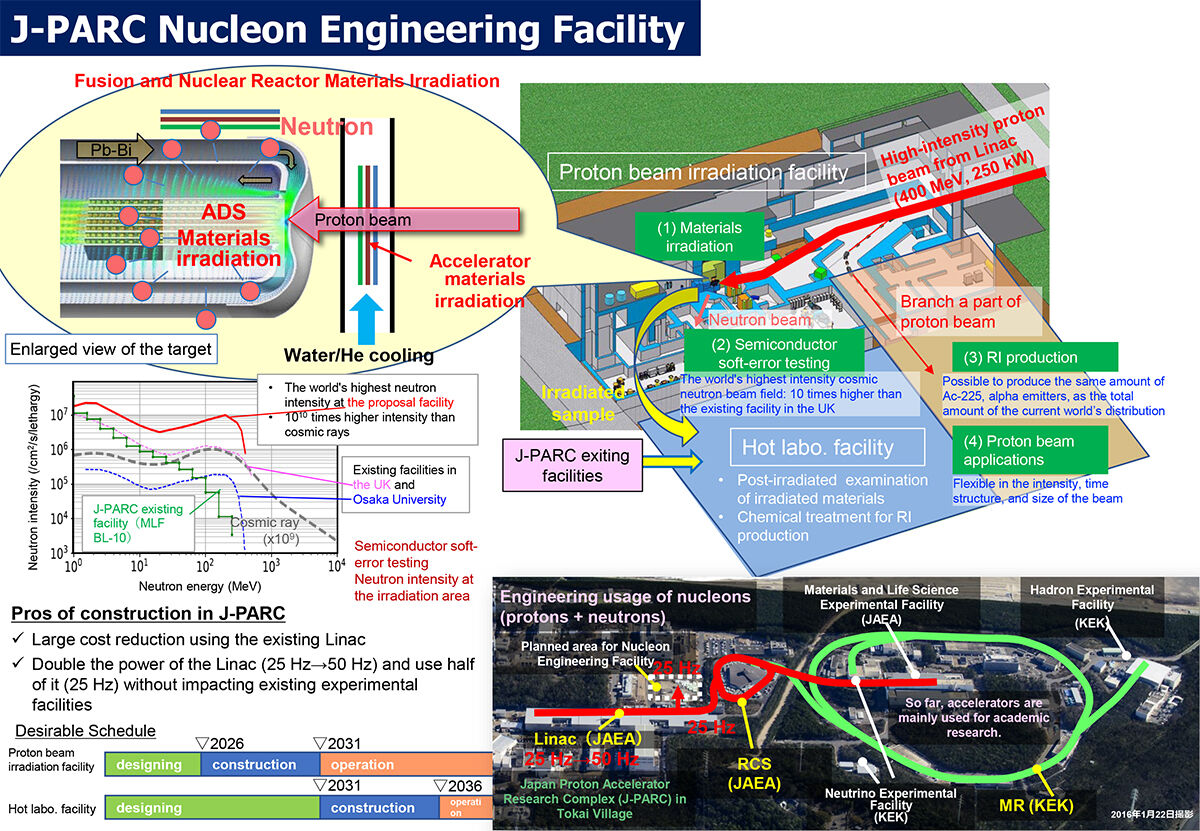
<p>Two proposals from J-PARC have been selected under Japan's Space Strategy Fund program. One project will establish a proton irradiation facility by branching the beam from the LINAC, while the other will construct a new proton beamline and irradiation facility in the hall of the Hadron Experimental Facility. Both projects aim to provide test environments for radiation-induced soft errors in semiconductors and electronic systems, supporting space and advanced technology applications. </p>
<p>&nbsp;</p>
<p>-------------------------------------------------------------------------------------------------
<br /> INTERNATIONAL ADVISORY COMMITTEE WAS HELD  
<br /> -------------------------------------------------------------------------------------------------</p>
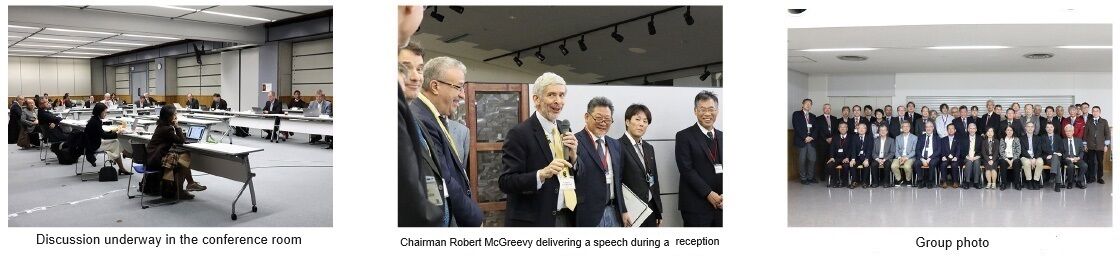
<p>The International Advisory Committee (IAC) meeting was held this year in a fully remote format, similar to the arrangement adopted during the COVID-19 period. External experts reviewed J-PARC's recent progress and future plans, providing valuable feedback on scientific priorities, facility upgrades, and long-term strategy. Their recommendations will contribute to shaping the next phase of J-PARC development. </p>

<p>&nbsp;</p>
<p><a name="ACC"></a></p>
<p align="left"><a href="https://j-parc.jp/c/en/topics/uploads/2023/Accelerator_haeds.jpg" style="text-decoration: none;"><img alt="Accelerator_haedms" src="https://j-parc.jp/c/en/topics/uploads/2023/Accelerator_haedms.jpg" width="900" height="290" /></a></p>
<p>☆<strong>-------------------------------------------------------------------------------------------------</strong>&hellip;
<br /> 2. [Accelerator Division] by YAMAMOTO Kazami 
<br /> &hellip;<strong>-------------------------------------------------------------------------------------------------</strong>★</p>
<p>-------------------------------------------------------------------------------------------------
<br /> OPERATION STATUS OF THE ACCELERATORS  
<br /> -------------------------------------------------------------------------------------------------</p>
<p>After the New Year's holiday, beam commissioning resumed on January 9 as part of Run #93, which began in October. The user program for the Materials and Life Science experimental Facility (MLF) restarted on January 15, followed by the Neutrino Facility (NU) on January 22nd. The user program for the Materials and Life Science experimental Facility (MLF) restarted on January 15th, followed by the Neutrino Facility (NU) on January 22.The beam power was approximately 700 kW for the MLF and 900 kW for the NU. User operations at both facilities proceeded smoothly and are scheduled to continue until March 25. After the completion of the user run, maintenance work will be carried out on the accelerators. In addition, MR successfully demonstrated a 1 MW beam acceleration for NU. </p>
<p>&nbsp;</p>
<p>-------------------------------------------------------------------------------------------------
<br /> ACCELERATOR TECHNICAL ADVISORY COMMITTEE (A-TAC) MEETING WAS HELD  
<br /> -------------------------------------------------------------------------------------------------</p>
<p>The 25th A TAC meeting (<a href="https://j-parc.jp/c/en/forum-and-committee/a-tac-e.html" style="text-decoration: none"><font color="blue">https://j-parc.jp/c/en/forum-and-committee/a-tac-e.html</font></a>) was held from February 12 to 14 in a hybrid format, with most members participating on-site. (Seven of the nine committee members attended in person.) The main topics of discussion were the accelerator status and the responses to previous recommendations. The committee also noted J PARC's steady progress, including high power MR operation, while emphasizing the need to strengthen engineering resources and enhance cross divisional collaboration to support future reliability and upgrades. </p>
<p>&nbsp;</p>
<p>-------------------------------------------------------------------------------------------------
<br /> THE RCS BEAM COMMISSIONING GROUP, REPRESENTED BY DR. PRANAB KUMAR SAHA, HAS WON THE SUWA PRIZE   
<br /> -------------------------------------------------------------------------------------------------</p>
<p>The RCS Beam Commissioning Group, represented by Dr. SAHA Pranab Kumar, has been awarded the Suwa Prize by the Foundation for High Energy Accelerator Science (FAS). The award recognizes the group's significant contributions to the stable operation of the J-PARC RCS. Through rigorous beam simulations and systematic experiments, the group successfully minimized beam emittance and beam losses during the 1 MW operation of the MLF, thereby significantly increasing the beam power in the Main Ring. These achievements were published in Physical Review Accelerators and Beams (selected as an Editors' Suggestion) and have garnered international recognition. 
<br /><a href="https://www.j-parc.jp/c/en/topics/2026/03/11001783.html" style="text-decoration: none"><font color="blue">https://www.j-parc.jp/c/en/topics/2026/03/11001783.html</font></a></p>


<p>&nbsp;</p>
<p><a name="NU"></a> <a href="uploads/2023/Nu_heads.jpg" style="text-decoration: none;"><img alt="Nu_headms" src="uploads/2023/Nu_headms.jpg" width="900" height="290" /></a></p>
<p>☆<strong>-------------------------------------------------------------------------------------------------</strong>&hellip;
<br /> 3. [Particle and Nuclear Physics Division] 
<br /> &hellip;<strong>-------------------------------------------------------------------------------------------------</strong>★</p>
<p>-------------------------------------------------------------------------------------------------
<br /> PROGRAM ADVISORY COMMITTEE MEETING (by NAKADAIRA Takeshi) 
<br /> -------------------------------------------------------------------------------------------------</p>
<p>The 41st Program Advisory Committee (PAC) meeting was held on January 21-23, 2026. Updates were provided on the status of J-PARC accelerator operations following the summer maintenance in 2025, prospects for Main Ring (MR) beam power improvements, and the status of experiments along with plans for operations leading up to summer 2026. A summary of experimental proposals for the coming years was also presented. 
<br /><br />This time, one proposal was submitted. 
<br />Details can be found at the following link: 
<br /><a href="https://kds.kek.jp/event/58237/" style="text-decoration: none" target="_blank"><font color="blue">https://kds.kek.jp/event/58237/</font></a>
<br /><br />The PAC report will be available on the following webpage:
<br /><a href="https://j-parc.jp/researcher/Hadron/en/PAC_for_NuclPart_e.html" style="text-decoration: none" target="_blank"><font color="blue">https://j-parc.jp/researcher/Hadron/en/PAC_for_NuclPart_e.html</font></a>
<br /><br />The next PAC meeting is scheduled to be held in July 2026. </p>
<p>&nbsp;</p>


<p>-------------------------------------------------------------------------------------------------
<br /> ACHIEVEMENT OF STABLE 900 kW HIGH-POWER OPERATION AT THE NEUTRINO EXPERIMENTAL FACILITY AND THE INTERNATIONAL ADVISORY COMMITTEE MEETING TOWARD THE HYPER-KAMIOKANDE PROJECT (by ISHIDA Taku)  
<br /> -------------------------------------------------------------------------------------------------</p>
<p>The Neutrino Experimental Facility had been operating at 750 kW until December 2025. In January 2026, the repetition cycle was shortened from 1.36 s to 1.28 s, enabling higher repetition-rate operation. As a result, acceleration of 2.4 × 10<sup>14</sup> protons per pulse--representing a world record for a synchrotron--enabled operation at 900 kW, which is the upper limit acceptable for the current target system. From late November 2025 to March 2026, the beamline achieved an operational availability of 85%, providing highly stable data acquisition. This achievement represents an important step toward long-term stable operation at the MW-class level and contributes to strengthening the foundation for the realization of the Hyper-Kamiokande project, scheduled to start in JFY2028. 
<br />Upgrades to the beamline system required for 1.3 MW operation--including improvements to remote maintenance in the final focusing magnet section, the target and its cooling system, and the secondary beamline cooling water system--are scheduled for summer 2026. 
<br />To discuss the validity of these upgrade plans and technical challenges toward MW-class beam operation, such as optimization of replacement cycles for the target and beam window, an International Advisory Committee meeting was held on February 16-17, 2026. During the meeting, valuable comments were provided by committee members with extensive experience in the operation of high-power target facilities worldwide. </p>
<p>&nbsp;</p>
<p>-------------------------------------------------------------------------------------------------
<br /> STATUS OF THE JSNS2 / JSNS2-II (SEARCH FOR STERILE NEUTRINOS AT J-PARC MLF, E56 / E82) (by MARUYAMA Takasumi) 
<br /> -------------------------------------------------------------------------------------------------</p>
<p>The JSNS2 (E56) / JSNS2-II (E82) collaboration investigates the anomaly reported by the LSND experiment, namely the observed excess of electron antineutrinos, through a direct measurement at the J-PARC Materials and Life Science Experimental Facility (MLF). 
<br />Data taking with both the near detector, located on the third floor of the MLF, and the far detector, installed outside the MLF building, has been ongoing since November 2025. As of 12 March 2026, new physics data corresponding to 9.088×10<sup>21</sup> Proton-On-Target (POT) have been accumulated for the near detector. This already corresponds to approximately 19% of the total data accumulated between 2021 and 2024. The current run is scheduled to continue until June 2026. 
<br />In parallel with the ongoing data-taking efforts, we have also presented and published the first results of our studies based on data collected in 2022 (<a href="http://arxiv.org/abs/2602.06274" style="text-decoration: none" target="_blank"><font color="blue">http://arxiv.org/abs/2602.06274</font></a>). The new far detector is currently in the commissioning phase. Analysis of the beam commissioning data indicates that the rate of beam-induced neutrons is higher than expected. To mitigate this issue, effective passive shielding is being investigated through various measurements. </p>
<p>&nbsp;</p>
<p>-------------------------------------------------------------------------------------------------
<br /> MAJOR HONORS FOR KEK/J-PARC RESEARCH: SUWA PRIZE FOR TWO PIONEER LEADERS OF RARE K DECAY EXPERIMENTS AND AWARD-WINNING RESULTS FROM THE J-PARC E40 EXPERIMENT (by NOMURA Tadashi and TAKAHASHI Hitoshi)   
<br /> -------------------------------------------------------------------------------------------------</p>
<p>Researchers and experiments at KEK and J-PARC have recently received significant recognition from the scientific community for their contributions to particle and nuclear physics. Two pioneer leaders of rare kaon decay experiments were awarded the 2025 Suwa Prize, honoring their long-standing leadership and groundbreaking work in the field. In addition, the J-PARC E40 experiment was honored with the 31st Outstanding Paper Award from the Physical Society of Japan, recognizing the impact of its published results. Together, these achievements highlight the continued global influence of KEK and J-PARC in advancing our understanding of fundamental particles and interactions. 
<br />The KOTO experiment at the Hadron Experimental Facility is the world-leading experiment dedicated to searching for the CP-violating rare kaon decay, where a long-lived neutral kaon decays to a neutral pion and a neutrino-antineutrino pair. Although the decay mode is attractive because the theoretical uncertainty of the branching ratio is small, and thus it can be a good probe to study physics beyond the Standard Model, realization of the experiment had been thought to be extremely difficult. However, two pioneer leaders and their experimental teams have successfully realized it. 
<br />The first dedicated experiment to search for the KL→&#960;0&#957;&#957; decay was conducted at KEK 12 GeV proton synchrotron by KEK E391a group in the early 2000s, led by Professor Takao Inagaki (KEK). He brought unique ideas for the experiment, such as a thin neutral beam, a hermetic veto system that ensures no extra particle other than two photons from &#960;0 decay, and a differential pumping scheme that enables a clean vacuum at a level of 1e-5 Pa separated by a thin film from a low vacuum region (～0.1 Pa) for the detectors. 
<br />Its successor is the KOTO experiment, led by Professor Taku Yamanaka (University of Osaka), utilizing the high intensity proton beam at J-PARC. He has been a world leader of kaon physics through the KTeV experiment at Fermi National Laboratory in the U.S. and introduced the high-resolution electromagnetic calorimeter based on ~2700 undoped CsI crystals used in KTeV to KOTO. Under his leadership, KOTO achieved the world-best sensitivity of the search, which corresponds to more than an order of magnitude improvement of the world record. 
<br />In recognition of the establishment of an innovative experimental method to study the KL→&#960;0&#957;&#957; decay and long-term contributions to the new physics search, professors emeritus T. Inagaki and T. Yamanaka received Suwa Prize of the year 2025 (by Foundation for High Energy Accelerator Science). The awards ceremony was held on February 27, 2026. 
<br />KOTO continues accumulating data for several years toward another order of magnitude improvement, seeking a signature of new physics. 
<br />A paper published by the J-PARC E40 experiment has received the 31st Outstanding Paper Award of the Physical Society of Japan. 
<br />The E40 experiment was conducted at the K1.8 beamline of the Hadron Experimental Facility with the aim of performing high-statistic measurements of hyperon-nucleon scattering. 
<br />The award-winning paper reports the measurement results for the differential cross section of elastic scattering between Sigma+ hyperons and protons with a statistical precision 100 times greater than that of previous experiments. 
<br />Through phase analysis, it derived the magnitude of the repulsive force between the two particles for the first time in the world, representing a highly significant achievement in elucidating the origin of the repulsive core of the nuclear force. 
<br />See the paper: T. Nanamura et al, "Measurement of differential cross sections for Sigma+p elastic scattering in the momentum range 0.44-0.80 GeV/c," Prog. Theor. Exp. Phys. 2022, 093D01. <a href="https://doi.org/10.1093/ptep/ptac101" style="text-decoration: none" target="_blank"><font color="blue">https://doi.org/10.1093/ptep/ptac101</font></a> </p>
<p>&nbsp;</p>
<p>-------------------------------------------------------------------------------------------------
<br /> STATUS OF THE COMET EXPERIMENT (by FUKAO Yoshinori)  
<br /> -------------------------------------------------------------------------------------------------</p>
<p>Construction of the COMET experiment, which aims to search for muon-to-electron conversion with a Phase-I sensitivity of 10<sup>-14</sup> or better, is underway.  
<br />Installation of the detector solenoid magnet (DS) and the bridge solenoid (BS) was successfully completed last December, thanks to the great efforts of the J-PARC cryogenic section. With their completion, all superconducting magnets for COMET Phase-I are now present in the experimental hall. The DS and BS, as well as the muon transport solenoid (MTS), have been cooled down as expected, and their commissioning to reach the designed operating current is in progress. This series of activities will be followed by a campaign of magnetic field measurements inside the DS, which is one of the important milestones toward the physics measurements. Detector assembly and operation tests are also being continuously carried out at J-PARC in preparation for installation into the DS later this year. 
<br />The 48th collaboration meeting was held at Yokohama National University (YNU) in March. The experimental status and technical issues were presented and discussed in order to accomplish the construction in an optimized configuration. An impressive discussion on theoretical aspects was also held since one of the theory groups in the COMET collaboration is affiliated with YNU. </p>
<p>&nbsp;</p>
<p>-------------------------------------------------------------------------------------------------
<br /> STATUS OF THE MUON g-2/ELECTRIC DIPOLE MOMENT (EDM) (E34) (by MIBE Tsutomu)   
<br /> -------------------------------------------------------------------------------------------------</p>
<p>The E34 collaboration aims for precision measurements of the muon anomalous magnetic moment and its electric dipole moment. 
<br />The collaboration carried out the commissioning of the surface muon beam in the MLF H line. Silicon strip detectors, which will be used as positron tracking detectors, were installed in the muonium hyperfine structure measurement experiment (MuSEUM), and data acquisition of positrons from muon decay was performed for its evaluation. In November, tests and performance evaluations of the Ultra-slow muon Diagnostic Line (UDL) were carried out in the S2 area, confirming its basic performance. In December, the system was moved to the H2 area. In parallel, the group prepared the laser system for muonium ionization using a Lyman-α laser. By the end of December, the collaboration had successfully generated, ionized, and extracted muonium in the H2 area. Since then, the muon source has been reconfigured so that it can be connected to the RF accelerating cavity. In parallel, preparations for the operation of the RFQ accelerating cavities are underway. In the future, we plan to test the ultra-cold muon source and to demonstrate RF acceleration up to an energy of 0.3 MeV in the 2026A period. A research group from INFN (Italy) and Osaka Metropolitan University has newly joined the collaboration. </p>

<p>&nbsp;</p>
<p><a name="MLF"></a></p>
<p><a href="https://j-parc.jp/c/en/topics/uploads/2023/MLF_heads.jpg" style="text-decoration: none;"><img alt="MLF_HEadms" src="https://j-parc.jp/c/en/topics/uploads/2023/MLF_HEadms.jpg" width="900" height="290" /></a></p>
<p>☆<strong>-------------------------------------------------------------------------------------------------</strong>&hellip;
<br /> 4. [Materials and Life Science Division] 
<br /> &hellip;<strong>-------------------------------------------------------------------------------------------------</strong>★</p>
<p>-------------------------------------------------------------------------------------------------
<br /> NEUTRON SOURCE, CONTINUATION OF STABLE BEAM OPERATION (by HARADA Masahide)    
<br /> -------------------------------------------------------------------------------------------------</p>
<p>Beam operation at the MLF resumed at 780 kW on October 30, 2025. The beam power was adjusted to 710 kW on November 27 due to a change in the MR accelerator mode. Although issues occurred in the cooling water system and the cryogenic system of the neutron source during the beam operation, they were resolved through several measures. As of the end of March 2026, the beam operation has continued, following a brief shutdown over the New Year holiday period. The neutron source has maintained excellent operational stability, achieving a facility availability of over 92%. 
<br />Finally, from January 26 to 29, 2026, a joint workshop on neutron sources was held at J-PARC with the Spallation Neutron Source (SNS) group of Oak Ridge National Laboratory (ORNL). In-depth discussions were conducted on operational status, technical issues, research and development activities, and future research collaboration related to the neutron source. </p> 
<p>&nbsp;</p>
<p>-------------------------------------------------------------------------------------------------
<br /> MLF ADVANCES TOWARD 2026A WITH NEW PROPOSAL CALL, ADVISORY REVIEWS, AND A SERIES OF KEY MEETINGS (by NAKAMURA Mitsutaka)   
<br /> -------------------------------------------------------------------------------------------------</p>
<p>The call for neutron general proposals for the 2026A cycle has opened. The general proposal category covers short-term experimental assignments, including one year proposals. A total of 324 applications were submitted for neutron experiments alone, which is almost the same as the average in recent cycles. In the 2025B term, the MLF call was open only to domestic users, as the available beam time was quite limited. Proposals originating from overseas accounted for 54% of the total, which was roughly the same proportion as in 2025A. All programs were reviewed at the MLF Advisory Board on March 10. 
<br /><br />Report on Meetings and Other Events: 
<br />&#149; Neutron Advisory Committee (NAC), February 16-18 
<br /><a href="https://kds.kek.jp/event/58692/" style="text-decoration: none" target="_blank"><font color="blue">https://kds.kek.jp/event/58692/</font></a>
<br /><br />Reports were presented on the development status of neutron beamlines, detectors, and sample environments, as well as on industrial applications. Committee members provided advice on data utilization and on the roadmap for future progress. 
<br /><br />Recent press release from Neutron Science at MLF: 
<br />BL15 and BL18 on Feb. 27 "Multiscale Insights into Sodium Storage in Hard Carbon from Operando Small- and Wide-Angle Neutron Scattering Measurements"  
<br /><a href="https://doi.org/10.1038/s41586-025-09633-4" style="text-decoration: none" target="_blank"><font color="blue">https://doi.org/10.1038/s41586-025-09633-4</font></a>
<br />BL21 on Feb. 17 "Superprotonic Conduction in Donor Co-Doped Perovskites" 
<br /><a href="https://doi.org/10.1002/anie.202521773" style="text-decoration: none" target="_blank"><font color="blue">https://doi.org/10.1002/anie.202521773</font></a>
<br />BL21 and S1 on Jan. 19 "Frustrated random-singlet state with ice-type structural fluctuation in spinel titanates" 
<br /><a href="https://doi.org/10.1073/pnas.2517926123" style="text-decoration: none" target="_blank"><font color="blue">https://doi.org/10.1073/pnas.2517926123</font></a></p>
<p>&nbsp;</p>
<p>-------------------------------------------------------------------------------------------------
<br /> DR. SHINOHARA TAKENAO OF THE NEUTRON SCIENCE SECTION AND COLLEAGUES RECEIVE THE KOSHIBA AWRAD (by NAKAMURA Mitsutaka) 
<br /> -------------------------------------------------------------------------------------------------</p>
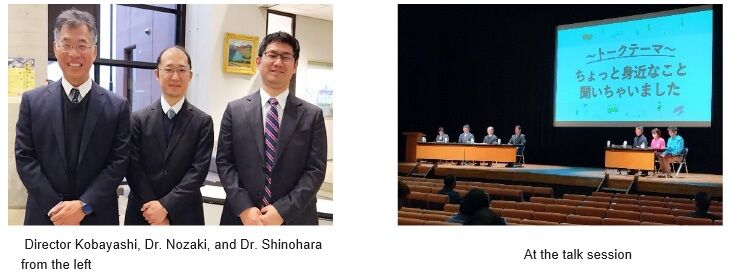
<p>Dr. SHINOHARA Takenao (J-PARC MLF) and Dr. KATO Satoru and colleagues (Toyota Central R&D Labs., Inc.) received the FY2025 Koshiba Award for "Establishment of multiphase transport visualization methods using energy-selective neutron imaging". They developed an advanced neutron imaging technique to distinguish and visualize water and ice inside operating fuel cells at sub-zero temperatures at BL22 RADEN. 
<br /><a href="https://www.j-parc.jp/c/en/topics/2026/03/11001784.html" style="text-decoration: none"><font color="blue">https://www.j-parc.jp/c/en/topics/2026/03/11001784.html</font></a></p>
<p>&nbsp;</p>
<p>-------------------------------------------------------------------------------------------------
<br /> SYMPOSIUM AND WORKSHOP 
<br /> -------------------------------------------------------------------------------------------------</p>
<p>&#149; FY2025 Quantum Beam Science Festa (QBSF) and 17th MLF Symposium, March 12-13 in Mito 
<!-- <br /><a href="https://www2.kek.jp/imss/qbsf/2025/" style="text-decoration: none" target="_blank"><font color="blue">https://www2.kek.jp/imss/qbsf/2025/</font></a> -->
<br />At the MLF Symposium held on March 13, facility reports, presentations on recent achievements, and the general meeting of the J-PARC MLF Users Society took place. 
<br />&#149; 2nd MLF Roadmap Workshop, March 14 in Mito 
<!-- <br /><a href="https://kds.kek.jp/event/58498/" style="text-decoration: none" target="_blank"><font color="blue">https://kds.kek.jp/event/58498/</font></a> -->
<br />Group discussions were conducted across a wide range of scientific and technical fields. </p>
<p>&nbsp;</p>
<p>-------------------------------------------------------------------------------------------------
<br /> MUON SCIENCE FACILITY (MUSE), MAC WAS HELD（by KAWAMURA Naritoshi) 
<br /> -------------------------------------------------------------------------------------------------</p>
<p>Beam operation is proceeding smoothly following the scheduled shutdown over the New Year's holiday period. 
<br />In the Muon Science Proposal Review Committee (MSPRC) meeting, 46 proposals submitted for the 2026A period, including 5 KEK IMSS S2-type proposals, were reviewed, resulting in 38 approved and 8 reserved. 
<br />The Muon Advisory Committee (MAC) meeting was held from January 26 to 27, chaired by Prof. Klaus Kirch of the Paul Scherrer Institute (PSI): <a href="https://kds.kek.jp/event/57889/" style="text-decoration: none" target="_blank"><font color="blue">https://kds.kek.jp/event/57889/</font></a>. 
<br />The facility staff reported the progress in the target system and each beamline. In addition, during the session on prospects for the MLF, discussions were held regarding the MLF-double project, which aims to maximize the results of the current first target station and the second target station (MLF-TS2) project. After two days of thorough discussion, the committee provided us with valuable recommendations. Based on these recommendations, we will strive to ensure stable operations next fiscal year and advance the plans. 
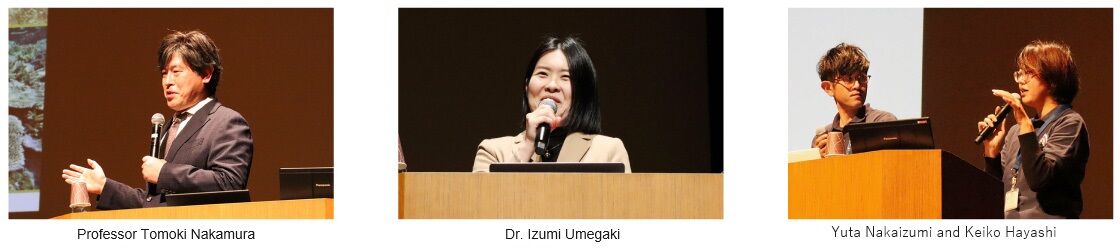
<br />Dr. UMEGAKI Izumi received the 2026 Fumiko Yonezawa Memorial Award of the Physical Society of Japan for her work on "Application of muon beam to Li-ion battery research": 
<br /><a href="https://www.jps.or.jp/english/meetings-and-awards/awards/yonezawa/yonezawa7-2026e.html" style="text-decoration: none" target="_blank"><font color="blue">https://www.jps.or.jp/english/meetings-and-awards/awards/yonezawa/yonezawa7-2026e.html</font></a>. </p>


<p>&nbsp;</p>
<p><a name="NTD"></a></p>
<p>☆<strong>-------------------------------------------------------------------------------------------------</strong>&hellip;
<br /> 5. [Nuclear Transmutation Division] by MAEKAWA Fujio  
<br /> &hellip;<strong>-------------------------------------------------------------------------------------------------</strong>★</p>
<p>-------------------------------------------------------------------------------------------------
<br /> THE TECHNICAL ADVISORY COMMITTEE (T-TAC) MEETING WAS HELD  
<br /> -------------------------------------------------------------------------------------------------</p>
<p> The 11th TEF (Transmutation Experimental Facility) Technical Advisory Committee (T-TAC) meeting was held at the J-PARC Research Building on February 2-3, 2026. Three foreign and two Japanese committee members gathered to review the current progress of planning the Proton Beam Irradiation Facility, an advanced concept of TEF, and related research and development (R&D) studies. At the meeting, after an overview of J-PARC, division staff introduced their activities in two sessions: the facility design update session and the R&D activities session. On the second day, the meeting concluded with a summary talk by the chair, followed by a site tour. 
<br />On February 24, 2026, we received the final T-TAC report, which included 27 observations, 28 comments, and a general conclusion. T-TAC provided positive statements such as, "In its current form, the project demonstrates the capacity to deliver tangible impact in the short term while preserving the flexibility required to accommodate longer-term developments." 
<br /><a href="https://j-parc.jp/c/en/forum-and-committee/t-tac-e.html" style="text-decoration: none"><font color="blue">https://j-parc.jp/c/en/forum-and-committee/t-tac-e.html</font></a></p>

<p>&nbsp;</p>
<p><a name="SD"></a></p>
<p>☆<strong>-------------------------------------------------------------------------------------------------</strong>&hellip;
<br /> 6. [Safety Division] by BESSHO Kotaro, KASUGAI Yoshimi
<br /> &hellip;<strong>-------------------------------------------------------------------------------------------------</strong>★</p>
<p>-------------------------------------------------------------------------------------------------
<br /> 10TH SYMPOSIUM ON SAFETY IN ACCELERATOR FACILITIES 
<br /> -------------------------------------------------------------------------------------------------</p>
<p>The 10th Symposium on Safety in Accelerator Facilities was held on January 29 at the Tokai-mura Industry and Information Plaza (iVil) with 71 participants in a face-to-face format.
The topics of the workshop were the current status and challenges in online education for radiation safety and heatstroke prevention measures at accelerator facilities. Seven accelerator facilities introduced their circumstances and approaches to address these issues. In addition, 14 posters highlighting various safety initiatives were displayed, and the coffee break provided an opportunity for information exchange and networking. It is expected that the information shared will be effectively utilized to improve safety at each facility. </p>
<p>&nbsp;</p>
<p><a name="Outreach"></a></p>
<p>☆<strong>-------------------------------------------------------------------------------------------------</strong>&hellip;
<br /> 7. [Outreach Activities]  
<br /> &hellip;<strong>-------------------------------------------------------------------------------------------------</strong>★</p>


<p>&#9733; Outreach Lecture at the National Institute of Technology, Ibaraki College (December 24) 
<!-- <p> -1-  </p> -->
<br /><a href="https://www.j-parc.jp/c/en/topics/2026/02/27001761.html#BNo6" style="text-decoration: none"><font color="blue">https://www.j-parc.jp/c/en/topics/2026/02/27001761.html</font></a>
<br />
<!-- <p> -2-  </p> -->
<br />&#9733; Outreach Lecture at Yokoshibahikari Town Community Center, Sambu District, Chiba Prefecture (January 17) 
<br /><a href="https://www.j-parc.jp/c/en/topics/2026/02/03001732.html#BNo01" style="text-decoration: none"><font color="blue">https://www.j-parc.jp/c/en/topics/2026/02/03001732.html</font></a> 
<br />
<!-- <p> -3-  </p> -->
<br />&#9733; Outreach Lecture at Muramatsu Elementary School, Tokai Village (January 27) 
<br /><a href="https://www.j-parc.jp/c/en/topics/2026/02/03001732.html#BNo02" style="text-decoration: none"><font color="blue">https://www.j-parc.jp/c/en/topics/2026/02/03001732.html</font></a> 
<br />
<!-- <p> -4-  </p> -->
<br />&#9733; Outreach Lecture at Nagi Junior High School, Nagi Town, Okayama Prefecture (February 6) 
<br /><a href="https://www.j-parc.jp/c/en/topics/2026/02/10001733.html#BNo260206" style="text-decoration: none"><font color="blue">https://www.j-parc.jp/c/en/topics/2026/02/10001733.html</font></a> 
<br />
<!-- <p> -5-  </p> -->
<br />&#9733; Kojima Children's Science Park (February 21) 
<br /><a href="https://www.j-parc.jp/c/en/topics/2026/04/27001796.html#BNo7" style="text-decoration: none"><font color="blue">https://www.j-parc.jp/c/en/topics/2026/04/27001796.html</font></a> 
<br />
<!-- <p> -6-  </p> -->
<br />&#9733; Outreach Lecture at Ishigami Elementary School (February 26) 
<br /><a href="https://www.j-parc.jp/c/en/topics/2026/04/17001785.html#BNo260226" style="text-decoration: none"><font color="blue">https://www.j-parc.jp/c/en/topics/2026/04/17001785.html</font></a> 
<br />
<!-- <p> -7-  </p> -->
<br />&#9733; Sakurie Science Festival (March 14) 
<br /><a href="https://www.j-parc.jp/c/en/topics/2026/04/27001796.html#BNo6" style="text-decoration: none"><font color="blue">https://www.j-parc.jp/c/en/topics/2026/04/27001796.html</font></a> 
<br />
<!-- <p> -8-  </p> -->
<br />&#9733; Muographic Investigation of Ancient Burial Mounds in Tokai: Summary of Activities in 2025 (March 15) 
<br /><a href="https://www.j-parc.jp/c/en/topics/2026/04/27001796.html#BNo8" style="text-decoration: none"><font color="blue">https://www.j-parc.jp/c/en/topics/2026/04/27001796.html</font></a>
</p> 

<p>&nbsp;</p>
<p><a name="ED"></a></p>
<p>☆<strong>-------------------------------------------------------------------------------------------------</strong>&hellip;
<br /> 8. [Editorial Note] 
<br /> &hellip;<strong>-------------------------------------------------------------------------------------------------</strong>★</p>
<p>&nbsp; Past issues are available from the link below.  
<br />&nbsp; <a href="http://j-parc.jp/c/en/topics/project-newsletter/index.html" style="text-decoration: none"><font color="blue">http://j-parc.jp/c/en/topics/project-newsletter/index.html</font></a>

<p>&nbsp;</p>
<p><strong>┏----&hellip;----&hellip;----&hellip;----&hellip;----&hellip;----&hellip;----&hellip;----&hellip;----&hellip;----&hellip;----&hellip;----&hellip;☆</strong> 
<br /> <strong>┃</strong> Editorial Board: 
<br /> <strong>┃</strong> OGURI Hidetomo (Chair) : oguri.hidetomo[at]jaea.go.jp 
<br /> <strong>┃</strong> SHOBUDA Yoshihiro: yoshihiro.shobuda[at]j-parc.jp
<br /> <strong>┃</strong> OZAWA Kyoichiro: ozawa[at]post.kek.jp 
<br /> <strong>┃</strong> MARUSAWA Machiko: machiko[at]post.kek.jp 
<br /> <strong>┃</strong> Bruce YEE-RENDON: byee[at]post.j-parc.jp 
<br /> <strong>┃</strong> OGAWA China (Secretary) : ogawa.china[at]jaea.go.jp 
<br /> <strong>┃</strong> * Please replace "(at)" with "@" when you enter an email address.
<br /> <strong>★----&hellip;----&hellip;----&hellip;----&hellip;End of Letter&hellip;----&hellip;----&hellip;----&hellip;----&hellip;----</strong></p>
<p>&nbsp;</p>]]>
        
    </content>
</entry>

<entry>
    <title>J-PARC News March 2026 (Issue#251)</title>
    <link rel="alternate" type="text/html" href="2026/04/27001796.html" />
    <id>tag:cms01.j-parc.jp,2026:/c/en/topics//8.1796</id>

    <published>2026-04-27T04:57:10Z</published>
    <updated>2026-04-27T06:11:40Z</updated>

    <summary> ■Award Awarded the 15th High Energy Acc...</summary>
    <author>J-PARC</author>
    
        <category term="J-PARC News" />
    
    
    <content type="html" xml:lang="ja" xml:base="http://cms01.j-parc.jp/c/en/topics/">
        <![CDATA[<a name="BNo1"></a>
<p><strong><span style="color: #0000ff; font-family: arial, helvetica, sans-serif;">■Award
<br />Awarded the 15th High Energy Accelerator Science Research Encouragement Awards: Koshiba Award and Suwa Award (February 27) </strong>
<br />Researchers including Dr. SHINOHARA Takenao from the Neutron Science Section were awarded the Koshiba Award, and researchers including Dr. SAHA Pranab Kumar from the Accelerator Division were awarded the Suwa Award. 
<br />For more details, please visit the J-PARC website. 
<br />(1) Koshiba Award <a href="https://www.j-parc.jp/c/en/topics/2026/03/11001784.html" style="text-decoration: none"><font color="blue">https://www.j-parc.jp/c/en/topics/2026/03/11001784.html</font></a>
<br />(2) Suwa Awrad <a href="https://www.j-parc.jp/c/en/topics/2026/03/11001783.html" style="text-decoration: none"><font color="blue">https://www.j-parc.jp/c/en/topics/2026/03/11001783.html</font></a></span></p>

<p><a name="fig1"></a></p>
<table>
<tbody>
<tr>
<td style="border-color: #ffffff;"><a href="uploads/2026/news251_1.jpg"><img alt="news251_1" src="assets_c/2026/04/news251_1-thumb-350xauto-11560.jpg" width="350" height="226" class="mt-image-center" style="text-align: center; display: block; margin: 0 auto 20px;" /></a></td>
</tr>
</tbody>
</table>

<a name="BNo2"></a>
<p><strong><span style="color: #0000ff; font-family: arial, helvetica, sans-serif;">■Press Release
<br />(1) Significant Improvement in Proton Conductivity at Intermediate Temperatures by Co-doping with Two Elements - Achieving both higher conductivity than existing materials and high chemical stability - (February 17) </strong> 
<br />In a hydrogen energy society, which is key to a carbon-neutral future, protonic ceramic fuel cells (PCFCs) and protonic ceramic electrolysis cells (PCECs), which operate at intermediate temperatures of 220-400&#8451;, are attracting attention as next-generation technologies. These devices can efficiently convert hydrogen into electricity. However, it has been difficult to find materials with both high proton conductivity and good chemical stability at these temperatures. 
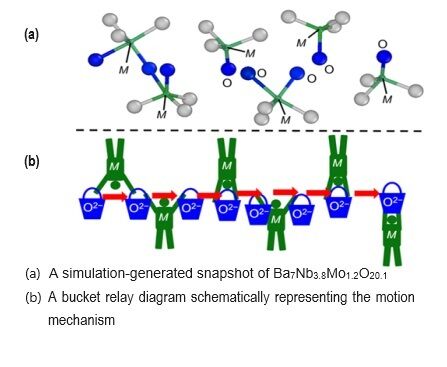
<br />In this study, a new material design called "donor co-doping" was applied to an oxygen-deficient perovskite oxide, BaScO<sub>2.5</sub>. By adding two donor elements, molybdenum (Mo) and tungsten (W), a new ceramic material, BaSc<sub>0.8</sub>Mo<sub>0.1</sub>W<sub>0.1</sub>O<sub>2.8</sub>, was discovered. This material exhibits world-leading proton conductivity at intermediate temperatures, along with high chemical stability. Neutron diffraction analysis using the high-intensity total scattering instrument "NOVA" at the Materials and Life Science Experimental Facility (MLF), together with first-principles molecular dynamics calculations, revealed that this material has a high proton diffusion coefficient. In addition, donor co-doping does not cause an increase in the activation energy (proton trapping), which is a problem in conventional acceptor co-doping, and it can maintain a low activation energy. 
<br />The proton-conducting material discovered in this study is expected to contribute to distributed energy systems that integrate hydrogen production, storage, and utilization. It is also suitable for long-term operation under practical conditions. In the future, PCFCs and PCECs using this material as an electrolyte will be developed and evaluated, with the aim of achieving lower operating temperatures and higher performance. 
<br />For more details (in Japanese only), please visit the J-PARC website. 
<br /><a href="https://j-parc.jp/c/press-release/2026/02/17001747.html" style="text-decoration: none"><font color="blue">https://j-parc.jp/c/press-release/2026/02/17001747.html</font></a></span></p>


<p><strong><span style="color: #0000ff; font-family: arial, helvetica, sans-serif;">(2) First Direct Observation of the Charging Mechanism in Next-Generation Sodium-Ion Batteries - Revealing the mystery of hard carbon through multi-scale observation using neutron scattering - (February 27) </strong>
<br />Sodium-ion batteries (NIBs), which are low-cost and sustainable alternatives to lithium-ion batteries, are attracting attention. For their wider use, it has been important to understand how sodium is stored in hard carbon, a material used for the negative electrode--specifically, where it accumulates and in what order. 
<br />In this study, the neutron small- and wide-angle scattering instrument "TAIKAN" at the MLF was used to observe how sodium moves inside the battery during charging. The behavior was observed simultaneously across multiple scales, from the mesoscale (less than about one-thousandth of a millimeter) to the atomic scale (about one ten-millionth of a millimeter). The results showed that sodium is stored in three steps: adsorption on the surface, insertion between layers, and filling nanoscale pores. In addition, theoretical calculations supported that the structural changes in the carbon layers observed in the experiment are reasonable. 
<br />This study clearly revealed the sodium storage process in hard carbon through multi-scale observations. These findings provide useful guidelines for designing sodium-ion batteries and are expected to accelerate the development of low-cost and sustainable energy storage systems that do not rely on lithium, as well as long-life and highly reliable next-generation batteries. 
<br />For more details (in Japanese only), please visit the J-PARC website. 
<br /><a href="https://j-parc.jp/c/press-release/2026/02/27001759.html" style="text-decoration: none"><font color="blue">https://j-parc.jp/c/press-release/2026/02/27001759.html</font></a></span></p>

<a name="BNo3"></a>
<p><strong><span style="color: #0000ff; font-family: arial, helvetica, sans-serif;">■International Advisory Committee (IAC 2026) Held Online (March 9, 10, and 17 at J-PARC) </strong>
<br />The IAC was established under the "Fundamental Collaboration Agreement Regarding the Management of High-Intensity Proton Accelerator Facilities" and serves as a committee in which domestic and international experts deliberate on important matters concerning the operation, user access, and facility development of J-PARC. The committee, consisting of 16 members (12 from abroad and 4 from Japan), which is led by the Chair (Science & Technology Facilities Council, UK), submitted recommendations regarding J-PARC's management, operations, and R&D activities for fiscal year 2025. While J-PARC possesses technical superiority, structural challenges such as financial constraints, human resource issues, and aging infrastructure have become apparent, raising questions about the facility's sustainability. 
<br />The J-PARC Center takes these recommendations seriously and will work to improve its future management, operations, and business activities. </span></p>


<p><a name="fig3"></a></p>
<table>
<tbody>
<tr>
<td style="border-color: #ffffff;"><a href="uploads/2026/news251_2.jpg"><img alt="news251_2" src="assets_c/2026/04/news251_2-thumb-350xauto-11562.jpg" width="350" height="229" class="mt-image-center" style="text-align: center; display: block; margin: 0 auto 20px;" /></a></td>
</tr>
</tbody>
</table>


<a name="BNo4"></a>
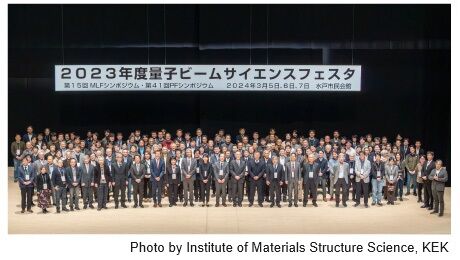
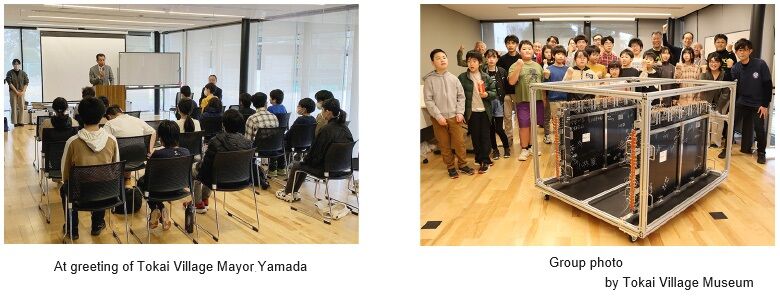
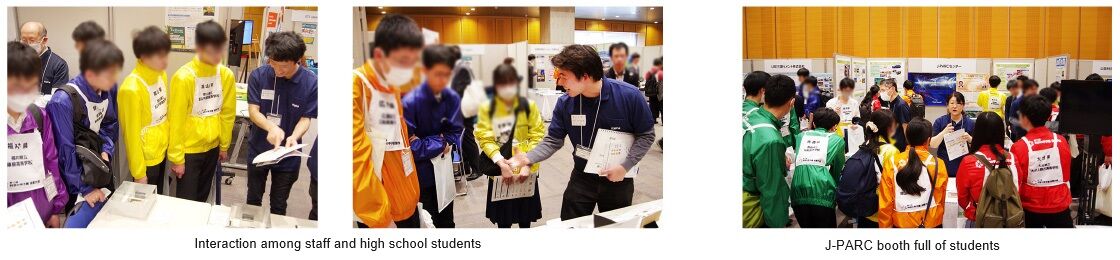
<p><strong><span style="color: #0000ff; font-family: arial, helvetica, sans-serif;">■Quantum Beam Science Festa 2025 Held (March 11-13, Mito City Civic Center) </strong> 
<br />The 17th MLF Symposium and the 43rd PF Symposium, known as the Quantum Beam Science Festa (QBSF), provide a place for researchers to connect across different probes, including synchrotron radiation, neutrons, muons, and positrons, at the Photon Factory (PF) of KEK and the MLF of J-PARC. The event is held alternately in Tsukuba and Mito each year, and 607 participants registered this year.  
<br />At QBSF, the PF Symposium was held on the first day, followed by keynote lectures, poster presentations, and parallel sessions on the second day, and the MLF Symposium on the third day. A total of 227 posters were presented, including 63 entries for the Student Encouragement Award. Three MLF users received awards, and the award ceremony was held during a reception attended by more than 150 participants. 
<br />At the MLF Symposium, research results from MLF were mainly presented. In addition, future plans were discussed at the 2nd Roadmap Workshop, a satellite event held on the following day. </span></p>

<p><a name="fig4"></a></p>
<table>
<tbody>
<tr>
<td style="border-color: #ffffff;"><a href="uploads/2026/news251_3.jpg"><img alt="news251_3" src="assets_c/2026/04/news251_3-thumb-350xauto-11564.jpg" width="350" height="225" class="mt-image-center" style="text-align: center; display: block; margin: 0 auto 20px;" /></a></td>
</tr>
</tbody>
</table>

<a name="BNo5"></a>
<p><strong><span style="color: #0000ff; font-family: arial, helvetica, sans-serif;">■J-PARC Hello Science
<br />Next-Generation Radiography Using Neutrons (February 27) </strong>
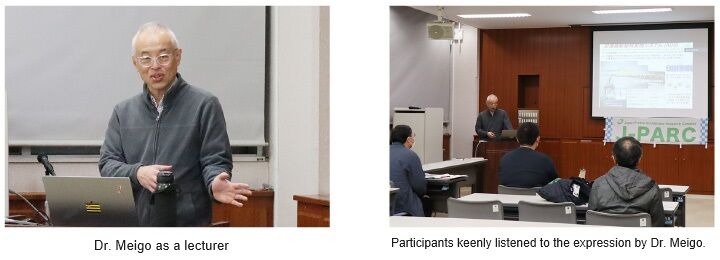
<br />Dr. TSUCHIKAWA Yusuke of the Materials and Life Science Division introduced "neutron imaging," a technique used to observe the inside of objects using neutrons.
One of the major features of neutron imaging is its capability to perform non-destructive measurements, which is difficult to achieve with X-rays. For example, it allows us to observe the movement of water inside metal containers. It can also reveal what elements are inside an object, in what state, and how much is contained. By taking many images while rotating the sample little by little, it is possible to reconstruct the internal structure in three dimensions. 
<br />At the MLF of J-PARC, pulsed neutrons are generated every 0.04 seconds. By measuring the arrival time of neutrons that have passed through the sample at a two-dimensional detector, it is possible to analyze the energy spectrum of neutrons at each pixel with very high accuracy. The results obtained at MLF are used in many fields, such as decommissioning research through investigations of reactor structures, non-destructive elemental analysis of cultural properties, and research on battery materials and new functional materials. </span></p>

<p><a name="fig5"></a></p>
<table>
<tbody>
<tr>
<td style="border-color: #ffffff;"><a href="uploads/2026/news251_4.jpg"><img alt="news251_4" src="assets_c/2026/04/news251_4-thumb-350xauto-11566.jpg" width="350" height="123" class="mt-image-center" style="text-align: center; display: block; margin: 0 auto 20px;" /></a></td>
</tr>
</tbody>
</table>

<a name="BNo6"></a>
<p><strong><span style="color: #0000ff; font-family: arial, helvetica, sans-serif;">■Sakurie Science Festival (March 14, Hitachi Civic Center Science Museum) </strong>
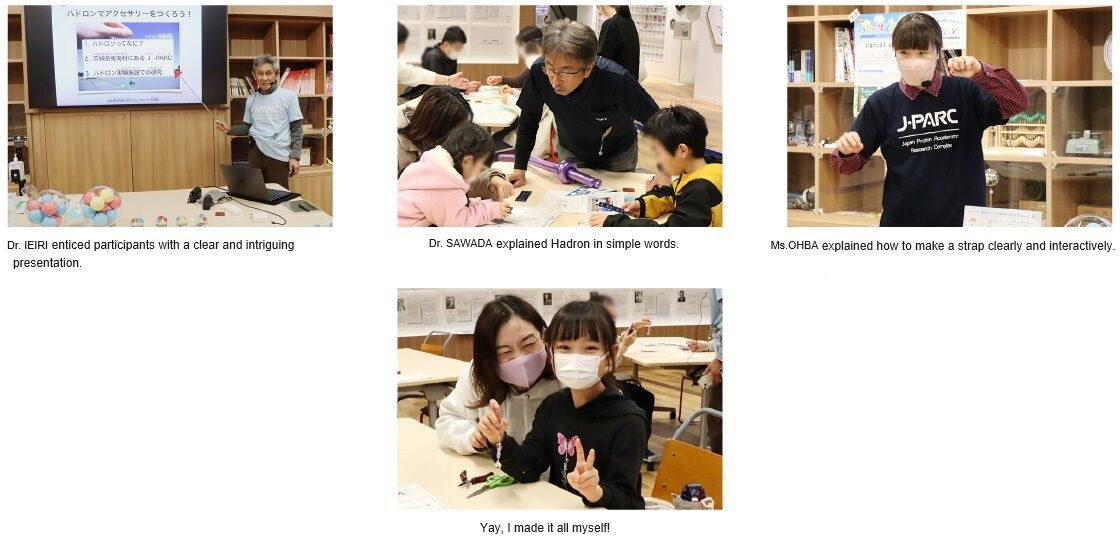
<br />At the science festival, the J-PARC Center held workshops on hadron accessories and cloud chambers, and demonstrations and hands-on activities of a superconducting coaster. The hadron accessory workshop was very popular, and queue tickets for each session were quickly taken. In the cloud chamber workshop, all participants were able to observe the tracks of radiation. 
<br />During the superconducting coaster demonstration, many children listened carefully to explanations about extremely low temperatures and superconductivity. At the hands-on booth, many people from children to adults enjoyed running the coaster and trying simple experiments to learn about the properties of superconductors. 
<br />They also experienced unique experiments using liquid nitrogen, such as making a light bulb glow brighter by cooling a wire, and changing the color of an orange LED to green when cooled with liquid nitrogen, which was unveiled for the first time at this event. </span></p>

<p><a name="fig6"></a></p>
<table>
<tbody>
<tr>
<td style="border-color: #ffffff;"><a href="uploads/2026/news251_5.jpg"><img alt="news251_5" src="assets_c/2026/04/news251_5-thumb-350xauto-11568.jpg" width="350" height="306" class="mt-image-center" style="text-align: center; display: block; margin: 0 auto 20px;" /></a></td>
</tr>
</tbody>
</table>

<a name="BNo7"></a>
<p><strong><span style="color: #0000ff; font-family: arial, helvetica, sans-serif;">■J-PARC Outreach Lecture
<br />(1) Kojima Children's Science Park, Tochigi Prefecture (February 21) </strong>
<br />Superconducting coaster workshops have previously been held at various locations. Following one such event, Kojima Children's Science Park asked us to hold an experiment class for elementary and junior high school students at the Kurashi Lounge. This museum was renewed in October last year. It has many hands-on exhibits, and it is a popular place with about 4,000 to 5,000 visitors on weekends. 
<br />Dr. SASAKI Kenichi from the Cryogenics Section was the instructor. He held two classes, one in the morning and one in the afternoon. The class included quizzes such as "What happens when we cool a balloon or a rubber ball with liquid nitrogen?" Participants experienced a superconducting coaster and closely observed that a magnet ring rolls down more slowly when it passes next to a cooled copper plate. </span></p>

<p><a name="fig7"></a></p>
<table>
<tbody>
<tr>
<td style="border-color: #ffffff;"><a href="uploads/2026/news251_6-1.jpg"><img alt="news251_6-1" src="assets_c/2026/04/news251_6-1-thumb-350xauto-11570.jpg" width="350" height="124" class="mt-image-center" style="text-align: center; display: block; margin: 0 auto 20px;" /></a></td>
</tr>
</tbody>
</table>

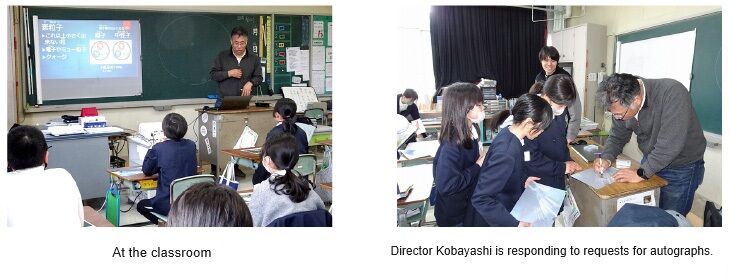
<p><strong><span style="color: #0000ff; font-family: arial, helvetica, sans-serif;">(2) Ishigami Elementary School (Thursday, February 26, 2026) </strong>
<br />The MLF Outreach Group "Protons" delivered a special outreach class for approximately 30 fourth-grade students. This class was conducted as a joint program with the Tokai Village Museum. 
<br />The lesson focused on the theme, "The first step in research is careful observation," and included two activities: "Let's Observe Daphnia, the Masters of Swimming!" and "Dissecting Dried Sardines." 
<br />In fourth-grade science, students study the structure of the human body in the unit "Our Body and Movement." In this class, students observed the movements of Daphnia using microscopes and examined the anatomical features of dried sardines using magnifying glasses. Through these hands-on activities, they learned about "life" by exploring the structure of living organisms. Many students actively asked questions, making the class highly engaging and meaningful. 
<br />This outreach lecture was supported in part by the KEK Mirai Fund program, "Sowing the Seeds of Science for the Next Generation from J-PARC." 
<br />For more details (in Japanese only), please visit the J-PARC website. 
<br /><a href="https://www2.kek.jp/kff" style="text-decoration: none" target="_blank"><font color="blue">https://www2.kek.jp/kff/</font></a></span></p>

<p><a name="fig7"></a></p>
<table>
<tbody>
<tr>
<td style="border-color: #ffffff;"><a href="uploads/2026/news251_6-2.jpg"><img alt="news251_6-2" src="assets_c/2026/04/news251_6-2-thumb-350xauto-11572.jpg" width="350" height="83" class="mt-image-center" style="text-align: center; display: block; margin: 0 auto 20px;" /></a></td>
</tr>
</tbody>
</table>

<a name="BNo8"></a>
<p><strong><span style="color: #0000ff; font-family: arial, helvetica, sans-serif;">■Muographic Investigation of Ancient Burial Mounds in Tokai: Summary of Activities in 2025 (Tokai Village Museum, March 15)</strong>
<br />The final activity of FY2025 was held with 19 participants on March 15. First, Dr. FUJII from J-PARC gave a lecture titled "Can you find the Nobel Prize peak?" Participants looked at data from the 2012 LHC experiment, where the Higgs boson was discovered, and worked in groups to identify which peak corresponded to the Higgs boson. Through this activity, they learned that "peaks have meaning." 
<br />After that, Mr. KUZUBA from Ibaraki University reported on the analysis of data from the first detector measurement device installed at the Detector for History and Future No. 2 on October 13, 2024. Participants also worked in groups to examine the data and discussed possible locations of cavities (stone chambers). As a result of the analysis, three possible cavity areas were identified at this stage. 
<br />While measurements with the first detector continue, the second detector was installed on November 16, 2025, and the data has been steadily collected. The second detector device observes from a direction almost perpendicular to the first one, so analyzing this data may help identify the exact locations of the cavities. 
<br />The Muographic Investigation of Ancient Burial Mounds in Tokai will continue its activities next year. Updates will be shared as further analysis results of the burial mound have become available. </span></p>
 
<p><a name="fig8"></a></p>
<table>
<tbody>
<tr>
<td style="border-color: #ffffff;"><a href="uploads/2026/news251_7.jpg"><img alt="news251_7" src="assets_c/2026/04/news251_7-thumb-350xauto-11574.jpg" width="350" height="254" class="mt-image-center" style="text-align: center; display: block; margin: 0 auto 20px;" /></a></td>
</tr>
</tbody>
</table>


<a name="BNo9"></a>
<p><strong><span style="color: #0000ff; font-family: arial, helvetica, sans-serif;">■J-PARC Sanpo-michi 68: 15 Years of Recovery and Progress </strong>
<br />Visitors who come to J-PARC for the first time often say that it looks like a huge factory. In fact, the facilities are built with extremely high precision. The position of beamline components is controlled within 0.1 mm. For example, to keep the 330 m-long linac tunnel straight, its center must be about 2 mm lower than both ends, assuming they are at the same elevation. This is because the Earth is round, and a completely level structure would not be straight. 
<br />During the Great East Japan Earthquake 15 years ago, Tokai Village was hit by strong shaking (seismic intensity 6−), and J-PARC was seriously damaged. In the linac tunnel, more than 10 cm of groundwater collected, reaching about 100 tons in total. Inside the tunnel, there was no power, and the water was strongly alkaline (pH 11). It was treated with sulfuric acid and then removed in very humid conditions. Another major challenge was restoring the beam path. Due to the strong shaking, the tunnel was deformed, and in some places the linac subsided by up to 43 mm compared to before the earthquake. Such large deformation made it difficult to realign the magnets and restore a straight beamline. Instead, a new beam path with a slight bend was introduced to follow the deformation of the floor. As a result, the linac successfully resumed beam operation on December 9, eight months after the earthquake. 
<br />Even today, the proton beam path in the linac remains slightly V-shaped. However, the beam power at MLF has increased from 200 kW before the earthquake to 1,000 kW today. </span></p>
</span></p>

<p><a name="fig9"></a></p>
<table>
<tbody>
<tr>
<td style="border-color: #ffffff;"><a href="uploads/2026/news251_9.jpg"><img alt="news251_9" src="assets_c/2026/04/news251_9-thumb-300xauto-11576.jpg" width="300" height="239" class="mt-image-center" style="text-align: center; display: block; margin: 0 auto 20px;" /></a></td>
</tr>
</tbody>
</table>


]]>
        
    </content>
</entry>

<entry>
    <title>&quot;J-PARC Outreach Lecture&quot; held in February 2026</title>
    <link rel="alternate" type="text/html" href="2026/04/17001785.html" />
    <id>tag:cms01.j-parc.jp,2026:/c/en/topics//8.1785</id>

    <published>2026-04-17T04:59:24Z</published>
    <updated>2026-04-17T05:15:11Z</updated>

    <summary> ◆◇◆Nagi Junior High School, Nagi Town, ...</summary>
    <author>J-PARC</author>
    
        <category term="J-PARC Outreach Lectures" />
    
    
    <content type="html" xml:lang="ja" xml:base="http://cms01.j-parc.jp/c/en/topics/">
        <![CDATA[<a name="BNo260206"></a>
<p><b><font color="orange">◆◇◆</font>Nagi Junior High School, Nagi Town, Okayama Prefecture (Friday, February 6, 2026) <font color="orange">◆◇◆</font></b></p>
<p>A special outreach class titled "The Mysteries of the Vast Universe, the Microscopic World, and Accelerators" was delivered on February 6 by Dr. KOBAYASHI Takashi, Director of the J-PARC Center. 
<br />The program was designed to encourage students to learn actively while enjoying the experience. In addition to a lecture, the class included a question-and-answer session and group work using a cloud chamber experiment. Participating students asked questions such as "How was the universe created?", "What triggered the formation of the Earth?", "Why does fog form inside the cloud chamber?", and "Why do these results occur?", and engaged in lively exchanges of opinions with Dr. KOBAYASHI. 
<br />The class was a meaningful opportunity for students to think independently rather than leaving mysteries unexplored, starting from familiar questions of "why?" and "how?". 
<br />Through their surprise and excitement during the experiments, the class also helped spark their interest in science. </p>
<p><a name="fig20251202"></a></p>
<table>
<tbody>
<tr>
<td style="border-color: #ffffff;"><a href="uploads/2026/J-PARCTopics20260206_01s.jpg"><img alt="J-PARCTopics20260206_01s" src="assets_c/2026/02/J-PARCTopics20260206_01s-thumb-300xauto-11173.jpg" width="300" height="225" class="mt-image-center" style="text-align: center; display: block; margin: 0 auto 20px;" /></a></td>
<td style="border-color: #ffffff;"><a href="uploads/2026/J-PARCTopics20260206_02s.jpg"><img alt="J-PARCTopics20260206_02s" src="assets_c/2026/02/J-PARCTopics20260206_02s-thumb-300xauto-11175.jpg" width="300" height="225" class="mt-image-center" style="text-align: center; display: block; margin: 0 auto 20px;" /></a></td>
</tr>
<tr>
<td style="border-color: #ffffff;"><a href="uploads/2026/J-PARCTopics20260206_03s.jpg"><img alt="J-PARCTopics20260206_03s" src="assets_c/2026/02/J-PARCTopics20260206_03s-thumb-300xauto-11177.jpg" width="300" height="225" class="mt-image-center" style="text-align: center; display: block; margin: 0 auto 20px;" /></a></td>
<td style="border-color: #ffffff;"><a href="uploads/2026/J-PARCTopics20260206_04s.jpg"><img alt="J-PARCTopics20260206_04s" src="assets_c/2026/02/J-PARCTopics20260206_04s-thumb-300xauto-11179.jpg" width="300" height="225" class="mt-image-center" style="text-align: center; display: block; margin: 0 auto 20px;" /></a></td>
</tr>
</tbody>
</table>
<p>&nbsp;</p>
<a name="BNo260226"></a>
<p><b><font color="orange">◆◇◆</font>Ishigami Elementary School (Thursday, February 26, 2026) <font color="orange">◆◇◆</font></b></p>
<p>The MLF Outreach Group "Protons" delivered a special outreach class for approximately 30 fourth-grade students. This class was conducted as a joint program with the Tokai Village Museum. 
<br />The lesson focused on the theme, "The first step in research is careful observation," and included two activities: "Let's Observe Daphnia, the Masters of Swimming!" and "Dissecting Dried Sardines."
<br />In fourth-grade science, students study the structure of the human body in the unit "Our Body and Movement." In this class, students observed the movements of Daphnia using microscopes and examined the anatomical features of dried sardines using magnifying glasses. Through these hands-on activities, they learned about "life" by exploring the structure of living organisms. Many students actively asked questions, making the class highly engaging and meaningful. 
<br />This outreach lecture was supported in part by the KEK Mirai Fund program, "Sowing the Seeds of Science for the Next Generation from J-PARC."
<br />For more information, please visit (Japanese only): <a href="https://www2.kek.jp/kff/" style="text-decoration: none" target="_blank"><font color="blue">https://www2.kek.jp/kff/</font></a>

</p>
<p><a name="fig20260226"></a></p>
<table>
<tbody>
<tr>
<td style="border-color: #ffffff;"><a href="uploads/2026/J-PARC-HP01_DSC03881r.png"><img alt="J-PARC-HP01_DSC03881r" src="assets_c/2026/04/J-PARC-HP01_DSC03881r-thumb-300xauto-11481.png" width="300" height="200" class="mt-image-center" style="text-align: center; display: block; margin: 0 auto 20px;" /></a></td>
<td style="border-color: #ffffff;"><a href="uploads/2026/J-PARC-HP02_HP_DSC03925.png"><img alt="J-PARC-HP02_HP_DSC03925" src="assets_c/2026/04/J-PARC-HP02_HP_DSC03925-thumb-300xauto-11483.png" width="300" height="200" class="mt-image-center" style="text-align: center; display: block; margin: 0 auto 20px;" /></a></td>
<td style="border-color: #ffffff;"><a href="uploads/2026/J-PARC-HP03_HP_DSC03845.png"><img alt="J-PARC-HP03_HP_DSC03845" src="assets_c/2026/04/J-PARC-HP03_HP_DSC03845-thumb-300xauto-11485.png" width="300" height="200" class="mt-image-center" style="text-align: center; display: block; margin: 0 auto 20px;" /></a></td>
</tr>

<tr>
<td style="border-color: #ffffff;"><a href="uploads/2026/J-PARC-HP08_HP_DSC03945.png"><img alt="J-PARC-HP08_HP_DSC03945" src="assets_c/2026/04/J-PARC-HP08_HP_DSC03945-thumb-300xauto-11487.png" width="300" height="200" class="mt-image-center" style="text-align: center; display: block; margin: 0 auto 20px;" /></a></td>
<td style="border-color: #ffffff;"><a href="uploads/2026/J-PARC-HP09_HP_DSC03911.png"><img alt="J-PARC-HP09_HP_DSC03911" src="assets_c/2026/04/J-PARC-HP09_HP_DSC03911-thumb-300xauto-11489.png" width="300" height="200" class="mt-image-center" style="text-align: center; display: block; margin: 0 auto 20px;" /></a></td>
<td style="border-color: #ffffff;"><a href="uploads/2026/J-PARC-HP10_HP_DSC03871.png"><img alt="J-PARC-HP10_HP_DSC03871" src="assets_c/2026/04/J-PARC-HP10_HP_DSC03871-thumb-300xauto-11491.png" width="300" height="200" class="mt-image-center" style="text-align: center; display: block; margin: 0 auto 20px;" /></a></td>
</tr>

<tr>
<td style="border-color: #ffffff;"><a href="uploads/2026/J-PARC-HP04_HP_DSC03955.png"><img alt="J-PARC-HP04_HP_DSC03955" src="assets_c/2026/04/J-PARC-HP04_HP_DSC03955-thumb-300xauto-11493.png" width="300" height="200" class="mt-image-center" style="text-align: center; display: block; margin: 0 auto 20px;" /></a></td>
<td style="border-color: #ffffff;"><a href="uploads/2026/J-PARC-HP05_HP_DSC03828.png"><img alt="J-PARC-HP05_HP_DSC03828" src="assets_c/2026/04/J-PARC-HP05_HP_DSC03828-thumb-300xauto-11495.png" width="300" height="200" class="mt-image-center" style="text-align: center; display: block; margin: 0 auto 20px;" /></a></td>
<td style="border-color: #ffffff;"><a href="uploads/2026/J-PARC-HP06_HP_DSC03892.png"><img alt="J-PARC-HP06_HP_DSC03892" src="assets_c/2026/04/J-PARC-HP06_HP_DSC03892-thumb-300xauto-11497.png" width="300" height="200" class="mt-image-center" style="text-align: center; display: block; margin: 0 auto 20px;" /></a></td>
</tr>

<tr>
<td style="border-color: #ffffff;"><a href="uploads/2026/J-PARC-HP07_HP_DSC03876r.png"><img alt="J-PARC-HP07_HP_DSC03876r" src="assets_c/2026/04/J-PARC-HP07_HP_DSC03876r-thumb-300xauto-11499.png" width="300" height="200" class="mt-image-center" style="text-align: center; display: block; margin: 0 auto 20px;" /></a></td>
<td style="border-color: #ffffff;"><a href="uploads/2026/J-PARC-HP11_HP_DSC03834.png"><img alt="J-PARC-HP11_HP_DSC03834" src="assets_c/2026/04/J-PARC-HP11_HP_DSC03834-thumb-300xauto-11501.png" width="300" height="200" class="mt-image-center" style="text-align: center; display: block; margin: 0 auto 20px;" /></a></td>
<td style="border-color: #ffffff;"><a href="uploads/2026/J-PARC-HP12_HP_DSC03980.png"><img alt="J-PARC-HP12_HP_DSC03980" src="assets_c/2026/04/J-PARC-HP12_HP_DSC03980-thumb-300xauto-11503.png" width="300" height="200" class="mt-image-center" style="text-align: center; display: block; margin: 0 auto 20px;" /></a></td>
</tr>

</tbody>
</table>
<p>&nbsp;</p>
]]>
        
    </content>
</entry>

<entry>
    <title>Dr. ADACHI Kyosuke of Accelerator Section II Receives the Beam Physics Young Presentation Award 2025</title>
    <link rel="alternate" type="text/html" href="2026/04/15001807.html" />
    <id>tag:cms01.j-parc.jp,2026:/c/en/topics//8.1807</id>

    <published>2026-04-15T08:30:00Z</published>
    <updated>2026-05-14T05:00:36Z</updated>

    <summary>Dr. ADACHI Kyosuke, a postdoctoral resea...</summary>
    <author>J-PARC</author>
    
        <category term="Topics" />
    
    
    <content type="html" xml:lang="ja" xml:base="http://cms01.j-parc.jp/c/en/topics/">
        <![CDATA[<p>Dr. ADACHI Kyosuke, a postdoctoral researcher of Accelerator Section II, received the Young Presentation Award 2025 at the 2025 Beam Physics Workshop and Young Researchers' Meeting for his presentation entitled "Optimization study of bunch lengthening with second harmonic RF voltage in J-PARC RCS." This award is presented to outstanding young researchers and students in the field of beam physics in order to encourage their research activities and support their independence and development as researchers and professionals. 
<br />Dr. ADACHI investigated a method for flattening the beam bunch shape by applying a radio-frequency voltage with twice the fundamental frequency during the final stage of acceleration in the accelerator. This approach successfully reduced beam loss and is expected to contribute significantly to realizing even higher-intensity beams at J-PARC. </p>

<p><a name="fig2060415"></a></p>
<table>
<tbody>
<tr>
<td style="border-color: #ffffff;"><img alt="20260415" src="uploads/2026/20260415.png" width="320" height="269" class="mt-image-center" style="text-align: center; display: block; margin: 0 auto 20px;" /></td>
</tr>
</tbody>
</table>

<p></p><p></p>
]]>
        
    </content>
</entry>

<entry>
    <title>J-PARC News February 2026 (Issue#250)</title>
    <link rel="alternate" type="text/html" href="2026/03/27001782.html" />
    <id>tag:cms01.j-parc.jp,2026:/c/en/topics//8.1782</id>

    <published>2026-03-27T00:26:53Z</published>
    <updated>2026-04-17T02:05:22Z</updated>

    <summary> ■Start of the Stable User Operations at...</summary>
    <author>J-PARC</author>
    
        <category term="J-PARC News" />
    
    
    <content type="html" xml:lang="ja" xml:base="http://cms01.j-parc.jp/c/en/topics/">
        <![CDATA[<a name="BNo1"></a>
<p><strong><span style="color: #0000ff; font-family: arial, helvetica, sans-serif;">■Start of the Stable User Operations at 900 kW in the MR</strong>
<br />Stable user operation at a beam power of 900 kW has been continuously maintained in the Main Ring (MR) accelerator since January 27. Toward the Hyper-Kamiokande experiment scheduled to start in 2028, the beam power upgrade will continue step by step with the goal of achieving 1.3 MW operation. 
<br />For more details (Japanese only), please visit the J-PARC website.
<br /><a href="https://www.j-parc.jp/c/en/topics/2026/02/03001734.html" style="text-decoration: none"><font color="blue">https://www.j-parc.jp/c/en/topics/2026/02/03001734.html</font></a></span></p>

<a name="BNo2"></a>
<p><strong><span style="color: #0000ff; font-family: arial, helvetica, sans-serif;">■Award
<br />(1) The 31st Outstanding Paper Award of the Physical Society of Japan (January 16) </strong> 

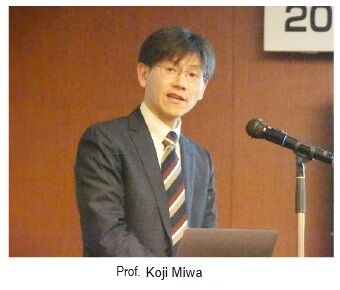
<br />The J-PARC E40 Experiment Group, including Prof. MIWA Kouji of the Graduate School of Science, Tohoku University, and a specially appointed professor at the High Energy Accelerator Research Organization (KEK), and Dr. NANAMURA Takuya, Assistant Professor at the Graduate School of Science, Tohoku University, received the 31st Outstanding Paper Award of the Physical Society of Japan. 
<br />Through experiments using a scattering-particle detector operating under J-PARC's high-intensity beam conditions, the E40 Experiment Group successfully detected elastic scattering events between Sigma (Σ) particles and protons with more than 100 times higher statistics than previously achieved. Since scattering experiments using extremely short-lived Σ particles are very challenging, this result represents a major breakthrough. In addition, the group revealed for the first time in the world that the strong repulsive force predicted by quark-model theories of baryon-baryon interactions does not appear as prominently as suggested by theory. 
<br />This research established a new experimental technique for hyperon-proton scattering. It was highly evaluated as an important contribution to understanding hyperon-nucleon interactions and as a result that will greatly contribute to future developments in nuclear physics. </span></p>

<p><a name="fig2-1"></a></p>
<table>
<tbody>
<tr>
<td style="border-color: #ffffff;"><a href="uploads/2026/news250_1-1.jpg"><img alt="news250_1-1" src="assets_c/2026/04/news250_1-1-thumb-180xauto-11458.jpg" width="180" height="150" class="mt-image-center" style="text-align: center; display: block; margin: 0 auto 20px;" /></a></td>
</tr>
</tbody>
</table>

<p><strong><span style="color: #0000ff; font-family: arial, helvetica, sans-serif;">(2) The 7<sup>th</sup> Fumiko Yonezawa Memorial Award of the Physical Society of Japan</strong> 
<br />Dr. UMEGAKI Izumi of the Muon Science Section, Materials and Life Science Division, has been awarded the 7th Fumiko Yonezawa Memorial Award. 
<br />Dr. UMEGAKI has conducted pioneering research on advanced analysis of lithium-ion batteries using muons, making significant contributions to the advancement of muon science. 
<br />For more details (Japanese only), please visit the KEK IMSS website. 
<br /><a href="https://www2.kek.jp/imss/news/2026/topics/0224JPSJ-Yonezawa-Awd/" style="text-decoration: none" target="_blank"><font color="blue">https://www2.kek.jp/imss/news/2026/topics/0224JPSJ-Yonezawa-Awd/</font></a></span></p>

<p><a name="fig2-2"></a></p>
<table>
<tbody>
<tr>
<td style="border-color: #ffffff;"><a href="uploads/2026/news250_1-2.jpg"><img alt="news250_1-2" src="assets_c/2026/04/news250_1-2-thumb-180xauto-11461.jpg" width="180" height="140" class="mt-image-center" style="text-align: center; display: block; margin: 0 auto 20px;" /></a></td>
</tr>
</tbody>
</table>


<a name="BNo3"></a>
<p><strong><span style="color: #0000ff; font-family: arial, helvetica, sans-serif;">■The 20<sup>th</sup> Tokai Forum Held (February 18, Tokai Cultural Center) </strong> 
<br />The Japan Atomic Energy Agency (JAEA) holds the Tokai Forum every year as part of its annual activity report to help local residents understand its activities in the Tokai village. This year marks the 20<sup>th</sup> anniversary of JAEA's establishment. A total of 127 people attended the forum on-site, while 111 people watched the event online. 
<br />At the forum, the activities of the Nuclear Fuel Cycle Engineering Laboratories, the Nuclear Science Research Institute, and the J-PARC Center were reported. Dr. NAKAMURA Mitsutaka of the Materials and Life Science Division, J-PARC Center, gave a presentation titled "The Power to Shape the Future: Challenges of the MLF Neutron Instruments," reporting on neutron utilization research conducted at the Materials and Life Science Experimental Facility (MLF). The presentation introduced the world's most intense neutron beam provided by the MLF and neutron instruments designed to maximize the unique properties of neutrons. These instruments enable rapid and detailed observations of light elements and structural analyses of materials. 
<br />For more details (Japanese only), please visit the following website. 
<br /><a href="https://www.jaea.go.jp/04/ztokai/forum/" style="text-decoration: none" target="_blank"><font color="blue">https://www.jaea.go.jp/04/ztokai/forum/</font></a></p>

<p><a name="fig3"></a></p>
<table>
<tbody>
<tr>
<td style="border-color: #ffffff;"><a href="uploads/2026/news250_2.jpg"><img alt="news250_2" src="assets_c/2026/04/news250_2-thumb-180xauto-11460.jpg" width="180" height="144" class="mt-image-center" style="text-align: center; display: block; margin: 0 auto 20px;" /></a></td>
</tr>
</tbody>
</table>

<p><strong><span style="color: #0000ff; font-family: arial, helvetica, sans-serif;">■J-PARC Hello Science<br />
<br />From Hospitals to Artworks: Surprising Places Where Accelerators Are Used (January 30) </strong>
<br />Dr. YAMAMOTO Kazami of the Accelerator Division introduced various accelerator technologies used in daily life. 
<br />An accelerator is a device that accelerates charged particles, such as electrons and protons, to high energies. At J-PARC, three accelerators are combined to generate a high-intensity proton beam. 
<br />Particles produced from the proton beam--such as neutrons, muons, neutrinos, and mesons--are used to study the inside of objects nondestructively and to investigate phenomena related to the origin of the universe. 
<br />When people hear the word "accelerator," they may imagine a huge device in a special research facility. However, accelerators are actually used in many familiar places. In the medical field, accelerators are used to generate X rays for diagnostic imaging and radiation therapy, and to deliver accelerated particle beams directly for treatment. X-rays produced by accelerators are also used for baggage screening at airports. In addition, cathode-ray tube (CRT) televisions, once common in many households, used an accelerated electron beam directed at the screen to produce light. Accelerators are also used in various other fields, such as quality control in the food and agricultural industries, and in semiconductor manufacturing. 
<br />Accelerator technology is not limited to research. It is an important technology that supports society, and it is expected to play an active role in many more fields in the future. </span></p>

<p><a name="fig4"></a></p>
<table>
<tbody>
<tr>
<td style="border-color: #ffffff;"><a href="uploads/2026/news250_3.jpg"><img alt="news250_3" src="assets_c/2026/04/news250_3-thumb-250xauto-11463.jpg" width="250" height="87" class="mt-image-center" style="text-align: center; display: block; margin: 0 auto 20px;" /></a></td>
</tr>
</tbody>
</table>

<a name="BNo5-1"></a>
<p><strong><span style="color: #0000ff; font-family: arial, helvetica, sans-serif;">■J-PARC Outreach Lecture
<br />(1) Yokoshibahikari Town Community Center, Sambu District, Chiba Prefecture (January 17) </strong>
<br />As part of the Parent and Child Challenge Seminar "Enjoyable Science Experiment Class," an experimental workshop was held with the theme of "Dissection of Dried Sardines" for lower-grade elementary school students and "Let's Observe Snow Crystals" for upper-grade students. 
<br />The class was conducted by Dr. SHIBAZAKI Chie of the MLF Outreach Circle "Protons" (Technology Development Section). 
<br />On the day of the event, participants observed dissected dried sardines and ice crystals carefully using magnifying glasses, under the slogan, "The first step in research is to observe closely with your own eyes." 
<br />Many impressions and questions were shared by the participants, such as: "I observed dried sardines and now I would like to observe more living things around me," "I was surprised that the brain and heart are only about 5 millimeters in size," "What is the function of fish gills?" and "Does the shape of ice crystals change depending on how they are cooled? I would like to learn more about why water expands when it freezes." 
<br />Through these activities, the class successfully encouraged participants' interest in science. </span></p>

<p><a name="fig5-1"></a></p>
<table>
<tbody>
<tr>
<td style="border-color: #ffffff;"><a href="uploads/2026/news250_4-1.jpg"><img alt="news250_4-1" src="assets_c/2026/04/news250_4-1-thumb-350xauto-11465.jpg" width="350" height="81" class="mt-image-center" style="text-align: center; display: block; margin: 0 auto 20px;" /></a></td>
</tr>
</tbody>
</table>

<a name="BNo5-2"></a>
<p><strong><span style="color: #0000ff; font-family: arial, helvetica, sans-serif;">(2)	Muramatsu Elementary School, Tokai Village (January 27) </strong>
<br />A hands-on workshop titled "Light Kaleidoscope" was held for third-grade students by Dr. UZUMAKI Tatsuya from the Public Relations Section. 
<br />During the session, students explored various optical phenomena, such as observing how liquids change color when illuminated with a black light, and how the appearance changes when two polarizing sheets are layered and one sheet is rotated. They also experienced the fascinating effects of light polarization firsthand. 
<br />In the final activity, the students created their own kaleidoscopes using diffraction grating sheets. By looking through their kaleidoscopes, they were able to see rainbow-colored light, and many students appeared very satisfied with the experience. 
<br />The school principal also observed the workshop and expressed interest in inviting the program again next year, commenting, "We would love to have this workshop again next year. </span></p>

<p><a name="fig5-2"></a></p>
<table>
<tbody>
<tr>
<td style="border-color: #ffffff;"><a href="uploads/2026/news250_4-2.jpg"><img alt="news250_4-2" src="assets_c/2026/04/news250_4-2-thumb-350xauto-11468.jpg" width="350" height="81" class="mt-image-center" style="text-align: center; display: block; margin: 0 auto 20px;" /></a></td>
</tr>
</tbody>
</table>


<a name="BNo5-3"></a>
<p><strong><span style="color: #0000ff; font-family: arial, helvetica, sans-serif;">(3)	Nagi Junior High School, Nagi Town, Okayama Prefecture (February 6) </strong>
<br />A special outreach class titled "The Mysteries of the Vast Universe, the Microscopic World, and Accelerators" was delivered on February 6 by Dr. KOBAYASHI Takashi, Director of the J-PARC Center. 
<br />The program was designed to encourage students to learn actively while enjoying the experience. In addition to a lecture, the class included a question-and-answer session and group work using a cloud chamber experiment. Participating students asked questions such as "How was the universe created?", "What triggered the formation of the Earth?", "Why does fog form inside the cloud chamber?", and "Why do these results occur?", and engaged in lively exchanges of opinions with Dr. KOBAYASHI. 
<br />The class was a meaningful opportunity for students to think independently rather than leaving mysteries unexplored, starting from familiar questions of "why?" and "how?". 
<br />Through their surprise and excitement during the experiments, the class also helped spark their interest in science. </span></p>

<p><a name="fig5-3"></a></p>
<table>
<tbody>
<tr>
<td style="border-color: #ffffff;"><a href="uploads/2026/news250_4-3.jpg"><img alt="news250_4-3" src="assets_c/2026/04/news250_4-3-thumb-250xauto-11470.jpg" width="250" height="87" class="mt-image-center" style="text-align: center; display: block; margin: 0 auto 20px;" /></a></td>
</tr>
</tbody>
</table>

<a name="BNo6"></a>
<p><strong><span style="color: #0000ff; font-family: arial, helvetica, sans-serif;">■Visitors</strong>
<br />Senior officials from the U.S. Department of Energy, including Dr. Darío Gil, visited J-PARC. 
<br />For more details (Japanese only), please visit the J-PARC website. 
<br /><a href="https://www.j-parc.jp/c/en/topics/2026/02/04001730.html" style="text-decoration: none"><font color="blue">https://www.j-parc.jp/c/en/topics/2026/02/04001730.html</font></a></span></p>

<p><a name="fig6"></a></p>
<table>
<tbody>
<tr>
<td style="border-color: #ffffff;"><a href="uploads/2026/news250_8s.jpg"><img alt="news250_8s" src="assets_c/2026/04/news250_8s-thumb-180xauto-11472.jpg" width="180" height="120" class="mt-image-center" style="text-align: center; display: block; margin: 0 auto 20px;" /></a></td>
</tr>
</tbody>
</table>

<a name="BNo7"></a>
<p><strong><span style="color: #0000ff; font-family: arial, helvetica, sans-serif;">■J-PARC Sanpo-michi 67: Reflections in a Convex Traffic Mirror </strong>
<br />The roads connecting the various facilities at J-PARC have many curves, and several convex traffic mirrors have been installed to improve visibility. These mirrors reflect a wide area and help reduce blind spots for drivers. On the other hand, because objects appear smaller than they actually are, cars or pedestrians may look farther away than they really are. 
<br />The photos show the LINAC Building and the MLF Building reflected in convex traffic mirrors near each facility. The LINAC Building is about 330 m long, about the length of Tokyo Tower laid on its side. For this reason, the entire building cannot be captured in the mirror, even when the viewing angle is changed. In contrast, the MLF Building is about 150 m long and 70 m wide, and it has a volume large enough to hold two jumbo jets if the inside were hollow. Even so, only part of the building can be seen in the mirror. 
<br />The buildings at J-PARC are so huge that they cannot fit completely even in mirrors designed to reflect a wide area. In the mirror, gentle winter sunlight under a blue sky can be seen casting a faint shadow on the white buildings. </span></p>

<p><a name="fig7"></a></p>
<table>
<tbody>
<tr>
<td style="border-color: #ffffff;"><a href="uploads/2026/news250_7.jpg"><img alt="news250_7" src="assets_c/2026/04/news250_7-thumb-250xauto-11474.jpg" width="250" height="98" class="mt-image-center" style="text-align: center; display: block; margin: 0 auto 20px;" /></a></td>
</tr>
</tbody>
</table>


]]>
        
    </content>
</entry>

<entry>
    <title>Dr. SAHA Pranab Kumar from the Accelerator Division and Colleagues Receive the Suwa Award</title>
    <link rel="alternate" type="text/html" href="2026/03/11001783.html" />
    <id>tag:cms01.j-parc.jp,2026:/c/en/topics//8.1783</id>

    <published>2026-03-11T08:30:00Z</published>
    <updated>2026-04-17T04:41:42Z</updated>

    <summary>The RCS (Rapid Cycling Synchrotron) Beam...</summary>
    <author>J-PARC</author>
    
        <category term="Topics" />
    
    
    <content type="html" xml:lang="ja" xml:base="http://cms01.j-parc.jp/c/en/topics/">
        <![CDATA[<p>The RCS (Rapid Cycling Synchrotron) Beam Commissioning Group, led by Dr. SAHA Pranab Kumar of the J-PARC Accelerator Division, has received the Suwa Award from the High Energy Accelerator Science Promotion Foundation. 
<br />The group successfully reduced beam emittance and minimized beam loss during 1 MW operation of the J-PARC RCS. This achievement significantly reduced residual radiation and contributed to stable operation and improved output of the MR. 
<br />This work has been highly recognized internationally and led to the receipt of the Suwa Award. 
<br />For more details (in Japanese only), please visit the website. 
<br /><a href="https://www.heas.jp/award/2025zyusyou.html" style="text-decoration: none" target="_blank"><font color="blue">https://www.heas.jp/award/2025zyusyou.html</font></a></p>

<p><a name="fig2060311"></a></p>
<table>
<tbody>
<tr>
<td style="border-color: #ffffff;"><a href="uploads/2026/IMG_5991s.jpg"><img alt="IMG_5991s" src="assets_c/2026/04/IMG_5991s-thumb-350xauto-11476.jpg" width="350" height="281" class="mt-image-center" style="text-align: center; display: block; margin: 0 auto 20px;" /></a></td>
</tr>
</tbody>
</table>

<p></p><p></p>
]]>
        
    </content>
</entry>

<entry>
    <title>Dr. SHINOHARA Takenao of the Neutron Science Section and Colleagues Receive the Koshiba Award</title>
    <link rel="alternate" type="text/html" href="2026/03/11001784.html" />
    <id>tag:cms01.j-parc.jp,2026:/c/en/topics//8.1784</id>

    <published>2026-03-11T04:42:57Z</published>
    <updated>2026-04-17T04:56:02Z</updated>

    <summary>A research group of Dr. SHINOHARA Takena...</summary>
    <author>J-PARC</author>
    
        <category term="Topics" />
    
    
    <content type="html" xml:lang="ja" xml:base="http://cms01.j-parc.jp/c/en/topics/">
        <![CDATA[<p>A research group of Dr. SHINOHARA Takenao of the J-PARC Materials and Life Science Experimental Facility (MLF) and Dr. KATO Satoru of Toyota Central R&D Labs., Inc. has received the FY2025 Koshiba Award. 
<br />Using the pulsed neutron imaging instrument BL22 "RADEN" at MLF, the group upgraded the energy selective neutron imaging technique utilizing the pulsed neutron beam in J-PARC and established a method to distinguish and visualize water and ice inside an operating fuel cell of commercial automotive under sub-zero temperature. This achievement is expected to improve performance of fuel cells in cold environments and also contribute to applications in disaster prevention and infrastructure, such as flooding and freezing. 
<br />For more details (in Japanese only), please visit the website. 
<br /><a href="" style="text-decoration: none"><font color="blue">https://www.heas.jp/award/2025zyusyou.html</font></a></p>

<p><a name="fig202604/19"></a></p>
<table>
<tbody>
<tr>
<td style="border-color: #ffffff;"><a href="uploads/2026/IMG_3341s.jpg"><img alt="IMG_3341S" src="assets_c/2026/04/IMG_3341s-thumb-autox347-11479.jpg" width="250" height="347" class="mt-image-center" style="text-align: center; display: block; margin: 0 auto 20px;" /></a></td>
</tr>
</tbody>
</table>

<p></p><p></p>
]]>
        
    </content>
</entry>

<entry>
    <title>J-PARC News January 2026 (Issue#249)</title>
    <link rel="alternate" type="text/html" href="2026/02/27001761.html" />
    <id>tag:cms01.j-parc.jp,2026:/c/en/topics//8.1761</id>

    <published>2026-02-27T06:28:01Z</published>
    <updated>2026-03-02T02:40:35Z</updated>

    <summary> ■Japanese Society of Radiation Safety M...</summary>
    <author>J-PARC</author>
    
        <category term="J-PARC News" />
    
    
    <content type="html" xml:lang="ja" xml:base="http://cms01.j-parc.jp/c/en/topics/">
        <![CDATA[<a name="BNo1"></a>
<p><strong><span style="color: #0000ff; font-family: arial, helvetica, sans-serif;">■Japanese Society of Radiation Safety Management FY2024 Technical Award</strong>
<br />SAKASHITA Koichi, ARAKAWA Yuto, MASUYAMA Koichi, SATO Koichi, SEKI Kazunari, KASUGAI Yoshimi of the Safety Division, and ISHII Tetsuro of the Comprehensive Research Organization for Science and Society received the Japanese Society of Radiation Safety Management Technical Award. 
<br />During beam operation at the J-PARC Materials and Life Science Experimental Facility, the air in the hot cell is activated by neutrons. As a result, short-lived radionuclides such as <sup>11</sup>C, <sup>13</sup>N, and <sup>15</sup>O are produced. Because these nuclides have the same decay mode, they are difficult to distinguish by measurement. 
<br />Under these conditions, the concentration of short-lived radionuclides was accurately evaluated by combining a simple measurement method using commercially available instruments with a simplified Monte Carlo-based model calculation. 
<br />Although this method is simple, it contributes to reliable radiation management. Its usefulness was highly recognized, leading to this award. </span></p>

<p><a name="fig1"></a></p>
<table>
<tbody>
<tr>
<td style="border-color: #ffffff;"><a href="uploads/2026/news249_1.jpg"><img alt="news249_1" src="assets_c/2026/02/news249_1-thumb-220xauto-11297.jpg" width="220" height="169" class="mt-image-center" style="text-align: center; display: block; margin: 0 auto 20px;" /></a></td>
</tr>
</tbody>
</table>

<a name="BNo2"></a>
<p><strong><span style="color: #0000ff; font-family: arial, helvetica, sans-serif;">■Press Release
<br />(1) Pixel Count Increased 1,000 Times: Successful Imaging with 400 Million Pixels in the Superconducting State (December 18) </strong> 
<br />Superconducting detectors can detect very weak signals with high sensitivity and have therefore been widely used in various fields such as astronomy and medical science. In particular, research on their application to imaging has been actively pursued. However, increasing the number of pixels in imaging devices has been challenging. Major issues include cooling the entire device to extremely low temperatures, increasing the pixel count while maintaining pixel uniformity, and implementing signal multiplexing circuit technologies that allow multiple signals to be transmitted through a single line. 
<br />In this study, a new type of superconducting detector based on a novel principle, called the current-biased kinetic inductance detector (CB-KID), was developed. A readout circuit equipped with a high-resolution time-to-digital converter (TDC) with a time resolution of 30 picoseconds (10<sup>-12</sup> seconds) was also developed. Using this system, imaging with 400 million pixels was successfully demonstrated. 
<br />By taking advantage of the high pixel count and the 30-picosecond time resolution, applications are expected across a wide range of fields, including astronomy, quantum information communication, life sciences, and medical science. Furthermore, as the system is equipped with a function that enables high-precision tracking over a dynamic range spanning 12 orders of magnitude-from 30 picoseconds to 30 seconds-it is expected to open the door to the development of new measurement and analysis methodologies. 
<br />For more details (Japanese only), please visit the J-PARC website. 
<br /><a href="https://j-parc.jp/c/press-release/2025/12/18001679.html" style="text-decoration: none"><font color="blue">https://j-parc.jp/c/press-release/2025/12/18001679.html</font></a></span></p>

<p><strong><span style="color: #0000ff; font-family: arial, helvetica, sans-serif;">(2) Do Electron Spins Freeze When Cooled?
<br />Discovery of Electron Spins Fluctuating Even at Low Temperatures Due to Ice-Like Disorder - Expected to Elucidate the Mechanism of Entangled Spin Fluctuations - (January 19) </strong>
<br />When the temperature decreases, materials generally crystallize because atoms and molecules arrange themselves in an ordered structure. However, in ice, H₂O molecules can face many different directions, and changing their direction does not change the energy. As a result, even in the solid state, the orientations of molecules remain disordered. 
<br />A similar situation can occur in the quantum spins of electrons. To reduce their energy by relieving disorder, electron spins may form pairs and lose their magnetic properties, giving rise to an unusual state known as the random singlet state. This state has long been theoretically proposed and actively explored. 
<br />In this study, we investigated a spinel-type oxide containing magnesium and titanium using specific heat measurements, nuclear magnetic resonance (NMR), muon spin relaxation (μSR) experiments conducted with the general-purpose μSR spectrometer ARTEMIS at J-PARC MLF and at the Rutherford Appleton Laboratory in the United Kingdom, as well as neutron pair distribution function (PDF) analysis using the high-intensity total scattering instrument NOVA at MLF. 
<br />The results revealed that when the arrangement of titanium atoms exhibits ice-like disorder, a random singlet state emerges. 
<br />These findings indicate that even in materials with disorder in atomic positions and chemical species, electron spins can still form singlet states. A singlet state is characterized by quantum-entangled spins that fluctuate dynamically. Understanding the mechanism by which such states are stabilized may lead to applications in quantum technologies, including quantum computing. Furthermore, this finding deepens our fundamental understanding of why some materials freeze at low temperatures while others do not. 
<br />Crystal structure analysis of the samples in this study was carried out using the synchrotron radiation facility, Photon Factory (PF) at KEK. This research represents a collaborative achievement that integrates three of the four quantum beam facilities operated by the Institute of Materials Structure Science at KEK: neutrons, muons, and synchrotron radiation (in addition to low-energy positrons). 
<br />For more details (Japanese only), please visit the J-PARC website. 
<br /><a href="https://j-parc.jp/c/press-release/2026/01/19001714.html" style="text-decoration: none"><font color="blue">https://j-parc.jp/c/press-release/2026/01/19001714.html</font></a></span></p>


<a name="BNo3"></a>
<p><strong><span style="color: #0000ff; font-family: arial, helvetica, sans-serif;">■J-PARC Hello Science
<br />Can the J-PARC Neutrino Beam Help Us Observe the Universe?! (December 19) </strong>
<br />Dr. HINO Yota of the Particle and Nuclear Physics Division introduced his research on using accelerator-produced neutrinos to study the history of the universe. 
<br />When stars in the universe reach the end of their life cycle, they undergo a massive explosion known as a supernova, releasing intense light along with a huge number of neutrinos. Over the long history of the universe, countless stars have ended their lives in such explosions. The neutrinos produced in these events are called the <i>Diffuse Supernova Neutrino Background</i> (DSNB), and they are still filling the universe today. Observing the DSNB would provide important clues about when and how frequently stars were formed throughout cosmic history. 
<br />However, the neutrinos that reach Earth also include atmospheric neutrinos, which are naturally produced in the Earth's atmosphere. When these atmospheric neutrinos interact with oxygen atoms in water molecules, they cause reactions that closely resemble those produced by DSNB neutrinos. As a result, it is difficult to distinguish neutrinos originating from space from background signals. 
<br />This is where artificially produced neutrinos from the T2K experiment at J-PARC become useful. These neutrinos have energies similar to those of atmospheric neutrinos, and their properties are precisely known. By using such controlled neutrinos, researchers can study background noise in detail and remove unwanted signals. 
<br />In the ongoing SK-Gd experiment, data from the T2K experiment are being used to aim for the world's first observation of the DSNB. Improvements in the analysis of background events using artificial neutrinos are increasing the likelihood of detecting neutrinos emitted by stars in the distant past. </span></p>

<p><a name="fig1"></a></p>
<table>
<tbody>
<tr>
<td style="border-color: #ffffff;"><a href="uploads/2026/news249_2.jpg"><img alt="news249_2" src="assets_c/2026/03/news249_2-thumb-380xauto-11299.jpg" width="380" height="132" class="mt-image-center" style="text-align: center; display: block; margin: 0 auto 20px;" /></a></td>
</tr>
</tbody>
</table>

<a name="BNo4"></a>
<p><strong><span style="color: #0000ff; font-family: arial, helvetica, sans-serif;">J-PARC Outreach Lecture 
<br />(1) Nakamaru Elementary School, Tokai Village (December 16) </strong>
<br />A special science class on the theme of "vacuum" was conducted by Ms. MOROHASHI Yuko of the Accelerator Division and Dr. UZUMAKI Tatsuya of the Public Relations Section for 4th- to 6th-grade students in the science club at Nakamaru Elementary School. 
<br />The students took part in a variety of experiments using a vacuum desiccator-such as observing what happens to balloons and marshmallows, or to hot water and carbonated water-and deepened their understanding of vacuum and atmospheric pressure in an enjoyable, hands-on way. They also learned that the accelerators at J-PARC operate under an extremely high-vacuum environment, comparable to the conditions at an altitude of about 40,000 kilometers, where many geostationary satellites orbit. 
<br />Finally, in the "vacuum cannon" demonstration, where students could experience the immense power of atmospheric pressure, loud pops accompanied the bursting of ping-pong balls and cans, prompting surprised reactions and excited cheers from the students. </span></p>

<p><a name="fig4"></a></p>
<table>
<tbody>
<tr>
<td style="border-color: #ffffff;"><a href="uploads/2026/news249_3-1.jpg"><img alt="news249_3-1" src="assets_c/2026/03/news249_3-1-thumb-200xauto-11301.jpg" width="200" height="145" class="mt-image-center" style="text-align: center; display: block; margin: 0 auto 20px;" /></a></td>
</tr>
</tbody>
</table>

<a name="BNo5"></a>
<p><strong><span style="color: #0000ff; font-family: arial, helvetica, sans-serif;">(2)	National Institute of Technology, Kagawa College, Takuma Campus (December 18) </strong>
<br />A special outreach lecture titled "How Accelerators Reveal the Microscopic World" was delivered by Dr. OTANI Masashi from the Accelerator Division at National Institute of Technology, Kagawa College, Takuma Campus. 
<br />Dr. OTANI explained the basic principles of accelerators and highlighted their broad applications in fields such as industry and medicine, along with recent technological developments. Participants shared comments such as, "I would like to learn how accelerators are built and how accelerators in Japan compare with those in other countries." </span></p>

<p><a name="fig5"></a></p>
<table>
<tbody>
<tr>
<td style="border-color: #ffffff;"><a href="uploads/2026/news249_3-2.jpg"><img alt="news249_3-2" src="assets_c/2026/03/news249_3-2-thumb-200xauto-11303.jpg" width="200" height="159" class="mt-image-center" style="text-align: center; display: block; margin: 0 auto 20px;" /></a></td>
</tr>
</tbody>
</table>

<a name="BNo6"></a>
<p><strong><span style="color: #0000ff; font-family: arial, helvetica, sans-serif;">(3) National Institute of Technology, Ibaraki College (December 24) </strong>
<br />A J-PARC introduction seminar was held at the National Institute of Technology (KOSEN), Ibaraki College, for third-year students in the Department of Chemistry, Biology, and Environment. The speakers were Dr. SHIBAZAKI Chie of the Materials and Life Science Division and Dr. AKUTSU Kazuhiro of CROSS, and a total of 37 students participated. 
<br />First, Dr. AKUTSU presented an overview of J-PARC and emphasized the importance of science and technology. He also explained how researchers from diverse fields collaborate in research activities, and shared the appeal of working at a research facility, as well as the wide range of possible career paths, based on his own experience. 
<br />Dr. SHIBAZAKI then introduced her career path as a researcher and presented her ongoing protein research. She also highlighted that the facility is not only focused on physics but also actively carries out biological experiments. 
<br />During the Q&A session, students asked questions related to their future careers, such as "What is the pathway to becoming a researcher?" and "Are there qualifications that are useful for employment?" After the seminar, students expressed surprise at the nearby world-class facility and showed interest in the research topics and J-PARC as a workplace. <br />We hope that this seminar will serve as a valuable guide for students as they consider their future academic and career paths. </span></p>

<p><a name="fig6"></a></p>
<table>
<tbody>
<tr>
<td style="border-color: #ffffff;"><a href="uploads/2026/news249_3-3.jpg"><img alt="news249_3-3" src="assets_c/2026/03/news249_3-3-thumb-380xauto-11305.jpg" width="380" height="132" class="mt-image-center" style="text-align: center; display: block; margin: 0 auto 20px;" /></a></td>
</tr>
</tbody>
</table>

<a name="BNo7"></a>
<p><strong><span style="color: #0000ff; font-family: arial, helvetica, sans-serif;">■J-PARC Sanpo-michi 66: <i>Susuki</i> in Midwinter </strong>
<br />On January 23, the nearby city of Mito recorded a minimum temperature of −6.3&#8451;. The photograph was taken on that day and shows a clump of <i>susuki</i> (Japanese pampas grass) growing in a narrow strip of soil between the parking lot and the road at the J-PARC Research Building. 
<br />The leaves have turned completely white and are hanging down, but the stems are still growing vigorously. At the tips of the stems, the plumes are surprisingly full. When observed up close, the plumes are covered with soft, cotton-like hairs and are densely packed with seeds. 
<br /><i>Susuki</i> is a perennial grass. In spring, reddish shoots emerge, and around the time of the Mid-Autumn Moon, the grass flowers and its plumes become most beautiful. Normally, the plants set seed in autumn, and the seeds are carried away by the wind. However, this season, some <i>susuki</i> plants have still not released their seeds, even at this time of year. 
<br /><i>Susuki</i> reproduces both through underground rhizomes and by seeds. Rhizomes help increase nearby plants, while seeds carry their genetic material over long distances. Having survived last year's long and hot summer, and now enduring the severe cold and strong winds of this day while still storing their seeds, what kind of survival strategy might these <i>susuki</i> plants be using?</span></p>


<p><a name="fig7"></a></p>
<table>
<tbody>
<tr>
<td style="border-color: #ffffff;"><a href="uploads/2026/news249_5.jpg"><img alt="news249_5" src="assets_c/2026/03/news249_5-thumb-200xauto-11307.jpg" width="200" height="145" class="mt-image-center" style="text-align: center; display: block; margin: 0 auto 20px;" /></a></td>
</tr>
</tbody>
</table>


]]>
        
    </content>
</entry>

<entry>
    <title>&quot;J-PARC Outreach Lecture&quot; held in February 2026</title>
    <link rel="alternate" type="text/html" href="2026/02/10001733.html" />
    <id>tag:cms01.j-parc.jp,2026:/c/en/topics//8.1733</id>

    <published>2026-02-10T01:50:49Z</published>
    <updated>2026-02-13T02:00:02Z</updated>

    <summary> ◆◇◆Nagi Junior High School, Nagi Town, ...</summary>
    <author>J-PARC</author>
    
        <category term="J-PARC Outreach Lectures" />
    
    
    <content type="html" xml:lang="ja" xml:base="http://cms01.j-parc.jp/c/en/topics/">
        <![CDATA[<a name="BNo260206"></a>
<p><b><font color="orange">◆◇◆</font>Nagi Junior High School, Nagi Town, Okayama Prefecture (Friday, February 6, 2026) <font color="orange">◆◇◆</font></b></p>
<p>A special outreach class titled "The Mysteries of the Vast Universe, the Microscopic World, and Accelerators" was delivered on February 6 by Dr. KOBAYASHI Takashi, Director of the J-PARC Center. 
<br />The program was designed to encourage students to learn actively while enjoying the experience. In addition to a lecture, the class included a question-and-answer session and group work using a cloud chamber experiment. Participating students asked questions such as "How was the universe created?", "What triggered the formation of the Earth?", "Why does fog form inside the cloud chamber?", and "Why do these results occur?", and engaged in lively exchanges of opinions with Dr. KOBAYASHI. 
<br />The class was a meaningful opportunity for students to think independently rather than leaving mysteries unexplored, starting from familiar questions of "why?" and "how?". 
<br />Through their surprise and excitement during the experiments, the class also helped spark their interest in science. </p>
<p><a name="fig20251202"></a></p>
<table>
<tbody>
<tr>
<td style="border-color: #ffffff;"><a href="uploads/2026/J-PARCTopics20260206_01s.jpg"><img alt="J-PARCTopics20260206_01s" src="assets_c/2026/02/J-PARCTopics20260206_01s-thumb-300xauto-11173.jpg" width="300" height="225" class="mt-image-center" style="text-align: center; display: block; margin: 0 auto 20px;" /></a></td>
<td style="border-color: #ffffff;"><a href="uploads/2026/J-PARCTopics20260206_02s.jpg"><img alt="J-PARCTopics20260206_02s" src="assets_c/2026/02/J-PARCTopics20260206_02s-thumb-300xauto-11175.jpg" width="300" height="225" class="mt-image-center" style="text-align: center; display: block; margin: 0 auto 20px;" /></a></td>
</tr>
<tr>
<td style="border-color: #ffffff;"><a href="uploads/2026/J-PARCTopics20260206_03s.jpg"><img alt="J-PARCTopics20260206_03s" src="assets_c/2026/02/J-PARCTopics20260206_03s-thumb-300xauto-11177.jpg" width="300" height="225" class="mt-image-center" style="text-align: center; display: block; margin: 0 auto 20px;" /></a></td>
<td style="border-color: #ffffff;"><a href="uploads/2026/J-PARCTopics20260206_04s.jpg"><img alt="J-PARCTopics20260206_04s" src="assets_c/2026/02/J-PARCTopics20260206_04s-thumb-300xauto-11179.jpg" width="300" height="225" class="mt-image-center" style="text-align: center; display: block; margin: 0 auto 20px;" /></a></td>
</tr>
</tbody>
</table>
<p></p>
]]>
        
    </content>
</entry>

<entry>
    <title>Senior Officials from the U.S. Department of Energy, Including Dr. Darío Gil, Visit J-PARC</title>
    <link rel="alternate" type="text/html" href="2026/02/04001730.html" />
    <id>tag:cms01.j-parc.jp,2026:/c/en/topics//8.1730</id>

    <published>2026-02-04T08:34:35Z</published>
    <updated>2026-02-13T00:30:45Z</updated>

    <summary>On January 29, Dr. Darío Gil, Under Secr...</summary>
    <author>J-PARC</author>
    
        <category term="Topics" />
    
    
    <content type="html" xml:lang="ja" xml:base="http://cms01.j-parc.jp/c/en/topics/">
        <![CDATA[<p>On January 29, Dr. Darío Gil, Under Secretary for Science at the U.S. Department of Energy, Dr. Harriet Kung, Deputy Director for Science Programs, Office of Science, Ms. Kristen Ellis, Associate Principal Deputy Under Secretary for Science, and Mr. Cameron Salony, DOE Japan Office Director and Energy Attaché at the U.S. Embassy in Tokyo, visited the Materials and Life Science Experimental Facility (MLF) and the neutrino experimental facilities at J-PARC. 
<br />The MLF is a research facility that produces the world's most intense neutron and muon beams. The visitors toured the experimental hall while receiving explanations of the experimental instruments. 
<br />A neutrino beam at J-PARC is directed toward Super-Kamiokande, located 295 km away. 
<br />The visitors also observed the near detector installed underground from ground level at the neutrino monitoring building. </p>

<p><a name="fig20251215"></a></p>
<table>
<tbody>
<tr>
<td style="border-color: #ffffff;"><a href="uploads/2026/20260129_01ems.jpg"><img alt="20260129_01ems" src="assets_c/2026/02/20260129_01ems-thumb-autox384-11144.jpg" width="380" height="384" class="mt-image-center" style="text-align: center; display: block; margin: 0 auto 20px;" /></a></td>
<td style="border-color: #ffffff;"><a href="uploads/2026/20260129_02ems.jpg"><img alt="20260129_02ems" src="assets_c/2026/02/20260129_02ems-thumb-380xauto-11146.jpg" width="380" height="313" class="mt-image-center" style="text-align: center; display: block; margin: 0 auto 20px;" /></a></td>
<td style="border-color: #ffffff;"><a href="uploads/2026/20260129_03ems.jpg"><img alt="20260129_03ems" src="assets_c/2026/02/20260129_03ems-thumb-380xauto-11148.jpg" width="380" height="313" class="mt-image-center" style="text-align: center; display: block; margin: 0 auto 20px;" /></a></td>
</tr>
</tbody>
</table>

<p></p><p></p>
]]>
        
    </content>
</entry>

<entry>
    <title>Start of the Stable User Operations at 900 kW in the MR</title>
    <link rel="alternate" type="text/html" href="2026/02/03001734.html" />
    <id>tag:cms01.j-parc.jp,2026:/c/en/topics//8.1734</id>

    <published>2026-02-03T02:01:30Z</published>
    <updated>2026-02-13T02:05:18Z</updated>

    <summary>Stable user operation at a beam power of...</summary>
    <author>J-PARC</author>
    
        <category term="Topics" />
    
    
    <content type="html" xml:lang="ja" xml:base="http://cms01.j-parc.jp/c/en/topics/">
        <![CDATA[<p>Stable user operation at a beam power of 900 kW has been achieved in the Main Ring (MR) accelerator. This means that stable operation with a more powerful beam than before is now possible, and the beam power upgrade is progressing as planned. 
<br /> Adjustments of the main magnet power supplies, necessary for shortening the operation cycle, have been implemented step by step over the past year. Starting on January 14, the repetition cycle of operation was shortened from 1.36 seconds to 1.28 seconds, initiating beam tuning at higher beam power. By carefully adjusting the beam path and motion, including the operating point (tune at injection), beam optics, tune control in the early stage of acceleration, intra-bunch feedback, and collimators, beam loss was successfully reduced to less than 1% even during operation at 910 kW. In addition, further beam tuning was carried out in the latter half of the acceleration process, and beam loss in the neutrino beamline after beam extraction was also reduced to within acceptable levels. These achievements have confirmed that stable user operation at 900 kW is feasible. 
<br />User operation began on January 17, and the beam power was gradually increased. Since January 27, stable operation at 900 kW has been continuously maintained.  
<br />Toward the Hyper-Kamiokande experiment scheduled to start in 2028, beam power upgrade will continue with the goal of achieving 1.3 MW operation. </p>

<p><a name="fig20260203"></a></p>
<table>
<tbody>
<tr>
<td style="border-color: #ffffff;"><a href="uploads/2026/J-PARCTopics20260130_01.png"><img alt="J-PARCTopics20260130_01" src="assets_c/2026/02/J-PARCTopics20260130_01-thumb-380xauto-11182.png" width="380" height="228" class="mt-image-center" style="text-align: center; display: block; margin: 0 auto 20px;" /></a></td>
</tr>
</tbody>
</table>

<p></p><p></p>
]]>
        
    </content>
</entry>

<entry>
    <title>&quot;J-PARC Outreach Lecture&quot; held in January 2026</title>
    <link rel="alternate" type="text/html" href="2026/02/03001732.html" />
    <id>tag:cms01.j-parc.jp,2026:/c/en/topics//8.1732</id>

    <published>2026-02-03T01:38:52Z</published>
    <updated>2026-02-18T01:29:48Z</updated>

    <summary> ◆◇◆Yokoshibahikari Town Community Cente...</summary>
    <author>J-PARC</author>
    
        <category term="J-PARC Outreach Lectures" />
    
    
    <content type="html" xml:lang="ja" xml:base="http://cms01.j-parc.jp/c/en/topics/">
        <![CDATA[<a name="BNo01"></a>
<p><b><font color="orange">◆◇◆</font>Yokoshibahikari Town Community Center, Sambu District, Chiba Prefecture (Saturday, January 17, 2026) <font color="orange">◆◇◆</font></b></p>
<p>As part of the Parent and Child Challenge Seminar "Enjoyable Science Experiment Class," an experimental workshop was held with the theme of "Dissection of Dried Sardines" for lower-grade elementary school students and "Let's Observe Snow Crystals" for upper-grade students.  
<br />The class was conducted by Dr. SHIBAZAKI Chie of the MLF Outreach Circle "Protons" (Technology Development Section). 
<br />On the day of the event, participants observed dissected dried sardines and ice crystals carefully using magnifying glasses, under the slogan, "The first step in research is to observe closely with your own eyes." 
<br />Many impressions and questions were shared by the participants, such as: "I observed dried sardines and now I would like to observe more living things around me," "I was surprised that the brain and heart are only about 5 millimeters in size," "What is the function of fish gills?" and "Does the shape of ice crystals change depending on how they are cooled? I would like to learn more about why water expands when it freezes." 
<br />Through these activities, the class successfully encouraged participants' interest in science. </p>
<p><a name="fig20260117"></a></p>
<table>
<tbody>
<tr>
<td style="border-color: #ffffff;"><a href="uploads/2026/J-PARCTopics20260117_01ms.jpg"><img alt="J-PARCTopics20260117_01ms" src="assets_c/2026/02/J-PARCTopics20260117_01ms-thumb-300xauto-11161.jpg" width="300" height="225" class="mt-image-center" style="text-align: center; display: block; margin: 0 auto 20px;" /></a></td>
<td style="border-color: #ffffff;"><a href="uploads/2026/J-PARCTopics20260117_02ms.jpg"><img alt="J-PARCTopics20260117_02ms" src="assets_c/2026/02/J-PARCTopics20260117_02ms-thumb-300xauto-11163.jpg" width="300" height="225" class="mt-image-center" style="text-align: center; display: block; margin: 0 auto 20px;" /></a></td>
<td style="border-color: #ffffff;"><a href="uploads/2026/J-PARCTopics20260117_03ms.jpg"><img alt="J-PARCTopics20260117_03ms" src="assets_c/2026/02/J-PARCTopics20260117_03ms-thumb-300xauto-11165.jpg" width="300" height="225" class="mt-image-center" style="text-align: center; display: block; margin: 0 auto 20px;" /></a></td>
</tr>
<tr>
<td style="border-color: #ffffff;"><a href="uploads/2026/J-PARCTopics20260117_04ms.jpg"><img alt="J-PARCTopics20260117_04ms" src="assets_c/2026/02/J-PARCTopics20260117_04ms-thumb-300xauto-11167.jpg" width="300" height="225" class="mt-image-center" style="text-align: center; display: block; margin: 0 auto 20px;" /></a></td>
<td style="border-color: #ffffff;"><a href="uploads/2026/J-PARCTopics20260117_05ms.jpg"><img alt="J-PARCTopics20260117_05ms" src="assets_c/2026/02/J-PARCTopics20260117_05ms-thumb-300xauto-11169.jpg" width="300" height="225" class="mt-image-center" style="text-align: center; display: block; margin: 0 auto 20px;" /></a></td>
<td style="border-color: #ffffff;"><a href="uploads/2026/J-PARCTopics20260117_06ms.jpg"><img alt="J-PARCTopics20260117_06ms" src="assets_c/2026/02/J-PARCTopics20260117_06ms-thumb-300xauto-11171.jpg" width="300" height="225" class="mt-image-center" style="text-align: center; display: block; margin: 0 auto 20px;" /></a></td>
</tr>
</tbody>
</table>
<p></p>
<a name="BNo02"></a>
<p><b><font color="orange">◆◇◆</font>Muramatsu Elementary School, Tokai Village (Friday, January 27, 2026) <font color="orange">◆◇◆</font></b></p>
<p>A hands-on workshop titled "Light Kaleidoscope" was held for third-grade students by Dr. UZUMAKI Tatsuya from the Public Relations Section. 
<br />During the session, students explored various optical phenomena, such as observing how liquids change color when illuminated with a black light, and how the appearance changes when two polarizing sheets are layered and one sheet is rotated. They also experienced the fascinating effects of light polarization firsthand. 
<br />In the final activity, the students created their own kaleidoscopes using diffraction grating sheets. By looking through their kaleidoscopes, they were able to see rainbow-colored light, and many students appeared very satisfied with the experience. 
<br />The school principal also observed the workshop and expressed interest in inviting the program again next year, commenting, "We would love to have this workshop again next year. </p>
<p><a name="fig20260127"></a></p>
<table>
<tbody>
<tr>
<td style="border-color: #ffffff;"><a href="uploads/2026/20260127_01.jpg"><img alt="20260127_01" src="assets_c/2026/02/20260127_01-thumb-300xauto-11209.jpg" width="300" height="223" class="mt-image-center" style="text-align: center; display: block; margin: 0 auto 20px;" /></a></td>
<td style="border-color: #ffffff;"><a href="uploads/2026/20260127_02s.jpg"><img alt="20260127_02s" src="assets_c/2026/02/20260127_02s-thumb-300xauto-11211.jpg" width="300" height="223" class="mt-image-center" style="text-align: center; display: block; margin: 0 auto 20px;" /></a></td>
</tr>
<tr>
<td style="border-color: #ffffff;"><a href="uploads/2026/20260127_03s.jpg"><img alt="20260127_03s" src="assets_c/2026/02/20260127_03s-thumb-300xauto-11213.jpg" width="300" height="200" class="mt-image-center" style="text-align: center; display: block; margin: 0 auto 20px;" /></a></td>
<td style="border-color: #ffffff;"><a href="uploads/2026/20260127_04.jpg"><img alt="20260127_04" src="assets_c/2026/02/20260127_04-thumb-300xauto-11215.jpg" width="300" height="199" class="mt-image-center" style="text-align: center; display: block; margin: 0 auto 20px;" /></a></td>
</tr>
</tbody>
</table>
<p></p>]]>
        
    </content>
</entry>

<entry>
    <title>J-PARC News December 2025 (Issue#248)</title>
    <link rel="alternate" type="text/html" href="2026/01/27001725.html" />
    <id>tag:cms01.j-parc.jp,2026:/c/en/topics//8.1725</id>

    <published>2026-01-27T08:00:00Z</published>
    <updated>2026-01-28T06:35:57Z</updated>

    <summary> ■J-PARC Lecture 2025: &quot;Think it&apos;s diffi...</summary>
    <author>J-PARC</author>
    
        <category term="J-PARC News" />
    
    
    <content type="html" xml:lang="ja" xml:base="http://cms01.j-parc.jp/c/en/topics/">
        <![CDATA[<a name="BNo1"></a>
<p><strong><span style="color: #0000ff; font-family: arial, helvetica, sans-serif;">■J-PARC Lecture 2025: "Think it's difficult? Let's explain the expanding world of elementary particles and atomic nuclei at J-PARC in an easy-to-understand way" (November 29) </strong>
<br />J-PARC holds this annual lecture to provide local residents and many others with a better understanding of its research activities. This year, it was held together with the 100th session of <i>J-PARC Hello Science</i>, the monthly outreach program that explores one theme in depth. A total of 102 participants attended the event at the Tokai Village Industrial and Information Plaza (iVil). 
<br />After opening remarks by Dr. KOBAYASHI Takashi, Director of the J-PARC Center, and Mr. YAMADA Osamu, Mayor of Tokai Village, Dr. MIHARA Satoshi of the Hadron Section delivered a talk titled "The Shadow Protagonist: Muon Reveals the Map of Elementary Particles." In his talk, he traced the history of muon research, from their discovery to the gradual understanding of their properties. 
<br />The second lecture was given by Dr. NAKAMURA Satoshi N., Professor in the Department of Physics and Director of the Quark Nuclear Science Institute at the Graduate School of Science, the University of Tokyo. His talk, "Exploring the Extremes of Matter with Quantum Beams from Hypernuclei to Neutron Stars," began with the story of alchemy, then moved on to the structure of nuclei, nucleons, and the quarks within them-especially strange quarks. 
<br />He highlighted recent advances in hypernuclear physics and concluded by outlining future research possibilities enabled by the planned extension of the hadron experimental facility. 
<br />Each lecture was followed by many questions from the audience. In the lobby, panel displays showing the overall layout of J-PARC and details of the Hadron Experimental Facility encouraged further discussion during breaks and before and after the sessions. 
<br />A full recording of the event is available on the J-PARC YouTube channel (Japanese only). 
<br /><a href="https://www.youtube.com/watch?v=9u4IK6Hacv0" style="text-decoration: none" target="_blank"><font color="blue">https://www.youtube.com/watch?v=9u4IK6Hacv0</a></font></span></p>
<p><a name="fig1"></a></p>
<table>
<tbody>
<tr>
<td style="border-color: #ffffff;"><a href="uploads/2026/news248_1.jpg"><img alt="news248_1" src="assets_c/2026/01/news248_1-thumb-380xauto-11077.jpg" width="380" height="182" class="mt-image-center" style="text-align: center; display: block; margin: 0 auto 20px;" /></a></td>
</tr>
</tbody>
</table>


<a name="BNo2"></a>
<p><strong><span style="color: #0000ff; font-family: arial, helvetica, sans-serif;">■Award
<br />(1) 20th Young Scientist Award (2026), Physical Society of Japan and the 32nd Nuclear Physics Colloquium Young Researcher Prize 
<br />① 20th Young Scientist Award (2026), Physical Society of Japan - Particle Experiment Division </strong>
<br />Dr. ICHIKAWA Go of the Neutron Science Section has successfully measured a neutron whispering gallery state using the neutron beam of the Neutron Optics and Fundamental Physics Beamline (BL05/NOP) at the J PARC Materials and Life Science Experimental Facility (MLF). This is the first time in the world that such a measurement has been achieved with pulsed neutrons. 
<br />When a neutron beam travels along a concave mirror, a near surface quantum state appears due to the centrifugal force. This is known as a whispering gallery state. When the equivalence between gravity and acceleration is applied, this quantum state can be treated as an analogy to a quantum state bound by gravity, allowing researchers to explore quantum behavior under a "virtual" gravitational field. The observed results matched theoretical calculations very well, and the experiment confirmed-at a precision of 2%-that quantum mechanics holds even under conditions equivalent to seven million times Earth's gravity. 
<br />With mirrors of even higher precision, it may become possible not only to further test quantum mechanics but also to search for hypothetical interactions between neutrons and the mirror surface. 
<br />The originality of this research and its significance as an important step toward fundamental experiments were highly evaluated, leading to Dr. ICHIKAWA receiving the award. </span></p>

<p><a name="fig2-1"></a></p>
<table>
<tbody>
<tr>
<td style="border-color: #ffffff;"><a href="uploads/2026/news248_2-1.jpg"><img alt="news248_2-1" src="assets_c/2026/01/news248_2-1-thumb-280xauto-11079.jpg" width="280" height="266" class="mt-image-center" style="text-align: center; display: block; margin: 0 auto 20px;" /></a></td>
</tr>
</tbody>
</table>

<p><strong><span style="color: #0000ff; font-family: arial, helvetica, sans-serif;">②20th Young Scientist Award (2026), Physical Society of Japan - Experimental Nuclear Physics Division and the 32nd Nuclear Physics Colloquium Young Researcher Prize </strong>
<br />Dr. OKUDAIRA Takuya, Assistant Professor at the Graduate School of Science, Nagoya University, and Visiting Researcher in the Technology Development Section of the J-PARC Center, has received the award. This award also serves as the 32nd Young Researcher Prize of the Nuclear Physics Forum. 
<br />Dr. OKUDAIRA, together with Dr. OKU Takayuki and colleagues at the J-PARC Center, developed a <sup>3</sup>He spin filter, achieving world leading performance. By installing this device on a J-PARC neutron beamline, he conducted research on the enhancement effect of time reversal symmetry violation in neutron resonance reactions of nuclei. These results were made possible by using J-PARC's high intensity polarized neutron beams and represent achievements unique to J-PARC. 
<br />This study demonstrated that, in neutron resonance reactions of nuclei, time reversal symmetry violation-believed to exist in nucleon-nucleon interactions-can appear with an effect up to one million times larger than in elementary processes. This is an important result in the search for physics beyond the Standard Model. In addition to the excellence of the research, Dr. OKUDAIRA's strong future potential was highly recognized. 
<br />Further contributions to the development of the Physical Society of Japan and the field of nuclear physics are expected in the future. </span></p>

<p><a name="fig2-2"></a></p>
<table>
<tbody>
<tr>
<td style="border-color: #ffffff;"><a href="uploads/2026/news248_2-2.jpg"><img alt="news248_2-2" src="assets_c/2026/01/news248_2-2-thumb-280xauto-11082.jpg" width="280" height="266" class="mt-image-center" style="text-align: center; display: block; margin: 0 auto 20px;" /></a></td>
</tr>
</tbody>
</table>

<p><strong><span style="color: #0000ff; font-family: arial, helvetica, sans-serif;">(2) 2025 Ibaraki Prefecture High-Pressure Gas Safety Award</strong>
<br />Dr. ASO Tomokazu and Dr. HASEGAWA Shoichi of the Neutron Source Section, who operate and manage the moderator cooling system for the neutron source at the MLF, received the President's Award from the Ibaraki Prefecture Refrigeration Equipment Safety Association as Excellent Refrigeration Safety Supervisors. 
<br />Dr. ASO serves as a Refrigeration Safety Supervisor, and Dr. HASEGAWA serves as an Assistant Refrigeration Safety Supervisor. They were recognized for their outstanding contributions as High-Pressure Gas Safety Supervisors, consistently complying with relevant regulations and fulfilling their responsibilities over many years to ensure safe and reliable operations. </span></p>

<p><a name="fig2-3"></a></p>
<table>
<tbody>
<tr>
<td style="border-color: #ffffff;"><a href="uploads/2026/news248_2-3-1.jpg"><img alt="news248_2-3-1" src="assets_c/2026/01/news248_2-3-1-thumb-300xauto-11084.jpg" width="300" height="182" class="mt-image-center" style="text-align: center; display: block; margin: 0 auto 20px;" /></a></td>
</tr>
</tbody>
</table>

<a name="BNo3"></a>
<p><strong><span style="color: #0000ff; font-family: arial, helvetica, sans-serif;">■Press Release 
<br />Development of a Distorted Triangular-Lattice Antiferromagnet Allowing Diverse Elemental Substitutions - Exploring the Mystery of One-Dimensional Magnetism Using a "Mixed-Anion Compound" - (November 27) </strong>
<br />Research on quantum spin liquid states, which are considered unusual magnetic states, has been gaining more attention in recent years. Until now, most studies have focused on two-dimensional triangular-lattice antiferromagnets, where spins sit on the corners of equilateral triangles, or on one-dimensional antiferromagnets, where spins line up along a chain. The isosceles triangular antiferromagnet found in this study connects these two models, making it possible to examine in detail how the ground state changes-or does not change-when moving from one limit to the other. 
<br />In this work, seven new compounds were synthesized based on the non magnetic mineral pinacolite (Pb<sub>3</sub>WO<sub>5</sub>Cl<sub>2</sub>), where tungsten (W) was replaced by the magnetic element rhenium (Re). In addition, calcium (Ca), strontium (Sr), and barium (Ba) were substituted at the lead (Pb) sites, and bromine (Br) was substituted at the chlorine (Cl) sites. All seven compounds showed one dimensional magnetic interaction behavior at low temperatures. 
<br />Neutron inelastic scattering experiments using the cold neutron disk chopper spectrometer AMATERAS at the J PARC MLF, together with muon spin rotation measurements using Muon D1, confirmed that dynamic spin fluctuations remain even at extremely low temperatures without any magnetic phase transition. These results suggest magnetic excitations consistent with a Tomonaga-Luttinger liquid, where electrons move collectively like waves in a one dimensional system.　
<br />These findings indicate that quantum spin liquid states may be controlled through chemical substitution and are expected to contribute to further progress in studying Tomonaga-Luttinger liquid behavior on anisotropic triangular lattices. 
<br />For more details (Japanese only), please visit the J-PARC website. 
<br /><a href="https://j-parc.jp/c/press-release/2025/11/27001651.html" style="text-decoration: none"><font color="blue">https://j-parc.jp/c/press-release/2025/11/27001651.html</a></font></span></p>
<p>&nbsp;</p>

<a name="BNo4"></a>
<p><strong><span style="color: #0000ff; font-family: arial, helvetica, sans-serif;">J-PARC Outreach Lecture 
<br />Muramatsu Elementary School, Tokai Village (December 2) </strong>
<br />Dr. KAMIYA Junichiro from the Accelerator Division and Mr. YASU Toshiyuki from the Tokai Village Board of Education delivered a science class titled "<i>What Is a Vacuum?</i>" for 5<sup>th</sup> grade students. 
<br />The class began with experiments that helped students understand invisible air, such as floating a ping-pong ball above the nozzle of a hair dryer. They then carried out experiments to observe what happens to balloons, hot water, carbonated water, and marshmallows when they are in vacuum. The instructors also guided the lesson by asking questions such as "<i>Why does a loud burglar alarm become silent when there is no air?</i>" 
<br />At the end of the lesson, the students counted down as a ping-pong ball was launched into an aluminum can using a vacuum cannon. 
<br />The instructors also explained that at J-PARC, maintaining a vacuum is extremely important because air molecules can interfere with the proton beam and reduce its intensity. </span></p>

<p><a name="fig4"></a></p>
<table>
<tbody>
<tr>
<td style="border-color: #ffffff;"><a href="uploads/2026/news248_3.jpg"><img alt="news248_3" src="assets_c/2026/01/news248_3-thumb-380xauto-11086.jpg" width="380" height="102" class="mt-image-center" style="text-align: center; display: block; margin: 0 auto 20px;" /></a></td>
</tr>
</tbody>
</table>

<a name="BNo5"></a>
<p><strong><span style="color: #0000ff; font-family: arial, helvetica, sans-serif;">■Muographic Investigation of Ancient Burial Mounds in Tokai: Talks on Muon Imaging of Pyramids and Ancient Burial Mounds (November 30, Tokai Village Museum) </strong>
<br />A total of 32 people - both children and parents - participated in the final session of the year. For this session, Dr. MORISHIMA Kunihiro, Associate Professor of Nagoya University, gave the lecture. He achieved major results in the international <i>ScanPyramids</i> project, conducted in collaboration with KEK researchers and other partners. 
<br />Dr. MORISHIMA and his research team at Nagoya University used cosmic-ray muons to visualize the interior of the Great Pyramid of Khufu, discovering a previously unknown large void without causing any damage to the structure. In his talk, he explained how nuclear emulsion plates, which detect muons, were installed inside the pyramid, how the recorded data are analyzed, and how muon imaging technology can be applied to various fields. 
<br />Following his talk, Mr. KUZUBA Masaya, a graduate student at Ibaraki University, introduced the results of their muon-based measurements of the Funatsuka No. 2 Burial Mound and outlined future plans for the project. 
<br />To conclude the session, participants gathered around a pot of Yamagata-style and Miyagi-style imoni stew prepared by the staff, enjoying warm food and conversation with one another. </span></p>

<p><a name="fig5"></a></p>
<table>
<tbody>
<tr>
<td style="border-color: #ffffff;"><a href="uploads/2026/news248_4.jpg"><img alt="news248_4" src="assets_c/2026/01/news248_4-thumb-280xauto-11088.jpg" width="280" height="204" class="mt-image-center" style="text-align: center; display: block; margin: 0 auto 20px;" /></a></td>
</tr>
</tbody>
</table>

<a name="BNo6"></a>
<p><strong><span style="color: #0000ff; font-family: arial, helvetica, sans-serif;">■J-PARC Sanpo-michi 65 : Winter Sunlight and Russian Olive </strong>
<br />As Christmas approaches, Russian olive trees become more noticeable. While evergreen trees such as Kuromatsu (Japanese black pine), Tabunoki (Machilus thunbergii), and Sudajii (Japanese evergreen beech) stay covered with deep green leaves even in winter-almost as if they are trying to photosynthesize as much as possible-the Russian olive looks very different. In winter, it has only a small number of long, pale-green leaves, making its thin branches stand out clearly. 
<br />Russian olives are semi-deciduous, meaning they may lose their leaves depending on the surrounding conditions. The Russian olives on the J-PARC site have already dropped some of their leaves, and the remaining ones reflect sunlight strongly. The backs of the leaves are almost white, so when the winter sun shines from a low angle, the trees seem to shimmer with a silver glow. Because the branches are thin and light, even a small breeze makes the tree sway, and the reflected light flickers like soft Christmas decorations. 
<br />Despite their delicate appearance, Russian olives are surprisingly hardy. They tolerate heat, cold, and dry environments, grow well in well-drained soil, and resist pests. Although they may look fragile, they are actually strong and adaptable, and their presence on the J-PARC grounds appears to be gradually increasing. </span></p>

<p><a name="fig5"></a></p>
<table>
<tbody>
<tr>
<td style="border-color: #ffffff;"><a href="uploads/2026/news248_6.jpg"><img alt="news248_6" src="assets_c/2026/01/news248_6-thumb-280xauto-11090.jpg" width="280" height="182" class="mt-image-center" style="text-align: center; display: block; margin: 0 auto 20px;" /></a></td>
</tr>
</tbody>
</table>


]]>
        
    </content>
</entry>

<entry>
    <title> J-PARC Project Newsletter No.101, January dispatch</title>
    <link rel="alternate" type="text/html" href="2026/01/27001722.html" />
    <id>tag:cms01.j-parc.jp,2026:/c/en/topics//8.1722</id>

    <published>2026-01-27T06:45:22Z</published>
    <updated>2026-01-28T05:12:07Z</updated>

    <summary>★☆--------------------------------------...</summary>
    <author>J-PARC</author>
    
        <category term="J-PARC Project Newsletter" />
    
    
    <content type="html" xml:lang="ja" xml:base="http://cms01.j-parc.jp/c/en/topics/">
        <![CDATA[<p>★☆<strong>-------------------------------------------------------------------------------------------------</strong></p>
<p><span>&nbsp;&nbsp;&nbsp;&nbsp; J-PARC Project Newsletter</span></p>
<p><span>&nbsp;&nbsp;&nbsp;&nbsp;&nbsp;&nbsp;&nbsp;&nbsp;&nbsp;&nbsp;&nbsp;&nbsp;&nbsp;&nbsp;&nbsp;&nbsp; &nbsp;&nbsp;&nbsp;&nbsp;&nbsp;&nbsp;&nbsp;&nbsp;&nbsp;&nbsp;&nbsp;&nbsp;&nbsp;&nbsp; No.101, January 2026</span>
<br /> Japan Proton Accelerator Research Complex under joint operation by the 
<br /> High Energy Accelerator Research Organization (KEK) and the Japan Atomic 
<br /> Energy Agency (JAEA) 
<br /> <a href="http://j-parc.jp/index-e.html" style="text-decoration: none;"><span color="blue" style="color: blue;">http://j-parc.jp/index-e.html</span></a>
<br /> <strong>-------------------------------------------------------------------------------------------------</strong>☆★</p>
<p>HEADLINES AND CONTENTS</p>
<p>1. [Overview] 
<br /> - J-PARC RESTARTS FULL USER OPERATIONS WITH STABLE BEAM DELIVERY 
<br /> - USERS' COUNCIL MEETING, COMMUNITY REQUESTS PRESENTED 
<br /> - GROUNDBREAKING OF IWCD FOR HYPER-KAMIOKANDE PROJECT HELD </p>

<p>2. [Accelerator Division] 
<br /> - ACCELERATOR OPERATIONS STATUS 
<br /> - WORKSHOP REPORT </p>

<p>3. [Particle and Nuclear Physics Division] 
<br /> - RESUMPTION OF HIGH-INTENSITY BEAM OPERATION AT THE NEUTRINO EXPERIMENTAL FACILITY AND START OF CONSTRUCTION OF THE HYPER-KAMIOKANDE INTERMEDIATE DETECTOR 
<br /> - STATUS OF THE JSNS2 / JSNS2-II (SEARCH FOR STERILE NEUTRINOS AT J-PARC MLF, E56 / E82) 
<br /> - SUCCESSFUL COMPLETION OF THE SECOND HALF OF 2025 OPERATION FOR THE HADRON EXPERIMENTAL FACILITY 
<br /> - STATUS OF THE COMET EXPERIMENT </p>

<p>4. [Materials and Life Science Division] 
<br /> - NEUTRON SOURCE; COMPLETION OF MAINTENANCE WORK OF THE NEUTRON SOURCE AND BEAM OPERATION RESUMPTION AS SCHEDULED 
<br /> - SINQ-MLF WORKSHOP ADVANCES NEUTRON INSTRUMENTATION AND FACILITY DEVELOPMENT 
<br /> - MUON SCIENCE FACILITY (MUSE); BEAM OPERATION RESUMED </p>

<p>&nbsp;5. [Nuclear Transmutation Division] 
<br /> - WORKSHOP ON J-PARC PROTON BEAM IRRADIATION FACILITY </p>

<p>&nbsp;6. [Safety Division] 
<br /> - FISCAL 2025 J-PARC SAFETY AUDIT 
<br /> - AN EMERGENCY DRILL AT MLF </p>

<p>&nbsp;7. [Outreach Activities] 


<p>&nbsp;8. [Editorial Note] 
<br /> PAST ISSUES ARE AVAILABLE FROM THE LINK BELOW. 
<br /> <a href="http://j-parc.jp/c/en/topics/project-newsletter/index.html" style="text-decoration: none"><font color="blue">http://j-parc.jp/c/en/topics/project-newsletter/index.html</font></a></p>
<p>&nbsp;</p>

<p><a name="overview"></a></p>
<p><a href="uploads/2023/overview_head_base.jpg" style="text-decoration: none;"><img alt="overview_Headms" src="uploads/2023/overview_Headms.jpg" width="900" height="290" /></a></p>
<p>☆<strong>-------------------------------------------------------------------------------------------------</strong>&hellip;
<br /> 1. [Overview] by KOBAYASHI Takashi 
<br /> &hellip;<strong>-------------------------------------------------------------------------------------------------</strong>★</p>
<p>-------------------------------------------------------------------------------------------------
<br /> J-PARC RESTARTS FULL USER OPERATIONS WITH STABLE BEAM DELIVERY 
<br /> -------------------------------------------------------------------------------------------------</p>
<p>This autumn marked a steady resumption of user operations across J-PARC following the summer maintenance period. We successfully established stable, continuous beam delivery for all experimental facilities. MLF operations resumed at 710 kW equivalent per pulse to secure the two-year mercury target lifetime, the Hadron Experimental Facility achieved 80 kW stable operation, and the Neutrino Experimental Facility successfully resumed stable operation at around 750 kW for T2K after the target failure in March 2025. </p>
<p>&nbsp;</p>
<p>-------------------------------------------------------------------------------------------------
<br /> USERS' COUNCIL MEETING, COMMUNITY REQUESTS PRESENTED 
<br /> -------------------------------------------------------------------------------------------------</p>
<p>The Users' Council meeting serving as an important forum for community engagement was held on September 25. Following the J-PARC status report delivered by the Center, we received presentations outlining requests and expectations from the particle physics, nuclear physics, muon, neutron, and industrial application communities. We agreed that the Users' Council will consolidate these inputs into a formal proposal document and submit it to J-PARC for continued improvement of accelerator availability, beamline environment, and user support frameworks. </p>
<p>&nbsp;</p>
<p>-------------------------------------------------------------------------------------------------
<br /> GROUNDBREAKING OF IWCD FOR HYPER-KAMIOKANDE PROJECT HELD 
<br /> -------------------------------------------------------------------------------------------------</p>
<p>On November 4, the groundbreaking ceremony for the Intermediate Water Cherenkov Detector (IWCD) facility for the Hyper-Kamiokande project was held at the construction site in Tokai Village. The ceremony was honored by distinguished guests who have long supported J-PARC and the IWCD project. We welcomed the Mayor of Tokai Village, community representatives from the region, the contracted design company, and the contracted construction company. We expressed our deep appreciation for their continued support as we move toward the IWCD first physics observations planned for FY2028. </p>
<p>&nbsp;</p>
<p><a name="ACC"></a></p>
<p align="left"><a href="https://j-parc.jp/c/en/topics/uploads/2023/Accelerator_haeds.jpg" style="text-decoration: none;"><img alt="Accelerator_haedms" src="https://j-parc.jp/c/en/topics/uploads/2023/Accelerator_haedms.jpg" width="900" height="290" /></a></p>
<p>☆<strong>-------------------------------------------------------------------------------------------------</strong>&hellip;
<br /> 2. [Accelerator Division] by YAMAMOTO Kazami 
<br /> &hellip;<strong>-------------------------------------------------------------------------------------------------</strong>★</p>
<p>-------------------------------------------------------------------------------------------------
<br /> ACCELERATOR OPERATIONS STATUS 
<br /> -------------------------------------------------------------------------------------------------</p>
<p>Following the summer shutdown, maintenance work was carried out on all the accelerators. The linac was tuned on October 17, followed by the 3 GeV Rapid Cycling Synchrotron (RCS) on October 23. User operation of the Materials and Life Science Experimental Facility (MLF) began on October 30. As the current MLF target will remain in use for the next two years, operations are being conducted at a beam power equivalent to approximately 800 kW per pulse in order to maximize the target's lifespan. 
<br />Beam tuning and user operation also commenced at the Main Ring Synchrotron (MR) and the Hadron Experimental Facility (HD) on November 5, with the HD operating at a maximum beam power of 88 kW. 
<br />Shortly after operations began, the MR experienced a main magnet power supply failure and the RCS encountered a vacuum pump issue. Both incidents required approximately one and a half days to resolve, but have since been fixed. </p>
<p>&nbsp;</p>
<p>-------------------------------------------------------------------------------------------------
<br /> WORKSHOP REPORT 
<br /> -------------------------------------------------------------------------------------------------</p>
<p>The fourth Machine Learning Workshop on Accelerator and Beam Physics took place on December 8-9 at the Tokai Mirai Base in a hybrid format. A total of 103 people registered to attend, with around half of them attending in person. The workshop provided an overview of recent progress in applying machine learning to accelerator operation, tuning, and beam diagnostics. It also served as a platform for lively discussions on the latest initiatives at various facilities and future work within the accelerator and beam physics community. </p>
<p><a name="BNo2"></a>
<a href="uploads/2026/20260127_01ms.jpg"><img alt="20260127_01ms" src="assets_c/2026/01/20260127_01ms-thumb-350xauto-11073.jpg" width="350" height="234" class="mt-image-center" style="text-align: center; display: block; margin: 0 auto 20px;" /></a></p>
<p>&nbsp;</p>
<p><a name="NU"></a> <a href="uploads/2023/Nu_heads.jpg" style="text-decoration: none;"><img alt="Nu_headms" src="uploads/2023/Nu_headms.jpg" width="900" height="290" /></a></p>
<p>☆<strong>-------------------------------------------------------------------------------------------------</strong>&hellip;
<br /> 3. [Particle and Nuclear Physics Division] 
<br /> &hellip;<strong>-------------------------------------------------------------------------------------------------</strong>★</p>
<p>-------------------------------------------------------------------------------------------------
<br /> RESUMPTION OF HIGH-INTENSITY BEAM OPERATION AT THE NEUTRINO EXPERIMENTAL FACILITY AND START OF CONSTRUCTION OF THE HYPER-KAMIOKANDE INTERMEDIATE DETECTOR (by ISHIDA Taku) 
<br /> -------------------------------------------------------------------------------------------------</p>
<p>At the Neutrino Experimental Facility, remote repair work on a target piping issue that occurred in March was successfully completed. Following this, commissioning of the Main Ring and the neutrino beamline was carried out starting on November 28, and continuous beam operation for the T2K experiment was resumed in the evening of November 29. 
<br />The beam power at the restart was 700 kW, and it was subsequently increased to 750 kW on December 15. In addition, the facility successfully completed its periodic radiation safety inspection on December 17. While continuing further tuning toward stable operation at higher beam intensities, the facility plans to maintain high-intensity beam operation for the T2K experiment through June 2026, following a temporary shutdown during the year-end and New Year holidays. 
<br />Meanwhile, on November 4, a groundbreaking ceremony was held in Tokai Village, Ibaraki Prefecture, for the Intermediate Detector facility, one of the key components of the international Hyper-Kamiokande project. 
<br />The Intermediate Water Cherenkov Detector (IWCD) will observe neutrinos produced at J-PARC neutrino beamline at a location approximately 1 km from the neutrino production target. In parallel with upgrades to the Main Ring accelerator and the neutrino beamline, J-PARC has been preparing for the construction of this intermediate detector. The start of physics observations is planned for fiscal year 2028. 
<br /><a href="https://www.kek.jp/en/topics/202511111200iwcd" style="text-decoration: none" target="_blank"><font color="blue">https://www.kek.jp/en/topics/202511111200iwcd</font></a>
<p>&nbsp;</p>
<p>-------------------------------------------------------------------------------------------------
<br /> STATUS OF THE JSNS2 / JSNS2-II (SEARCH FOR STERILE NEUTRINOS AT J-PARC MLF, E56 / E82) (by MARUYAMA Takasumi)  
<br /> -------------------------------------------------------------------------------------------------</p>
<p>The JSNS2 (E56) / JSNS2-II (E82) collaboration investigates the anomaly reported by the LSND experiment, namely the observed excess of electron antineutrinos, through a direct measurement at the J-PARC Materials and Life Science Experimental Facility (MLF). 
<br />Data taking with both the near detector, located on the third floor of the MLF, and the far detector, installed outside the MLF building, began in November 2025. 
<br />In parallel, we have finalized the first results of our studies based on data collected in 2022. 
<br />These results are scheduled to be published and presented in January 2026. The new far detector is currently in the commissioning phase. Analysis of the beam commissioning data indicates that the rate of beam-induced neutrons is higher than expected. </p>
<p>&nbsp;</p>
<p>-------------------------------------------------------------------------------------------------
<br /> SUCCESSFUL COMPLETION OF THE SECOND HALF OF 2025 OPERATION FOR THE HADRON EXPERIMENTAL FACILITY (by TAKAHASHI Hitoshi, OZAWA Kyoichiro, TAKAHASHI Toshiyuki, NOMURA Tadashi) 
<br /> -------------------------------------------------------------------------------------------------</p>
<p>The beam time after the summer maintenance period was conducted in November. Beam commissioning in the MR began on November 5, and user operation commenced on November 10. The beam time concluded on the morning of November 26. In this beam operation, multiple experiments conducted important data-taking and commissioning activities, as summarized below. 
<br />The J-PARC E16 experiment aims to measure mass spectra of vector mesons in nuclei to study the partial restoration of chiral symmetry of QCD in a finite density matter. The E16 experiment took pilot data in the last year to evaluate the detector performance. After the discussion at the last PAC meeting, the experiment started the data acquisition for physics data in November. The experiment recorded over 400 terabytes of data and will continue the data-taking in the next beam time. 
<br />A new experiment, E72, was conducted at K1.8BR beamline to establish a narrow Lambda resonance with spin 3/2 and determine its parity. In the E72, K$^-$ + p -> Lambda + eta reaction at p(K)=735 MeV/c and nearby is measured using a liquid hydrogen target and a large-acceptance Hyperon Spectrometer which comprises a time projection chamber (TPC) and the surrounding scintillator hodoscope inside a superconducting Helmholtz magnet. From the angular distribution and polarization of a Lambda, the spin and parity of a parent Lambda resonance would be obtained. 
<br />At K1.8 beamline, commissioning of hyper-nuclear gamma-ray spectroscopy (E63) using beam and scattered particle spectrometers and a Germanium detector array, Hyperball, was carried out. In the E63, energy difference between 1+ and 0+ states of Hydrogen-4-Lambda hyper-nucleus is precisely measured and compared with that of Helium-4-Lambda, 1406 keV in order to study charge symmetry breaking in Lambda-Nucleon interaction. The 1+ state of Hydrogen-4-Lambda will be produced as a fragment via the K$^-$ + Lithium-6 -> pi- + (Lithium-6-Lambda*) reaction. By the present commissioning run, both spectrometers and Hyperball have become ready to conduct physics runs in the next SX beam operation. 
<br />Moreover, the KOTO experiment, which searches for rare kaon decays, continued to accumulate data at the KL beam line. </p>
<p>&nbsp;</p>
<p>-------------------------------------------------------------------------------------------------
<br /> STATUS OF THE COMET EXPERIMENT (by MIHARA Satoshi)  
<br /> -------------------------------------------------------------------------------------------------</p>
<p>The COMET experiment aims to search for the lepton-flavor-violating muon reaction, mu-e conversion, with a sensitivity better than 10-14 in Phase I. 
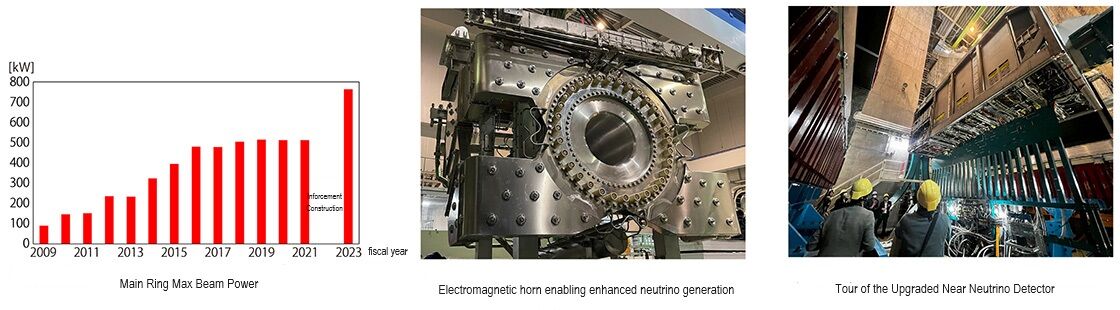
<br />The COMET Group, with significant cooperation from the Cryogenic Section, has completed the installation of the bridge solenoid (BS)-which connects the detector solenoid magnet (DS) to the transport solenoid magnet (TS) for muon transport-in the experiment area. Following installation, the magnets were also connected to each other. Moving forward, we plan to conduct excitation tests of these magnets and perform magnetic field measurements. 
<br />Construction of detectors for physics and beam measurements is also progressing smoothly. At the newly constructed R&D building, collaborators from Japan and abroad are gathering to fabricate and adjust the detectors. Preparations for assembling the individual detectors and installing them inside the DS are also proceeding steadily. 
<br />In November, a collaboration meeting was held at IHEP in China. Discussions focused on important issues for the experiment start-up, such as detector commissioning and run planning. </p>
<p>&nbsp;</p>

<p><a name="MLF"></a></p>
<p><a href="https://j-parc.jp/c/en/topics/uploads/2023/MLF_heads.jpg" style="text-decoration: none;"><img alt="MLF_HEadms" src="https://j-parc.jp/c/en/topics/uploads/2023/MLF_HEadms.jpg" width="900" height="290" /></a></p>
<p>☆<strong>-------------------------------------------------------------------------------------------------</strong>&hellip;
<br /> 4. [Materials and Life Science Division] 
<br /> &hellip;<strong>-------------------------------------------------------------------------------------------------</strong>★</p>
<p>-------------------------------------------------------------------------------------------------
<br /> NEUTRON SOURCE; COMPLETION OF MAINTENANCE WORK OF THE NEUTRON SOURCE AND BEAM OPERATION RESUMPTION AS SCHEDULED (by HARADA Masahide)   
<br /> -------------------------------------------------------------------------------------------------</p>
<p>The maintenance work was successfully performed during the outage of the MLF facility. In September, the used proton beam window mounted on the shielding plug was replaced with a new one, as preparation for the replacement of the proton beam window and shielding plug assembly next summer. Then, the power supply cables for the mercury pump were replaced with the temporary cables in order to recover their insulation resistance. In parallel, in the cryogenic circulation system, the activated charcoal was replaced with a new one and periodic voluntary inspections were conducted in accordance with the High Pressure Gas Safety Law. 
<br />No major problems were confirmed in this system. In October, hardware-related maintenance was performed on the power manipulator. And meters and valves at the off-gas process system were replaced with new ones. With these tasks completed, the maintenance works in the neutron source were successfully completed. The user program resumed on November 30 on schedule. The target diagnostic system indicated that pressure waves in the new mercury target vessel were reduced effectively by the bubble injection. However, in order to ensure the planned two-year operation of the mercury target vessel, the average beam power was reduced to approximately 720 kW. 
<br />Finally, on October 23 and 24, a mini workshop on neutron sources with Swiss Spallation Neutron Source (SINQ) group of PSI (Paul Scherrer Institute) was held. Progress of international collaboration for neutron source developments is expected. </p> 
<p>&nbsp;</p>
<p>-------------------------------------------------------------------------------------------------
<br /> SINQ-MLF WORKSHOP ADVANCES NEUTRON INSTRUMENTATION AND FACILITY DEVELOPMENT (by NAKAMURA Mitsutaka)  
<br /> -------------------------------------------------------------------------------------------------</p>
<p>The General User Proposal call for the 2026A cycle (short-term and one-year proposals) closed on November 7 and was reopened to both domestic and international applicants. A total of 277 neutron proposals were received, including 152 from abroad. 
<br />All proposals are currently under review, and final decisions will be made by the MLF Advisory Board on March 10. 
<br />The workshop "Advancing Neutron Facilities Together: Instrumentation, Source Operation, and International Collaboration between SINQ and MLF" was held on October 23 (<a href="https://conference-indico.kek.jp/event/351/" style="text-decoration: none" target="_blank"><font color="blue">https://conference-indico.kek.jp/event/351/</font></a>). Experts from SINQ and J-PARC MLF discussed neutron instrumentation, source operation, and future facility development. A tour of MLF and focused discussions with the Neutron Source, Sample Environment, and Neutron Optics groups further strengthened collaboration, enhancing mutual understanding and fostering new connections to support ongoing cooperation. 
<br />From November 17 to 21, the 14th AONSA Neutron School and 9th Neutron and Muon School hosted 38 graduate students and early-career researchers from Japan and abroad. The program offered lectures and hands-on training, with sessions at J-PARC MLF and JRR-3 providing direct experience at world-class facilities. (Program details: <a href="https://conference-indico.kek.jp/event/322/" style="text-decoration: none" target="_blank"><font color="blue">https://conference-indico.kek.jp/event/322/</font></a>) 
<br /><br />Recent press release from Neutron Science at MLF:
<br />BL15 and BL18 (October 23): "A metallic p-wave magnet with commensurate spin helix" 
<br /><a href="https://doi.org/10.1038/s41586-025-09633-4" style="text-decoration: none" target="_blank"><font color="blue">https://doi.org/10.1038/s41586-025-09633-4</font></a>
<br /><br />BL16 (October 6): "Supramolecular Interface Engineering via Interdiffusion for Reusable and Dismantlable Polymer Adhesion"
<br /><a href="https://doi.org/10.1002/adma.202507939" style="text-decoration: none" target="_blank"><font color="blue">https://doi.org/10.1002/adma.202507939</font></a></p>
<p>&nbsp;</p>
<p>-------------------------------------------------------------------------------------------------
<br /> MUON SCIENCE FACILITY (MUSE); BEAM OPERATION RESUMED (by KAWAMURA Naritoshi)    
<br /> -------------------------------------------------------------------------------------------------</p>
<p>Beam operation resumed on October 30 after an annual long maintenance shutdown. The malfunctioning target rotation introduction system was replaced as a preventive maintenance measure. All high-voltage modules for the S-line kicker power supply have been replaced with SiC-based units, replacing the frequently failing Si-based units. Preparations for the commissioning run of the muon accelerator in the H2 area on the H-line are nearly completed. 
<br />Repairs to the malfunctioning refrigerator for the D-line solenoid magnets have been completed, and it is now operating without issues. All instruments have been restarted without problems. 
<br />The 10th symposium on "Integration of arts and sciences" was held at the National Museum of Nature and Science, Tokyo, on October 10-11, gathering more than 250 attendees, including online participants. At the public lecture, three speakers provided accessible explanations for the public on non-destructive studies on cultural properties, introduced cultural property research at the Cyprus Research Institute, and discussed "ukiyo-e" production techniques. 
<br />The J-PARC workshop on "Bridging Research Innovations in Diverse muon and neutron science by GEneral collaboration between Japan and Switzerland (BRIDGE2025)" was held on October 20-22 at the University of Tokyo (<a href="https://conference-indico.kek.jp/event/321/" style="text-decoration: none" target="_blank"><font color="blue">https://conference-indico.kek.jp/event/321/</font></a>). 
<br />This workshop aims to promote academic exchange on experimental techniques in muon and neutron science and related areas between Japan and Switzerland. 60 participants, primarily researchers and engineers from J-PARC and PSI, gathered in lively discussions. On the second day of the meeting, a tour of J-PARC was also conducted. On the final day, future collaboration plans were reaffirmed, and the meeting concluded. </p>
<p>&nbsp;</p>
<p><a name="NTD"></a></p>
<p>☆<strong>-------------------------------------------------------------------------------------------------</strong>&hellip;
<br /> 5. [Nuclear Transmutation Division] by MEIGO Shin-ichiro  
<br /> &hellip;<strong>-------------------------------------------------------------------------------------------------</strong>★</p>
<p>-------------------------------------------------------------------------------------------------
<br /> WORKSHOP ON J-PARC PROTON BEAM IRRADIATION FACILITY 
<br /> -------------------------------------------------------------------------------------------------</p>
<p> On October 2, a workshop on "J-PARC Proton Beam Irradiation Facility" was held as an in-person and online hybrid mode. There were 101 participants, with 50 in-person and 51 online, including a large number of participants, 30 individuals, from the industry. After reviewing progress on the facility planning over the past year and the irradiation fields currently available at J-PARC, the facility's expectations and needs were explained for four potential research areas: material irradiation damage, semiconductor soft-error testing, radioisotopes (RIs) production for medical applications, and proton-beam applications. Additionally, recent progress on the RI production plan for molybdenum-99 (99Mo) for medical applications, and on the plan to develop a proton irradiation field in the existing LINAC tunnel with external funding from the Space Strategy Fund organized by the Japan Aerospace Exploration Agency (JAXA), were discussed. Throughout the discussion, it was demonstrated that there is a very high demand for proton and neutron beams at the proton beam irradiation facility, given the current shortage of irradiation facilities domestically and internationally. Furthermore, it was noted that improving access to the irradiation fields is essential for efficient experiments and that human resource development is crucial to advancing each research area to maturity. </p>
<p><a name="BNo5"></a>
<a href="uploads/2026/20260127_02ms.jpg"><img alt="20260127_02ms" src="assets_c/2026/01/20260127_02ms-thumb-350xauto-11075.jpg" width="350" height="195" class="mt-image-center" style="text-align: center; display: block; margin: 0 auto 20px;" /></a></p>
<p>&nbsp;</p>
<p><a name="SD"></a></p>
<p>☆<strong>-------------------------------------------------------------------------------------------------</strong>&hellip;
<br /> 6. [Safety Division] by BESSHO Kotaro, KASUGAI Yoshimi
<br /> &hellip;<strong>-------------------------------------------------------------------------------------------------</strong>★</p>
<p>-------------------------------------------------------------------------------------------------
<br /> FISCAL 2025 J-PARC SAFETY AUDIT 
<br /> -------------------------------------------------------------------------------------------------</p>
<p>Two auditors conducted the fiscal 2025 J-PARC safety audit. 
<br />At the preliminary briefing on September 29, the following points were explained: 1) The recent status of J-PARC, including accidents and issues, and 2) safety management initiatives and follow-up on issues raised in the previous year's audit. 
<br />A site inspection of the LINAC and MLF facilities, as well as interviews with leaders, were carried out on October 2. The focus of this year's inspection was to provide a comprehensive overview of the current situation at the workplaces. The auditors provided valuable recommendations. (1) Even for minor incidents, it is imperative to confirm whether they had the potential to escalate into serious accidents, and to implement countermeasures that reflect this potential. (2) When updating or modifying equipment installed during the initial construction phase, it is recommended that procedures be reviewed as new work and that risk assessments are re-conducted. All workers must thoroughly understand the fundamental meaning of safety measures. Past failures and innovations should be documented to facilitate knowledge transfer to future generations. </p>
<p>&nbsp;</p>
<p>-------------------------------------------------------------------------------------------------
<br /> AN EMERGENCY DRILL AT MLF     
<br /> -------------------------------------------------------------------------------------------------</p>
<p>An emergency drill was conducted at MLF on October 7. During the drill, a fire broke out in an experimental cabin in the First Experimental Hall of MLF and the staff performed initial firefighting procedures. Assuming that irradiated samples on the desk were dropped onto the floor during firefighting, scattering and causing radioactive contamination, decontamination of the affected area was carried out. Based on the lessons learned from the drill, various improvements will be implemented to enhance the emergency response. </p>
<p>&nbsp;</p>
<p><a name="Outreach"></a></p>
<p>☆<strong>-------------------------------------------------------------------------------------------------</strong>&hellip;
<br /> 7. [Outreach Activities]  
<br /> &hellip;<strong>-------------------------------------------------------------------------------------------------</strong>★</p>
<p>&#9733; Muographic Investigation of Ancient Burial Mounds in Tokai: Installation Site for "Detector for History and Future No. 2" Decided (September 21, Funatsuka No. 2 Burial Mound, Tokai Village) 
<br /><a href="https://www.j-parc.jp/c/en/topics/2025/10/31001670.html#BNo9" style="text-decoration: none"><font color="blue">https://www.j-parc.jp/c/en/topics/2025/10/31001670.html</font></a>
<br />
<br />&#9733; Outreach Lecture at Sannomaru Elementary School, Mito City (September 30) 
<br /><a href="https://www.j-parc.jp/c/en/topics/2025/09/30001654.html#BNo02" style="text-decoration: none"><font color="blue">https://www.j-parc.jp/c/en/topics/2025/09/30001654.html</font></a> 
<br />
<br />&#9733; Outreach Lecture at the National Institute of Technology, Sendai College (October 10) 
<br /><a href="https://www.j-parc.jp/c/en/topics/2025/10/31001653.html#BNo01" style="text-decoration: none"><font color="blue">https://www.j-parc.jp/c/en/topics/2025/10/31001653.html</font></a> 
<br />
<br />&#9733; Outreach Lecture at Kujigawa San-iku Elementary School (October 14) 
<br /><a href="https://www.j-parc.jp/c/en/topics/2025/10/31001653.html#BNo02" style="text-decoration: none"><font color="blue">https://www.j-parc.jp/c/en/topics/2025/10/31001653.html</font></a> 
<br />
<br />&#9733; Outreach Lecture at Ibaraki High School and Junior High School (November 15) 
<br /><a href="https://www.j-parc.jp/c/en/topics/2025/11/26001652.html#BNo01" style="text-decoration: none"><font color="blue">https://www.j-parc.jp/c/en/topics/2025/11/26001652.html</font></a> 
<br />
<br />&#9733; Outreach Lecture at the National Institute of Technology, Kagawa College, Takamatsu Campus (November 17) 
<br /><a href="https://www.j-parc.jp/c/en/topics/2025/11/26001652.html#BNo02" style="text-decoration: none"><font color="blue">https://www.j-parc.jp/c/en/topics/2025/11/26001652.html</font></a> 
<br />
<br />&#9733; Muographic Investigation of Ancient Burial Mounds in Tokai: Installation of "Detector for History and Future No. 2" (November 16, Funatsuka No. 2 Burial Mound, Tokai Village) 
<br /><a href="https://www.j-parc.jp/c/en/topics/2025/09/25001617.html#BNo6" style="text-decoration: none"><font color="blue">https://www.j-parc.jp/c/en/topics/2025/09/25001617.html</font></a> 
<br />
<br />&#9733; J-PARC Lecture 2025: "Think it's Difficult? Let's Explain the Expanding World of Elementary Particles and Atomic Nuclei at J-PARC in an Easy-to-Understand Way" (November 29, Tokai Village Industrial and Information Plaza, iVil). 
<br /><a href="https://www.j-parc.jp/symposium/lecture2025e/" style="text-decoration: none"><font color="blue">https://www.j-parc.jp/symposium/lecture2025e/</font></a>
<br />
<br />&#9733; Outreach Lecture at Muramatsu Elementary School, Tokai Village (December 2) 
<br /><a href="https://www.j-parc.jp/c/en/topics/2025/12/09001674.html#BNo01" style="text-decoration: none"><font color="blue">https://www.j-parc.jp/c/en/topics/2025/12/09001674.html</font></a> 
<br />
<br />&#9733; Outreach Lecture at Nakamura Elementary School, Tokai Village (December 16)
<br /><a href="https://www.j-parc.jp/c/en/topics/2025/12/09001674.html#BNo02" style="text-decoration: none"><font color="blue">https://www.j-parc.jp/c/en/topics/2025/12/09001674.html</font></a> 
<br />
<br />&#9733; Outreach Lecture at the National Institute of Technology, Kagawa College, Takuma Campus (December 18) 
<br /><a href="https://www.j-parc.jp/c/en/topics/2025/12/09001674.html#BNo03" style="text-decoration: none"><font color="blue">https://www.j-parc.jp/c/en/topics/2025/12/09001674.html</font></a></p> 

<p>&nbsp;</p>
<p><a name="ED"></a></p>
<p>☆<strong>-------------------------------------------------------------------------------------------------</strong>&hellip;
<br /> 8. [Editorial Note] 
<br /> &hellip;<strong>-------------------------------------------------------------------------------------------------</strong>★</p>
<p>&nbsp; Past issues are available from the link below.  
<br />&nbsp; <a href="http://j-parc.jp/c/en/topics/project-newsletter/index.html" style="text-decoration: none"><font color="blue">http://j-parc.jp/c/en/topics/project-newsletter/index.html</font></a>

<p>&nbsp;</p>
<p><strong>┏----&hellip;----&hellip;----&hellip;----&hellip;----&hellip;----&hellip;----&hellip;----&hellip;----&hellip;----&hellip;----&hellip;----&hellip;☆</strong> 
<br /> <strong>┃</strong> Editorial Board: 
<br /> <strong>┃</strong> OGURI Hidetomo (Chair) : oguri.hidetomo[at]jaea.go.jp 
<br /> <strong>┃</strong> SHOBUDA Yoshihiro: yoshihiro.shobuda[at]j-parc.jp
<br /> <strong>┃</strong> OZAWA Kyoichiro: ozawa[at]post.kek.jp 
<br /> <strong>┃</strong> MARUSAWA Machiko: machiko[at]post.kek.jp 
<br /> <strong>┃</strong> Bruce YEE-RENDON: byee[at]post.j-parc.jp 
<br /> <strong>┃</strong> OGAWA China (Secretary) : ogawa.china[at]jaea.go.jp 
<br /> <strong>┃</strong> * Please replace "(at)" with "@" when you enter an email address.
<br /> <strong>★----&hellip;----&hellip;----&hellip;----&hellip;End of Letter&hellip;----&hellip;----&hellip;----&hellip;----&hellip;----</strong></p>
<p>&nbsp;</p>]]>
        
    </content>
</entry>

<entry>
    <title>Detector Solenoid Magnet for the COMET Experiment Installed-- Probing One-in-a-Hundred-Trillion Phenomena【KEK site】</title>
    <link rel="alternate" type="text/html" href="2026/01/13001708.html" />
    <id>tag:cms01.j-parc.jp,2026:/c/en/topics//8.1708</id>

    <published>2026-01-13T07:39:01Z</published>
    <updated>2026-01-13T07:39:59Z</updated>

    <summary></summary>
    <author>J-PARC</author>
    
        <category term="Topics" />
    
    
    <content type="html" xml:lang="ja" xml:base="http://cms01.j-parc.jp/c/en/topics/">
        
        
    </content>
</entry>

</feed>